Are you thinking about importing a car from China to Germany to get your hands on a BYD, NIO, Xiaomi, or XPeng before it officially launches at local dealerships? With China now the world’s largest auto exporter, German buyers and businesses are increasingly looking east for better prices, shorter waiting lists, and technology that is often years ahead of European rivals.
However, shipping a car from China to Germany is not as simple as booking a container. You must navigate EU homologation, German customs duties (Zoll), import VAT, and the TÜV inspection process. One missing document can leave your vehicle stuck in a Hamburg bonded warehouse, racking up storage fees.
At Efanda Logistics, we have handled automotive shipments from Shenzhen, Shanghai, and Tianjin to Hamburg and Bremerhaven since 2018. We recently helped a Munich-based dealer import five BYD Seal units, and the only delay came from a supplier who forgot to provide the original Certificate of Conformity (COC). That experience is exactly why we wrote this guide.
This article is your complete roadmap for importing and shipping cars from China to Germany in 2026, with real numbers, port-to-port rates, and the compliance steps you cannot skip.
1. Regulations: Can I Import a Car from China to Germany?
Yes, you can import a car from China to Germany, but only if it can be made road-legal under German and EU rules. This is the first and most important checkpoint.
EU Homologation and the Certificate of Conformity (COC)
The easiest path is a valid EU Certificate of Conformity (COC).
- With COC: The vehicle already meets EU safety, emissions, and environmental standards. Registration in Germany is relatively straightforward.
- Without COC: Most Chinese domestic market (CDM) vehicles do not have a COC. You must apply for Individual Approval (Einzelbetriebserlaubnis) under § 21 StVZO. This requires a full technical inspection by TÜV SÜD, TÜV Rheinland, or another recognized body.
For authoritative technical guidance, refer to TÜV SÜD’s homologation services.
New vs. Used Car Import Rules
German customs defines “new” and “used” differently than common sense:
- New means: Less than 6 months old OR fewer than 6,000 km.
- Used means: More than 6 months old AND more than 6,000 km.
If your car shows 5,900 km, it is legally new for tax purposes. You will pay 19% import VAT on the value of a new car and cannot claim any used-personal-effects exemption.
Emission Standards and the GB/T Charging Problem
- Petrol / Diesel (ICE): The vehicle must meet current Euro 6d-ISC-FCM standards (with Euro 7 phasing in for light vehicles from 2025/2027). Many Chinese ICE models do not comply.
- Electric Vehicles (EVs): Zero tailpipe emissions make homologation easier, but charging is a major issue. China uses the GB/T plug, while Germany uses CCS2 / Type 2.
Our advice: do not rely on a simple travel adapter for DC fast charging. You may need to replace the charging inlet or use a certified, high-amperage adapter. Always confirm the solution with a specialized workshop before shipping.
2. Best Ways to Ship a Car from China to Germany (RoRo vs Container vs Rail)
The best shipping method depends on your budget, timeline, vehicle condition, and whether you are shipping one car or several. The three main options are RoRo, container shipping, and rail freight.

Roll-on/Roll-off (RoRo) Shipping
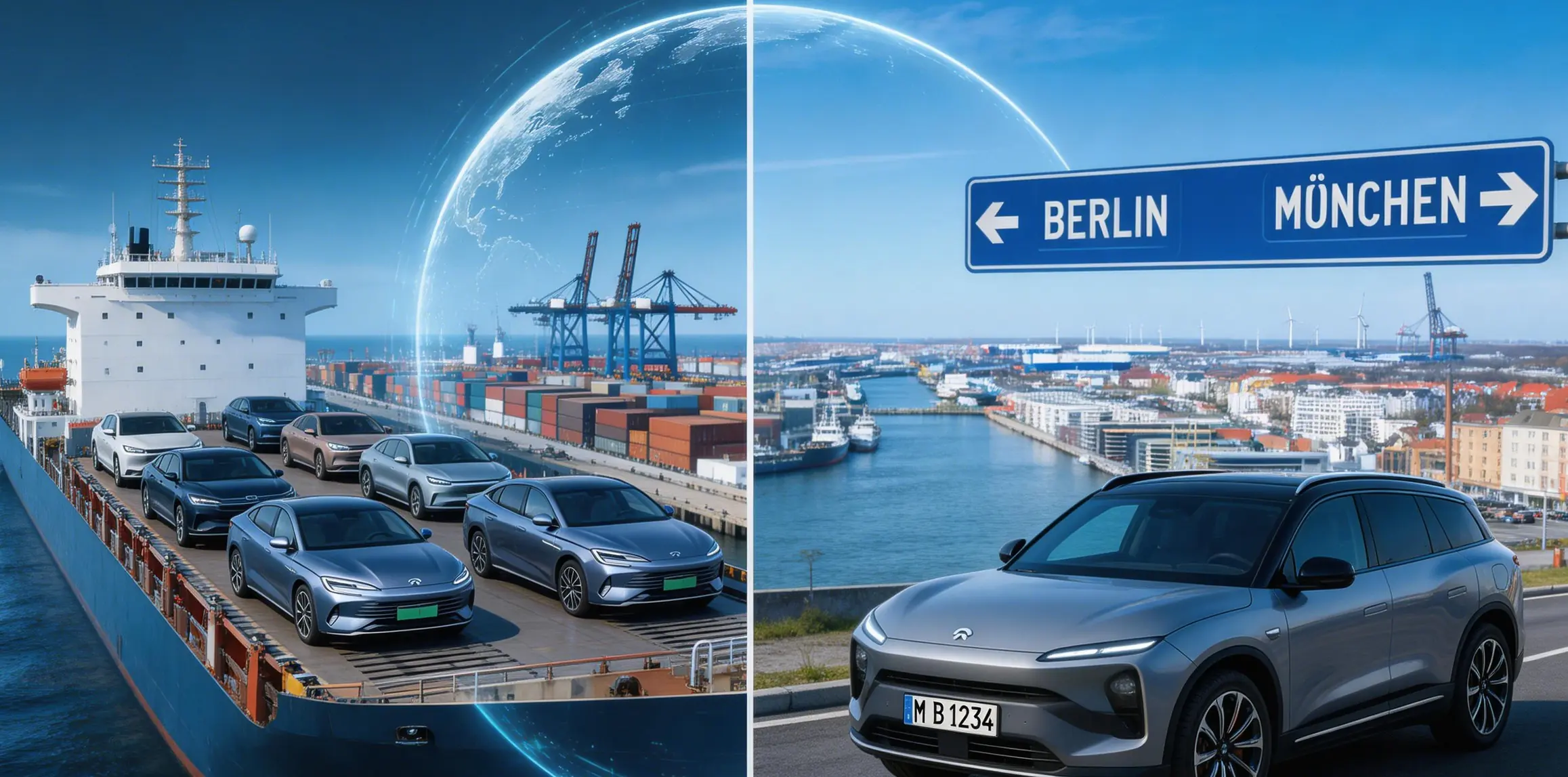
RoRo is the standard for running vehicles. Cars are driven onto the vessel in China and driven off in Germany.
- Pros: Usually the cheapest option; fast loading and unloading.
- Cons: No personal items may be left inside the car. We have seen shipments rejected because a client left spare tires or accessories in the trunk. The vehicle must be completely empty.
- Routes: Direct service from Shanghai (CNSHA), Tianjin (CNTSN), Guangzhou (CNNSA), or Ningbo (CNNGB) to Hamburg (DEHAM) or Bremerhaven (DEBRV).
Container Shipping (FCL / LCL)
For added protection, sea freight via container is the safer choice.
- FCL (Full Container Load): You rent a 20ft or 40ft container.
- Best for: Luxury or classic cars, non-runners, or shipments with personal effects. You can fit 2–3 cars in a 40HQ container to split costs.
- LCL (Less than Container Load): Your car shares a container with other cargo.
- Best for: Single-vehicle shipments when RoRo is unavailable.
Rail Freight (China–Europe Railway Express)
The “New Silk Road” offers a middle ground between sea and air.
- Route: From Chongqing or Xi’an to Duisburg or Hamburg.
- Speed: 18–22 days, much faster than sea freight.
- Cost: Higher than sea freight but far below air freight.
- Restriction: EV lithium-ion batteries (UN 3480/3171) require Class 9 Dangerous Goods handling. Efanda is certified to arrange this.
Port-to-Port Shipping Comparison Table
| China Port | Germany Port | Method | Transit Time | Cost per Car (USD) |
|---|---|---|---|---|
| Shanghai (CNSHA) | Hamburg (DEHAM) | RoRo | 30–40 days | $1,200 – $1,600 |
| Shanghai (CNSHA) | Bremerhaven (DEBRV) | RoRo | 32–42 days | $1,300 – $1,700 |
| Tianjin (CNTSN) | Hamburg (DEHAM) | RoRo | 35–45 days | $1,300 – $1,700 |
| Guangzhou (CNNSA) | Bremerhaven (DEBRV) | RoRo | 33–43 days | $1,400 – $1,800 |
| Ningbo (CNNGB) | Hamburg (DEHAM) | FCL 20ft | 30–40 days | $2,200 – $3,000 |
| Shanghai (CNSHA) | Hamburg (DEHAM) | FCL 40HQ | 30–40 days | ~$1,200 per car (3 cars) |
| Chongqing / Xi’an | Duisburg / Hamburg | Rail | 18–22 days | $3,500 – $5,500 |
Note: Rates are estimates based on Q1 2026 market conditions. Ocean freight fluctuates with fuel costs, peak seasons, and vessel availability. Contact Efanda for a real-time quote.
3. How Much Does it Cost to Ship a Car from China to Germany? (2026 Rates)
Shipping a car from China to Germany typically costs $1,200 to $5,500 per vehicle, depending on the shipping method, vehicle size, origin port, and fuel surcharges.
Ocean Freight Costs
| Method | Vehicle Type | Estimated Cost (USD) |
|---|---|---|
| RoRo | Sedan (e.g., BYD Seal) | $1,200 – $1,600 |
| RoRo | SUV (e.g., NIO ES8) | $1,500 – $1,900 |
| Container (20ft) | Single Car | $2,200 – $3,000 |
| Container (40HQ) | 3 Cars (Consolidated) | ~$1,200 per car |
Additional Fees
- Export Clearance (China): $200 – $350 (includes license plate cancellation for used cars).
- Port Handling (THC): €300 – €500 at German ports.
- Marine Insurance: Typically 0.4% – 0.6% of the vehicle value.
- Tip: Always request “All Risks” (Institute Cargo Clauses A). Total Loss Only is cheaper but will not cover scratches or dents caused during loading.
Need a tailored quote? Contact Efanda Logistics and our automotive team will compare RoRo, container, and rail options for your specific vehicle.
4. Import Duties (Zoll) and Taxes for Chinese Cars in Germany
Importing a Chinese car into Germany incurs a 10% customs duty, 19% import VAT, and—for electric vehicles—additional EU anti-subsidy tariffs. Calculating the true landed cost before you buy is essential.

Standard Import Duty
- Passenger Cars: 10% of the CIF value.
- Trucks / Pickups: 22% of the CIF value.
- Vintage Cars (Oldtimer): 0% duty if over 30 years old and in original condition.
For official duty rates, consult the German Customs (Zoll) website.
Electric Vehicle (EV) Anti-Subsidy Tariffs (2026 Update)
The EU has imposed additional anti-subsidy duties on Chinese EVs. As of early 2026, these typically range from 17.4% to 38.1% on top of the standard 10%, depending on the manufacturer:
- BYD: ~17.4%
- Geely / Volvo / Polestar: ~20%
- SAIC / MG: ~38.1%
- Tesla (made in China): individually calculated
Because these rates are subject to political and regulatory changes, always check the latest European Commission Trade Policy or TARIC database before buying.
Import VAT (Einfuhrumsatzsteuer)
Germany charges 19% VAT.
- Calculation Base: Vehicle Price + Shipping + Insurance + Import Duty + Anti-Subsidy Duty.
- Yes, you pay VAT on the duty and anti-subsidy duty too.
Real Landed Cost Examples for Popular Chinese EVs in Germany (2026 Estimates)
| Model | FOB (est.) | Shipping | Insurance | Duty 10% | Anti-Subsidy | VAT 19% | Total Landed Cost |
|---|---|---|---|---|---|---|---|
| BYD Seal | €25,000 | €1,600 | €130 | €2,673 | €4,651 (17.4%) | €6,470 | ~€40,500 |
| NIO ES8 | €45,000 | €1,800 | €230 | €4,703 | €9,406 (20%) | €11,616 | ~€72,800 |
| Xiaomi YU7 | €35,000 | €1,900 | €190 | €3,709 | TBD | €8,424 | ~€49,000+ |
| XPeng G6 | €28,000 | €1,700 | €150 | €2,985 | TBD | €6,724 | ~€39,500+ |
| Zeekr 001 | €35,000 | €1,800 | €180 | €3,698 | TBD | €8,175 | ~€48,900+ |
These figures are estimates for illustration only. Actual FOB prices, anti-subsidy rates, and freight rates change frequently. Contact Efanda for a current landed-cost calculation.
Germany vs. Netherlands vs. Poland: Where Should You Clear the Car?
| Country | Import VAT | Extra Vehicle Taxes | Best For |
|---|---|---|---|
| Germany | 19% | None for EVs | German residents and businesses; TÜV system is mature |
| Netherlands | 21% | BPM (passenger car tax) | Distribution to Western Europe; English-language services |
| Poland | 23% | Excise on combustion engines; 0% for EVs up to 2.0L | Eastern European markets; inland distribution |
If you are a German business, clearing in Germany is usually simplest. You can also recover import VAT if you have a German VAT number.
5. Essential Documents for Car Import Customs Clearance
To clear customs at Bremerhaven or Hamburg, you need a complete document package. Missing even one can lead to bonded-warehouse storage fees of €50–€150 per day.
- Bill of Lading (B/L) or Railway Bill: The official transport document.
- Commercial Invoice: Must clearly state the VIN, engine number, HS Code, Incoterms (e.g., FOB, CIF), and purchase price.
- Packing List: Vehicle dimensions and weight.
- Certificate of Origin: Proves the car was manufactured in China.
- Proof of Ownership: Purchase contract or sales invoice.
- T1 Document: Needed if you move the car to an inland customs office before clearance.
- Export License (China): Required for EV exports from China starting in 2026 under new Ministry of Commerce (MOFCOM) rules.
HS Codes and Incoterms You Should Know
- HS Code 8703.80: Passenger EVs.
- HS Code 8703.23 / 8703.24: Petrol-powered passenger cars.
- Recommended Incoterms:
- FOB (Free On Board): You control international shipping and insurance.
- CIF (Cost, Insurance, Freight): Seller arranges shipping to the destination port; simpler but less control.
For vehicle registration requirements, the Kraftfahrt-Bundesamt (KBA) provides official guidance on German road legality.
For complex paperwork, our customs clearance team can manage the entire process for you.
6. Step-by-Step Process: Importing a Car from China to Germany
The full process from purchase to German registration usually takes 8 to 12 weeks, depending on shipping method, customs workload, and TÜV requirements. Here is the standard flow.
Step 1: Sourcing & Verification
Find a reputable supplier. If buying used, verify the condition and confirm the seller has an Export License—many private sellers do not. We recommend a pre-shipment inspection with photos and video.
Step 2: Booking Freight with Efanda
Send us the vehicle details, pickup location, and destination. We arrange factory or dealer pickup in China, book the vessel or rail slot, and handle the Export Declaration.
Step 3: Export Clearance (China)
The car is transported to the port (e.g., Shanghai or Tianjin). Chinese customs inspects the VIN and documents. For used cars, the seller must cancel the domestic registration first.
Step 4: Arrival at Bremerhaven / Hamburg
Upon arrival, the car is unloaded. You or your customs broker present the documents to German Customs (Zoll).
Step 5: Customs Clearance (Verzollung)
You pay duty, anti-subsidy duties (if applicable), and VAT. German Customs issues the Unbedenklichkeitsbescheinigung (Clearance Certificate), which you need for registration.
Typical Import Timeline
| Stage | Duration |
|---|---|
| Sourcing & verification | 1–2 weeks |
| Export clearance & loading | 1–2 weeks |
| Sea freight (Shanghai → Hamburg) | 30–40 days |
| German customs clearance | 3–7 days |
| TÜV inspection & modifications | 1–3 weeks |
| Registration (Zulassung) | 1–3 days |
| Total | 8–12 weeks |
Rail freight can shorten the transit portion to 18–22 days, while air freight is rarely used for cars due to cost.
7. Homologation & Registration (Zulassung) of Chinese Cars in Germany
The final hurdle is getting German license plates. Without proper homologation, even a perfectly good Chinese EV cannot be driven legally.
The TÜV Inspection (§ 21 StVZO)
If your car lacks a COC, it must pass a “Vollabnahme” (Full Acceptance Test) at a TÜV station.
Common modifications for Chinese-market vehicles:
- Headlights: Chinese headlights often have a flat beam. Germany requires an asymmetric dipped beam (lower on the left, higher on the right). You may need new headlights or software reprogramming.
- Rear Fog Light: Must be on the left side.
- VIN Plate: Must be permanently attached and legible.
- Speedometer: Must display km/h.
- Infotainment: Flash software to support German or English and European navigation maps.
The Registration Office (Kfz-Zulassungsstelle)
Bring the following:
- Chinese registration papers (original)
- Purchase invoice
- Customs Clearance Certificate (Unbedenklichkeitsbescheinigung)
- TÜV Report (§ 21)
- eVB number (electronic insurance confirmation)
- Valid ID and proof of German residence
For official regulations, you can also check the Federal Ministry for Digital and Transport (BMDV).
8. EV Battery & Compliance Checklist for 2026
Electric vehicles face extra compliance layers. Use this checklist before shipping.
| Requirement | Why It Matters |
|---|---|
| COC / EU WVTA | Required for registration; bilingual German/English preferred |
| UN38.3 Battery Test Report | Proves lithium battery safety for transport |
| ECE R100 | Safety standard for electric powertrain and battery |
| ECE R10 (EMC) | Electromagnetic compatibility certification |
| EU Battery Regulation 2023/1542 | New sustainability, carbon footprint, and recycling rules |
| CCS2 / Type 2 Charging | GB/T plugs must be converted or adapted for German charging |
| China EV Export Permit (MOFCOM) | New 2026 requirement for Chinese EV exporters |
| Class 9 DG Booking | Required for sea and rail transport of lithium batteries |
EV battery regulations are tightening on both sides. Efanda’s Class 9 Dangerous Goods certification ensures your EV ships legally by sea or rail.
9. 7 Expert Tips Before You Import a Car from China
- Verify the COC before paying. A car without a COC can add €3,000–€10,000 in TÜV modifications and individual approval costs.
- Get an independent pre-shipment inspection. Capture 360° photos and video to support any insurance claim.
- Insist on “All Risks” marine insurance. Total Loss Only policies do not cover loading damage like scratches or dents.
- Confirm the seller’s export license. Private sellers often cannot export; only authorized dealers or licensed exporters can handle Chinese customs.
- Check the TARIC anti-subsidy rate for your brand. BYD, SAIC, and Geely face different rates, and they change.
- Book a Class 9 certified forwarder for EVs. Lithium batteries are regulated dangerous goods; not every forwarder can handle them.
- Plan for charging conversion early. GB-to-CCS2 adapter or inlet replacement should be confirmed before the car leaves China.
10. Why Choose Efanda Logistics for Car Shipping from China to Germany?
Efanda Logistics is a Shenzhen-based freight forwarder specializing in end-to-end automotive logistics from China to Germany. Since 2018, we have helped importers, dealers, and private buyers move vehicles safely through one of the world’s most complex trade lanes.
- EV Expertise: We are certified to handle Class 9 Dangerous Goods (lithium batteries), ensuring your EV ships legally by sea or rail.
- Door-to-Door Service: We offer comprehensive door-to-door shipping, from a BYD dealership in Shenzhen to your driveway in Stuttgart.
- Customs Support: We help you determine the correct HS Codes, navigate EU anti-subsidy tariffs, and avoid customs delays.
- Transparent Pricing: No hidden fees. You receive a clear breakdown of freight, duties, taxes, and handling before the car moves.
- Warehousing: Need temporary storage? Our warehouse services in China and Germany can safely hold your vehicle.
- Personalized Service: Every automotive shipment is assigned a dedicated logistics advisor.
Ready to import? Request a free landed-cost quote and our team will walk you through the most cost-effective and compliant option.
11. FAQ: Shipping and Importing Cars from China to Germany
Q: Is it legal to drive a Chinese-spec car in Germany?
A: Yes, but only after it passes the § 21 TÜV inspection (if no COC) and is properly registered. You cannot drive it permanently on Chinese plates.
Q: How long does it take to ship a car from China to Germany?
A: Sea freight takes 30–40 days; rail freight takes 18–22 days. The full process from purchase to registration is usually 8–12 weeks.
Q: What is the cheapest way to ship a car from China to Germany?
A: RoRo is usually cheapest for a single running vehicle, starting around $1,200–$1,600 from Shanghai to Hamburg. Sharing a 40HQ container can reduce the per-car cost when shipping 2–3 vehicles together.
Q: What is the “Unbedenklichkeitsbescheinigung”?
A: It is the German Customs clearance certificate confirming all duties and taxes have been paid. You cannot register the car without it.
Q: How much does it cost to import a BYD or NIO to Germany?
A: A BYD Seal can land around €40,500 including freight, 10% duty, 17.4% anti-subsidy duty, and 19% VAT. A NIO ES8 can land around €72,800. Exact costs depend on the FOB price, current freight rates, and the manufacturer-specific tariff.
Q: Can Efanda help with the TÜV conversion?
A: We handle logistics, customs, and documentation. For TÜV modifications, we can recommend specialized workshops in Bremerhaven and Hamburg that regularly convert Chinese EVs.
Q: Do I need an EORI number to import a car into Germany?
A: If you are importing as a business, yes. Private individuals can usually import without an EORI, but businesses need it for customs declarations.
Q: Can I recover the 19% import VAT as a German business?
A: Yes, if you are VAT-registered in Germany and the vehicle is used for business purposes, you can generally reclaim the import VAT through your regular VAT return.
Q: What about the warranty on a Chinese car imported to Germany?
A: A warranty from a Chinese dealer is usually invalid in Europe. You are importing at your own risk regarding maintenance. We recommend setting aside a budget for potential repairs.
Q: What is the EU anti-subsidy tariff on Chinese EVs in 2026?
A: As of early 2026, additional duties range from roughly 17.4% to 38.1% on top of the standard 10% import duty, depending on the manufacturer. These rates are subject to change, so verify the latest TARIC rate before buying.
Important Disclaimers
The rates, taxes, and timelines in this guide are estimates based on Q1 2026 market conditions and publicly available information. Ocean freight rates fluctuate with fuel costs, vessel availability, and seasonal demand. EU anti-subsidy tariffs and Chinese export regulations are subject to political and regulatory changes. Vehicle prices depend on the supplier, exchange rates, and specification. Always request a real-time quote and consult a licensed customs broker or tax advisor before importing.
Written by the automotive logistics team at Efanda Logistics. Efanda is a Shenzhen-based freight forwarder founded in 2018, specializing in sea freight, rail freight, customs clearance, and door-to-door vehicle shipping from China to Germany and the EU.