As of March 2026, the average Shipping Container Rates from China to Germany for a 20ft container range from $2,800 to $3,500, while a 40ft container costs between $4,500 and $5,800. These rates fluctuate based on fuel surcharges (BAF), seasonal demand (post-Chinese New Year), and geopolitical factors like Red Sea diversions.
Germany remains China’s largest trading partner in Europe, with over 250 billion Euros in bilateral trade annually. For importers, understanding the nuances of the China-Germany trade route is not just about finding the cheapest rate—it’s about securing capacity and ensuring timely delivery to major hubs like Hamburg, Bremerhaven, and Wilhelmshaven.
In our experience managing logistics for over a decade, we’ve seen how volatile this route can be. The “Red Sea Crisis” of 2024-2025 permanently altered shipping patterns, making the Cape of Good Hope route a new standard for many carriers, adding 10-14 days to transit times. While rates have stabilized in early 2026 compared to those historic peaks, understanding the detailed cost breakdown—freight, surcharges, and destination fees—is critical for maintaining your profit margins.
At Efanda Logistics, we don’t just quote prices; we provide Door to Door Shipping solutions that optimize your entire supply chain. Whether you are shipping electronics from Shenzhen or machinery from Shanghai, this guide will break down every cost you need to know.
1. Current FCL Shipping Rates: 20ft vs. 40ft Cost Analysis
A 40ft High Cube (40HQ) offers the best value for volume, costing only ~30% more than a 20ft container but providing double the capacity.
Full Container Load (FCL) is the backbone of international trade. Choosing the right container type can save you thousands of dollars annually.
The 20ft Container (TEU)
The 20ft container is the standard unit of cargo capacity (TEU). It is best suited for heavy cargo such as:
- Industrial Machinery
- Auto Parts
- Metal Components
- Chemicals (Non-Haz)
Current Market Rate (March 2026): $2,800 – $3,500
Why this price? Carriers price 20ft containers lower, but the “per cubic meter” cost is higher than a 40ft. If you have more than 15 CBM of cargo, a 20ft is often not the most economical choice.
The 40ft Container (FEU)
The 40ft container (FEU) is the workhorse for consumer goods. It is ideal for voluminous but lighter cargo like:
- Textiles and Apparel
- Consumer Electronics
- Furniture
- Toys
Current Market Rate (March 2026): $4,500 – $5,800
Why this price? You get double the volume of a 20ft (approx. 54-58 CBM usable) for less than double the price. This “volume discount” is why most importers prefer 40ft containers.
The 40ft High Cube (40HQ)
For most importers, the 40ft High Cube is the secret weapon. It offers an extra foot of height, increasing capacity to 76 CBM (approx. 68 CBM usable).
Current Market Rate: $4,800 – $6,000
Efanda Insight: The price difference between a standard 40ft and a 40HQ is often negligible (sometimes only $100-$200), but you gain over 10% more space. We almost always recommend 40HQ for furniture and e-commerce goods.
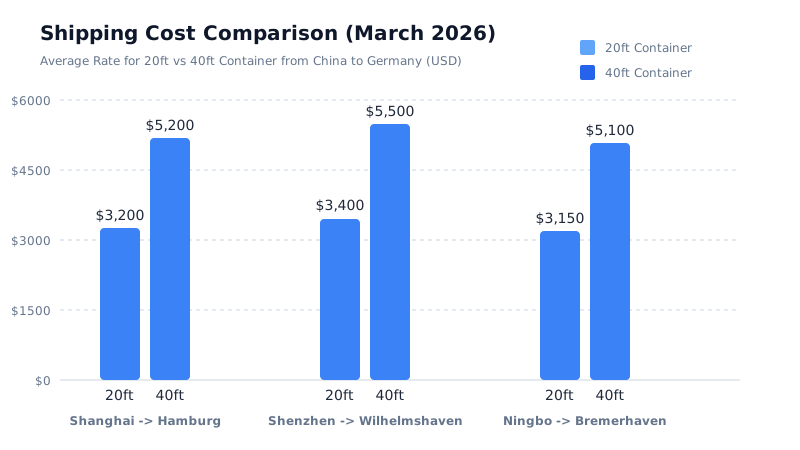
Comparative Rate Table (March 2026)
| Port of Loading (China) | Port of Discharge (Germany) | 20ft Container (USD) | 40ft Container (USD) | 40HQ Container (USD) | Transit Time (Days) |
|---|---|---|---|---|---|
| Shanghai | Hamburg | $2,850 – $3,200 | $4,600 – $5,200 | $4,800 – $5,500 | 32-38 |
| Ningbo | Bremerhaven | $2,800 – $3,150 | $4,550 – $5,100 | $4,750 – $5,400 | 33-40 |
| Shenzhen (Yantian) | Wilhelmshaven | $2,950 – $3,400 | $4,700 – $5,500 | $4,900 – $5,800 | 28-35 |
| Qingdao | Hamburg | $3,000 – $3,500 | $4,800 – $5,800 | $5,000 – $6,000 | 35-42 |
Note: These are port-to-port Sea Freight rates. They do not include origin trucking or destination clearance fees.
2. LCL Shipping Rates: Costs per CBM
For shipments under 15 CBM, LCL (Less than Container Load) is often more cost-effective. Expect to pay $80 – $120 per CBM, but beware of destination charges.
Not every shipment requires a full container. LCL allows you to pay only for the space you use. However, it comes with its own set of rules.
When to Choose LCL?
- Volume: 1 CBM to 15 CBM.
- Frequency: Weekly inventory replenishment for Amazon FBA or small retail.
- Samples: Large prototype orders that are too expensive for air freight.
The “Dead Freight” Trap
LCL rates are calculated based on the greater of Actual Weight or Volumetric Weight.
- Standard Ratio: 1 CBM = 1,000 KG.
- If your cargo is 2 CBM but weighs 3,000 KG, you will be charged for 3 CBM (3 Billing Tons).
- Efanda Tip: Always compress your packaging. “Shipping air” in LCL is the fastest way to lose money.
Destination Charges: The Hidden LCL Killer
Many importers are lured by “cheap” ocean freight rates (e.g., $10/CBM) only to be hit with massive Local Charges at the port of Hamburg. These can include:
- THC (Terminal Handling Charges): Much higher per unit for LCL.
- CFS Charges: Unloading and de-consolidation fees.
- Release Fees: Documentation fees.
We offer Warehouse Services in our Guangzhou and Yiwu facilities. We can consolidate multiple supplier orders into a single shipment. Instead of paying three separate LCL destination charges, you pay for one. This consolidation strategy saves our clients an average of 20-30% on landed costs. We also offer Shipping from China to Spain and Shipping from China to Italy consolidation services.
3. Rail Freight vs. Sea Freight Costs (The “Middle Way”)
The China-Europe Railway Express is 50% faster than sea freight (15-20 days vs. 35-45 days) but costs about 60-80% more than standard ocean shipping.
For high-value goods that can’t wait 40 days but can’t afford air freight, rail is the perfect middle ground.
The Route: Yiwu/Chongqing to Duisburg/Hamburg
The “New Silk Road” connects Chinese industrial hubs directly to the heart of Germany. The most popular route enters Europe via Poland (Malaszewicze) and terminates in Duisburg or Hamburg.
Cost & Speed Comparison
| Mode | Transit Time | Cost (40ft / 1000kg) | Best For |
|---|---|---|---|
| Sea Freight | 35-45 Days | $4,500 – $5,800 | Bulk goods, low value, planned inventory |
| Rail Freight | 18-22 Days | $7,500 – $9,000 | Electronics, fashion, seasonal promo items |
| Air Freight | 3-7 Days | $5.00 – $8.00 / KG | Urgent samples, high-value chips, medical |
Efanda Recommendation
If you are shipping high-value electronics or seasonal fashion where time-to-market is critical, rail freight is worth the premium. The interest saved on capital tied up in inventory often offsets the higher freight cost. According to DB Cargo, rail freight emits 95% less CO2 than air freight, supporting your sustainability goals.
4. Hidden Costs: Customs, Duties & Taxes (DDP)
The freight rate is just the beginning. You must account for German Import Duty (Zoll), Import VAT (Eust – 19%), and Terminal Handling Charges (THC).
Shipping to Germany requires strict adherence to EU customs regulations. Ignoring these can lead to your cargo being seized by the Zollamt (Customs Office). For official duty rates, always consult the TARIC Database.
1. Import Duty (Zoll)
Duties are calculated based on the CIF Value (Cost of Goods + Insurance + Freight) and the HS Code.
- Electronics: Often 0%.
- Textiles: Can be up to 12%.
- Bicycles: Anti-dumping duties can apply (up to 48.5%!).
- Action: Always verify your HS Code before shipping.
2. Import VAT (Einfuhrumsatzsteuer – EUSt)
Germany has a standard Import VAT rate of 19%.
- Calculation: (CIF Value + Import Duty) x 19%.
- Recovery: If you are a VAT-registered business in Germany, you can reclaim this. If you are a non-EU seller (e.g., Amazon FBA), you cannot reclaim it unless you have a fiscal representative.
3. The DDP Solution
For many clients, calculating these fees is a headache. Efanda Logistics offers a DDP (Delivered Duty Paid) service.
- How it works: We quote you an “All-In” price (e.g., $1.50/KG).
- What it includes: Sea freight, customs clearance, duty payment, VAT payment, and final truck delivery to your door or Amazon FBA warehouse.
- Benefit: You know your exact landed cost per unit before the goods even leave China. No surprises.
- Service: Customs Clearance is handled entirely by our German partners.
5. 5 Proven Tips to Reduce Your Shipping Costs
Booking 2 weeks in advance and optimizing your packaging to reduce “dead space” can save you up to 20% on shipping bills.
1. Book in Advance
Spot rates fluctuate daily. Booking your space 14-21 days in advance allows us to secure a better rate tier with carriers like COSCO, Evergreen, or Hapag-Lloyd. Last-minute bookings are subject to “Diamond Tier” pricing, which is significantly higher. Check the Shanghai Containerized Freight Index (SCFI) for current trend lines.
2. Optimize Packaging
“Shipping Air” is the enemy.
- Use vacuum packaging for textiles.
- Design product boxes to fit perfectly on standard ISO pallets (100x120cm or 80x120cm).
- A 10% reduction in box size can mean fitting 200 more units in a container, lowering your per-unit shipping cost.
3. Ship During “Shoulder Season”
Avoid the peak madness.
- Peak Season: August to October (Holiday rush). Rates spike.
- CNY Rush: January/February (Pre-Chinese New Year). Capacity crunch.
- Shoulder Season: March-April and October-November. Rates are often 15-20% lower.
4. Consolidate Suppliers
Buying from 3 different factories? Don’t send 3 LCL shipments.
- Use Efanda’s Warehouse to combine them into one FCL shipment.
- Scenario: 3 LCL shipments of 5 CBM each = 15 CBM total.
- Cost: 3 x Destination Fees = $$$
- Consolidated: 1 x 20ft Container = $ (Cheaper and safer).
5. Choose the Right Port
Hamburg is not the only option. Sometimes, discharging in Rotterdam (Shipping from China to Netherlands) or Antwerp (Shipping from China to Belgium) and trucking the goods into Western Germany (NRW region) is cheaper and faster due to less congestion at German terminals.
6. Why Efanda is Your Best Partner for Germany
We don’t just ship; we optimize. With local partners in Hamburg and our own warehouses in China, we offer end-to-end visibility and competitive contract rates.
Choosing a freight forwarder is choosing a business partner. Here is why Efanda stands out:
- Deep Expertise: We know German customs (Zoll) requirements inside out. We ensure your documents (Commercial Invoice, Packing List, ATR) are perfect to avoid delays. If you are also shipping to neighboring countries, we can help with Shipping from China to Netherlands or Shipping from China to France.
- Amazon FBA Specialists: We deliver daily to Amazon fulfillment centers across Germany (DTM2, LEJ1, WRO5, etc.). We understand strict FBA appointment slots and palletizing standards. Check our Amazon FBA services.
- Transparent Pricing: Our quotes are comprehensive. We don’t hide GRI or BAF charges in the fine print.
- End-to-End Visibility: Track your container from the factory floor in Shenzhen to your warehouse door in Munich. Whether you need Shipping from China to UK or Germany, we have you covered.
7. FAQ: Shipping from China to Germany
Q: How long does shipping take from China to Germany by sea?
A: Port-to-port transit time is typically 30-40 days (e.g., Shenzhen to Hamburg). However, you must add 5-7 days for customs clearance and final delivery. Total door-to-door time is usually 45-55 days.
Q: What is the cheapest month to ship to Germany?
A: Typically March and April (post-CNY) and October-November (post-Golden Week). Demand dips during these periods, and carriers often lower rates to fill ships.
Q: Can Efanda handle Amazon FBA shipments to Germany?
A: Yes, absolutely. We provide a full FBA service: labeling, palletizing to Amazon specs (Euro pallets), and booking delivery slots with Amazon’s carrier central.
Q: Is shipping insurance necessary?
A: Highly recommended. Under maritime law (General Average), you can be liable for ship repairs if a disaster occurs. Cargo Insurance Services cost a tiny fraction of your cargo value (often 0.3%) but provide total peace of mind.
Q: Do I need an EORI number to import to Germany?
A: Yes. Any business importing goods into the EU needs an EORI (Economic Operators Registration and Identification) number. You must apply for this before your goods arrive. Efanda can guide you through this process.