Is DDP shipping really the “magic button” for easy imports, or is it a ticking time bomb for your business? For many new importers—especially Amazon FBA sellers and e-commerce startups—DDP (Delivered Duty Paid) feels like the ultimate solution. You pay one price, and the goods magically appear at your warehouse. No customs headaches, no paperwork, no stress. But as we move into 2026, with stricter EU regulations like ICS2 and CBAM, the “convenience” of DDP is becoming a dangerous trap.
In our decade of experience at Efanda, we have seen hundreds of businesses start with DDP but switch to DAP as they scale. While DDP offers simplicity, it often hides inflated costs, compliance risks, and tax inefficiencies that can bleed your profit margins. As your business grows, relying on DDP can endanger your legal standing with customs authorities. In this guide, we will compare DDP vs DAP (Delivered at Place) to help you decide which Incoterm protects your profit and compliance in the evolving landscape of 2026 logistics.
Definitions: Understanding DDP vs DAP Incoterms 2026
Before comparing costs, it is crucial to understand that we are still operating under Incoterms® 2020 rules (the International Chamber of Commerce updates them every 10 years). However, the application of these rules has changed drastically due to new global trade laws.
What is DDP (Delivered Duty Paid)?
“The All-Inclusive Service”
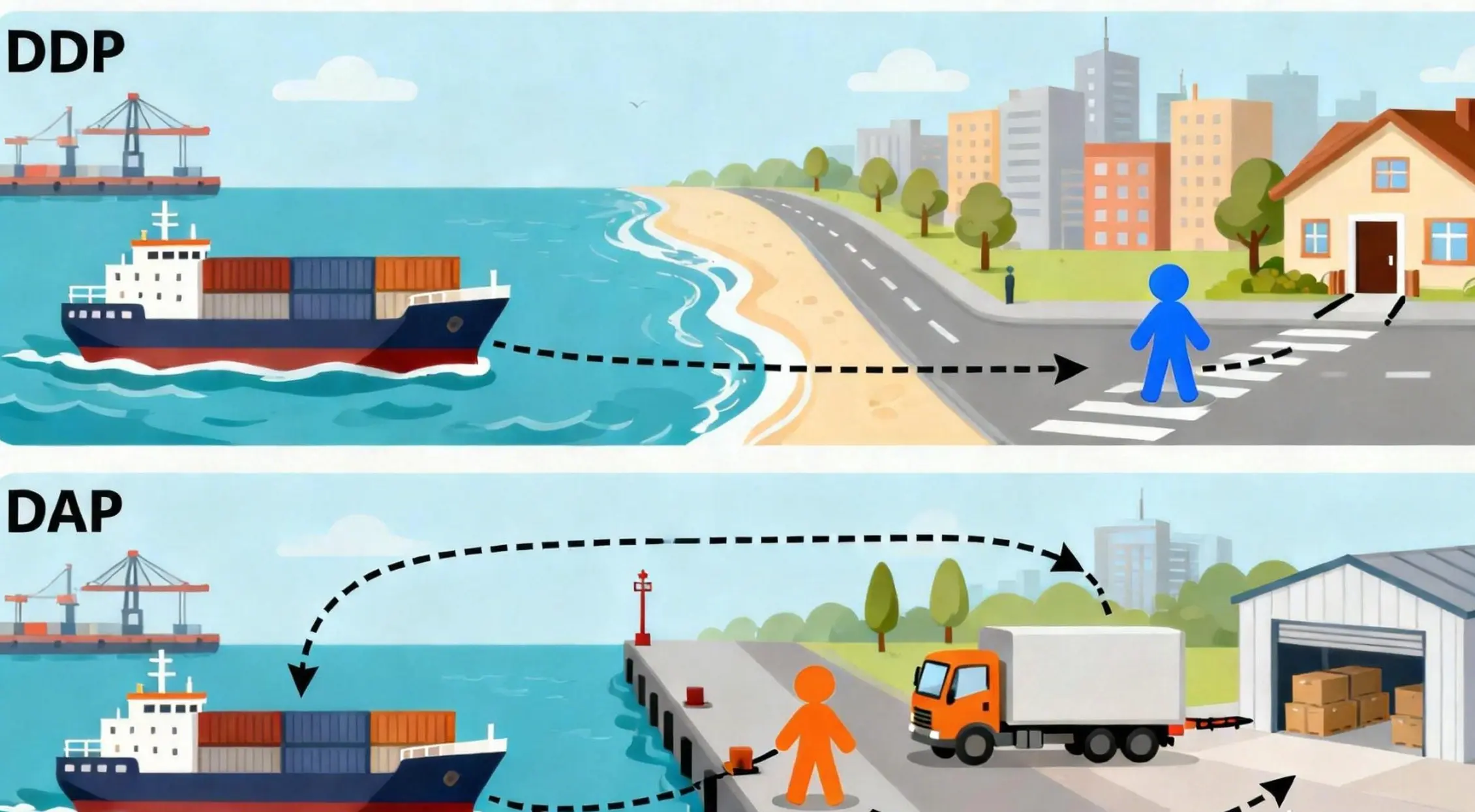
Under DDP, the seller (exporter) assumes maximum obligation. They are responsible for:
- Export formalities in China.
- International transport (Sea Freight, Air Freight, or Rail).
- Import customs clearance in the destination country.
- Payment of all Import Duties and VAT.
- Final delivery to your door.
Analogy: It’s like ordering a pizza. You pay one final price, and the driver handles the traffic, the gas, and the delivery. You just eat.
What is DAP (Delivered at Place)?
“The Team Effort”
Under DAP, the seller handles the transport to your door, BUT you (the buyer) are responsible for the legal entry of the goods.
- Seller: Handles export and transport to your warehouse.
- Buyer: Handles Customs Clearance and pays Duties & Taxes.
Analogy: It’s like buying furniture. They deliver the heavy boxes to your living room, but you have to sign for it and perhaps assemble it (handle the “last mile” paperwork).
Comparison: DDP vs DAP Responsibilities & Costs
To see why experienced importers prefer DAP, let’s look at who pays for what.
| Responsibility | DDP (Delivered Duty Paid) | DAP (Delivered at Place) |
|---|---|---|
| Export Declaration | Seller | Seller |
| International Freight | Seller | Seller |
| Import Customs Clearance | Seller (Risky) | Buyer (Control) |
| Import Duties & Taxes | Seller | Buyer |
| Unloading at Destination | Buyer | Buyer |
| Risk Transfer Point | At your door (cleared) | At your door (uncleared) |
| VAT Reclamation | Difficult/Impossible | Easy (Buyer is IOR) |
The 2026 Regulatory Shift: Why DDP is More Dangerous Now
In 2026, logistics is no longer just about moving boxes; it’s about data compliance. Two major changes make DDP riskier than ever:
1. ICS2 (Import Control System 2) Release 3
The EU’s new security regime requires detailed data on the actual buyer and seller before loading. In a DDP shipment, sellers often use “grey market” importer details to clear goods, which triggers ICS2 security rejections. This is particularly critical for routes like Shipping from China to Germany and Shipping from China to Netherlands, where customs scrutiny is highest.
2. CBAM (Carbon Border Adjustment Mechanism)
If you import steel, aluminum, or fertilizers into the EU, the Importer of Record (IOR) must report embedded carbon emissions. In a DDP shipment, the Chinese seller is technically the importer. Will they file your CBAM report correctly? Unlikely. If they fail, you (the receiver) could face supply chain disruptions.
The Risks of DDP Shipping: Why “Delivered Duty Paid” is a Trap
Risk 1: The VAT Reclamation Black Hole (Crucial for EU/UK)
This is the #1 reason businesses lose money.
- Scenario: You buy $10,000 of goods DDP for Shipping from China to UK. The seller pays the 20% Import VAT ($2,000).
- The Problem: Since the seller is the Importer of Record, the C79 certificate (proof of VAT payment) is issued to them, not you.
- The Consequence: You cannot reclaim that $2,000 on your tax return. According to HMRC Internal Manual VIT13300, import VAT can only be claimed by the owner of the goods. In DDP, the seller is the owner at the time of import. With DAP, you pay the VAT, so you can reclaim it.
Risk 2: Compliance & Audit Nightmares
Sellers want to save money. On DDP shipments, they often:
- Undervalue Goods: Declaring a $10,000 shipment as $2,000 to save duty.
- Misclassify HS Codes: Using a “duty-free” code for a taxable product.
- The Audit: When Customs audits the shipment, they find the goods at your warehouse. You can be fined for “aiding and abetting” customs fraud, even if you didn’t file the paperwork. This is a common issue we see in Shipping from China to USA, where CBP audits are aggressive.
Risk 3: Hidden Costs & “Risk Premium”
Sellers aren’t charities. If the estimated duty is 5%, they will charge you 10-15% in the DDP price to cover “risk” and currency fluctuation. You are paying a premium for their guesswork.
Regional Nuances: DDP vs DAP in Key Markets
The choice between DDP and DAP isn’t just about preference; it’s about local laws. Here is what we advise our clients in different regions:
1. United States (USA)
For Shipping from China to USA, DDP is popular but tricky.
- The Bond Issue: To legally import into the US, the IOR must have a Customs Bond. In DDP, the Chinese seller must buy this bond. Many don’t—they use a courier’s bond illegally for large freight.
- Our Advice: If you import more than $2,500 per year, get your own Annual Bond and ship DAP (or DDP excluding duties). It builds your compliance history with CBP.
2. European Union (EU)
For destinations like Shipping from China to France or Shipping from China to Spain:
- The VAT Trap: As mentioned, you lose the ability to reclaim Import VAT (19-21%) if you ship DDP.
- IOSS: For small e-commerce packages (<€150), DDP works well via the IOSS system. But for bulk freight, DAP is superior for tax recovery.
3. Middle East (Saudi Arabia, UAE)
In Shipping from China to Saudi Arabia and Shipping from China to UAE, customs rules are strict regarding product standards (SASO/SABER).
- DDP Risk: If the seller handles clearance but lacks the correct SABER certificate, goods will be rejected.
- DAP Advantage: You (or your local partner) control the certification process, ensuring goods actually clear.
Case Study: How “TechGadget GmbH” Saved 18% Switching to DAP
Note: Name changed for privacy.
Background: A German electronics retailer was importing smart home devices via DDP. They paid an “all-in” price of $50,000 for a container.
The Problem: They realized they were paying $10,000 more than competitors.
The Audit: We analyzed their costs.
- Hidden Duty Markup: The seller charged 10% duty. Actual rate: 0% (IT products are duty-free in EU).
- Lost VAT: They couldn’t reclaim the 19% German VAT ($9,500) because the Chinese seller was the IOR.
The Solution: They switched to DAP with Efanda.
- Freight: Paid $3,000 for Sea Freight.
- Clearance: Hired a local German broker ($150).
- VAT: Paid VAT directly to customs and reclaimed it next quarter.
Result: Total landed cost dropped from $50,000 to $41,000. Savings: $9,000 per container.
Benefits of DAP Incoterms for Scalable Imports
Why do smart importers switch to DAP as they grow?
- Control Over Compliance: You choose your own Customs Broker. You ensure the HS code is correct, keeping you safe from audits.
- Cash Flow Efficiency: You pay duties directly to the government. No middleman markup. Plus, with Postponed VAT Accounting (PVA) in the UK, you can defer VAT payments, improving cash flow.
- VAT Recovery: Since you are the IOR, you can legally reclaim 100% of Import VAT.
- Speed: Local brokers (hired by you) speak the local language and resolve customs holds faster than a remote seller’s cheap agent in China.
Decision Guide: DDP or DAP? How to Choose
| Choose DDP When… | Choose DAP When… |
|---|---|
| You are shipping samples or small orders (<$1,000). | You are a registered business (VAT/EORI registered). |
| You are a one-time buyer with no VAT registration. | You are importing regularly or in bulk (LCL/FCL). |
| You want zero involvement in logistics (and accept higher costs). | You want to optimize costs and ensure 100% legal compliance. |
| You are testing a new product market. | You are shipping to Amazon FBA (with your own IOR setup). |
Efanda Logistics: Your Partner for DDP and DAP Shipping
At Efanda Logistics, we understand that every business is at a different stage.
- Flexible Solutions: We offer both DDP (for ease) and DAP (for control) services worldwide, including specialized routes like Shipping from China to Canada and Shipping from China to Australia.
- The Hybrid Approach: For our DAP clients, we recommend trusted local brokers in Germany, UK, and USA. This gives you the “ease” of DDP with the “control” and tax benefits of DAP.
- Compliance First: Whether DDP or DAP, our team reviews your HS codes and compliance data (ICS2/CBAM) to prevent customs delays.
- Value-Added Services: We also provide Warehouse Services for consolidation and Cargo Insurance Services to protect your investment.
Ready to stop overpaying for DDP? Contact Efanda Logistics today for a transparent shipping quote that puts profit back in your pocket.
FAQ: Common Questions About DDP vs DAP Incoterms
Q: Is DDP cheaper than DAP?
A: Usually, no. DDP prices often include a 10-20% markup on duties and taxes to cover the seller’s risk. DAP is more transparent and often cheaper.
Q: Who pays for unloading in DAP?
A: The buyer. The seller delivers to your location, but you are responsible for unloading the truck or container. For Door to Door Shipping, clarify if a liftgate is needed.
Q: Can I use DDP for air freight?
A: Yes, DDP and DAP apply to all modes of transport: Air, Sea, Rail, and Truck.
Q: Does Amazon FBA require DDP?
A: Amazon requires “Free Domicile” delivery, meaning they won’t pay a penny to receive goods. While many interpret this as DDP, you can ship DAP if your freight forwarder (like Efanda) handles the duty payment on your behalf before delivery. This allows you to remain the Importer of Record.
Q: What is the “DDP Trap” in 2026?
A: The “trap” is the inability to reclaim Import VAT and the risk of being liable for the seller’s incorrect customs declarations under new EU/UK audit rules.