Efanda Insight: Updated February 2026. Based on our latest container bookings from Shenzhen and Shanghai to Le Havre.
Are you importing large volumes (over 15 CBM) from China to France? Struggling to predict costs amidst the fluctuating 2026 sea freight market? You are not alone. With major carriers like Maersk and Hapag-Lloyd adjusting their routes back through the Suez Canal in early 2026, the landscape of FCL shipping from China to France is changing rapidly.
FCL (Full Container Load) is the most cost-effective method for shipping high-volume goods (typically over 15 CBM) where an importer rents the entire container (20ft, 40ft, or 40HQ) exclusively for their cargo, ensuring better security, lower per-unit costs, and faster transit times compared to LCL.
In this comprehensive guide, we break down the 2026 freight rates, updated transit times to Le Havre and Marseille, customs duty requirements (including EORI), and expert tips to reduce your landed cost.
1. What Is FCL Shipping from China to France?
FCL shipping from China to France means you book a dedicated container for your goods. Unlike LCL (Less than Container Load), where you share space with other shippers, FCL gives you exclusive use of the steel box. This doesn’t mean you must fill it to the brim; it means you pay for the whole unit, guaranteeing that your cargo travels undisturbed from the factory in Shenzhen or Shanghai to your warehouse in Paris or Lyon.
When Should You Choose FCL?
- Volume: Ideally, if your cargo volume exceeds 15 CBM. At this point, the flat rate of a 20ft container is often cheaper than paying per CBM for LCL.
- Security: Since the container is sealed at the factory and only opened by customs or at your destination, the risk of damage or theft is minimized.
- Speed: FCL shipments bypass the consolidation and deconsolidation (CFS) processes, saving 4-7 days on average.
FCL vs. LCL Comparison Table
| Feature | FCL (Full Container Load) | LCL (Less than Container Load) |
|---|---|---|
| Cost | Economical for volumes > 15 CBM | Cheaper for small volumes (< 13 CBM) |
| Transit Time | Faster (No consolidation delays) | Slower (Requires CFS handling) |
| Risk | Low (Less handling) | Moderate (Multiple handling points) |
| Control | High (You decide loading schedule) | Low (Dependent on consolidator) |
2. FCL Shipping Cost from China to France: 2026 Rates Breakdown
Understanding the cost structure is vital for your budget. Note that ocean freight rates are volatile and influenced by the SCFI (Shanghai Containerized Freight Index).
Typical Price Range (2026 Estimate)
As of Q1 2026, with the gradual stabilization of Red Sea routes, rates have seen a correction from the 2024-2025 highs.
- 20ft Container (20GP): $1,800 – $2,600 USD
- 40ft High Cube (40HQ): $3,200 – $4,500 USD
> Note: These are estimated port-to-port market rates. Spot rates can spike during peak seasons (Jan-Feb before CNY, and Sep-Oct).
Key Cost Components
- Ocean Freight: The base rate charged by carriers (COSCO, CMA CGM, Evergreen) from Chinese ports to French ports.
- Origin Charges (China):
- Trucking: Moving the container from your supplier’s factory to the port.
- THC (Terminal Handling Charge): ~$150-$200.
- Export Customs Declaration: ~$50.
- Destination Charges (France):
- THC Destination: Handling at Le Havre or Marseille.
- D/O (Delivery Order) Fee: Paid to the agent to release cargo.
- Customs Clearance: Brokerage fees (usually €100-€150).
- Import Duty & VAT: 20% VAT + Duty (based on HS Code).
- Peak Season Surcharges (PSS): Expect an additional $500-$1000/TEU during peak demand periods.
3. Transit Time for FCL Shipping from China to France
Timeliness is money. In 2026, we are seeing a positive trend as some services resume Suez Canal transits, significantly reducing time on water compared to the Cape of Good Hope route.
Port-to-Port Transit Time Table (2026)
| Origin Port (China) | Destination Port (France) | Estimated Transit Time |
|---|---|---|
| Shanghai | Le Havre | 28 – 35 days |
| Ningbo | Le Havre | 30 – 36 days |
| Shenzhen (Yantian) | Le Havre | 25 – 30 days |
| Shanghai | Marseille (Fos) | 26 – 32 days |
| Qingdao | Dunkirk | 35 – 40 days |
Door-to-Door Estimate
For door to door shipping, add 7-10 days to the port-to-port time. This accounts for:
- Cargo pickup and loading in China (2-3 days).
- Export customs clearance (1-2 days).
- Import customs clearance in France (2-3 days).
- Final trucking delivery (1-2 days).
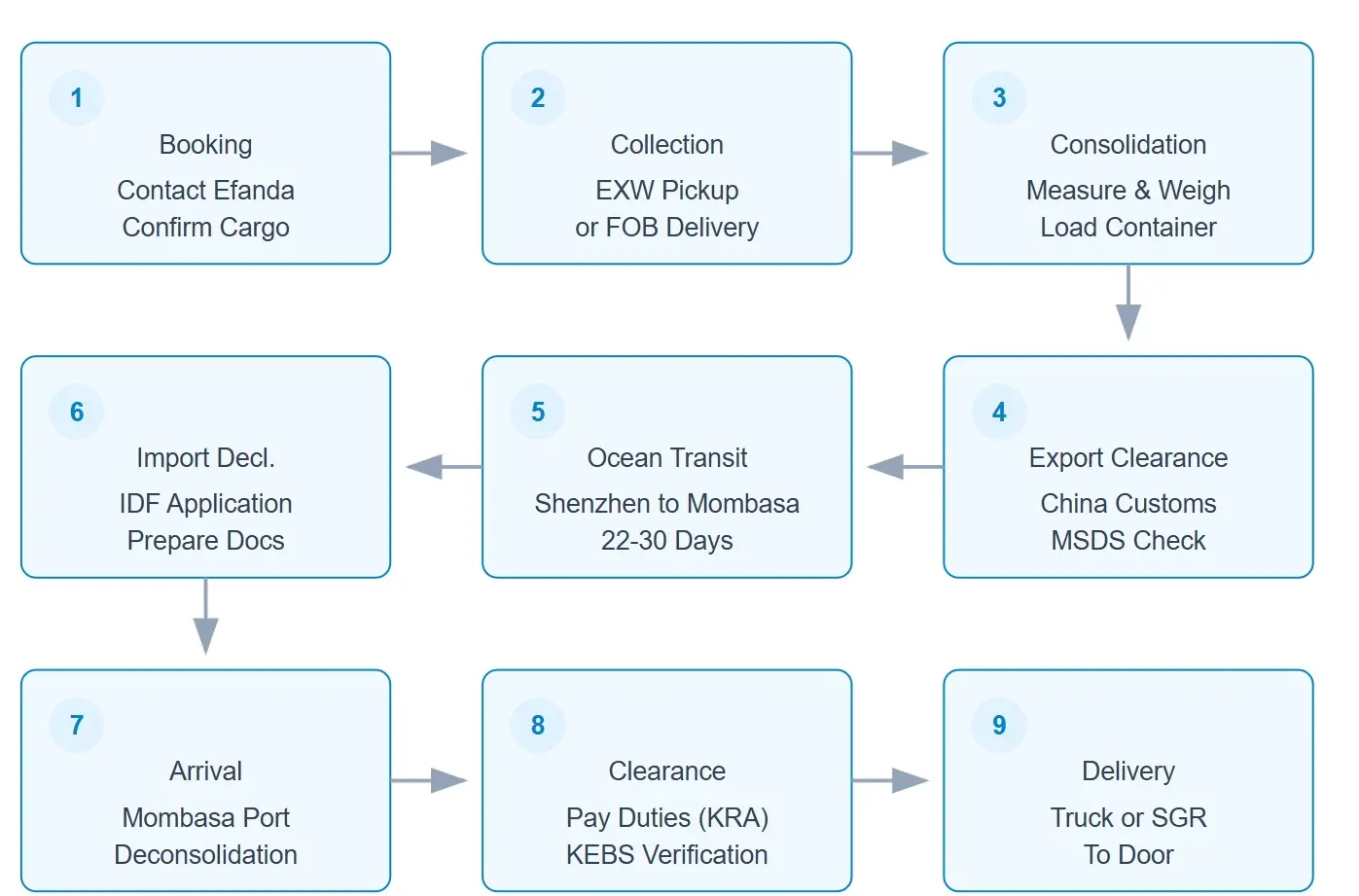
4. Step-by-Step Process for FCL Shipping from China to France
- Booking: You or your supplier contact Efanda Logistics to book space 2 weeks in advance.
- Container Loading:
- Live Load: The trucker brings the container to the factory; the driver waits (usually 2 hours free) while you load.
- Drop & Pick: The container is left at the factory for 1-2 days (better for complex loading).
- Export Customs (China): We submit the export documents. Once released, the container enters the terminal.
- Ocean Transit: The vessel departs. You receive the Bill of Lading (B/L).
- Arrival Notice: Approx. 3-5 days before the ship reaches France, the carrier’s agent sends an Arrival Notice.
- Import Customs (France): Your broker (or Efanda’s partner) submits the declaration using your EORI number. You pay Duty and VAT.
- Inland Delivery: Once cleared, the container is hauled to your warehouse for unloading.
5. Major Ports for FCL Shipping from China to France
Origins (China)
- Shanghai: World’s busiest port, ideal for suppliers in the Yangtze River Delta.
- Shenzhen (Yantian/Shekou): Best for electronics and manufacturing goods from the Pearl River Delta.
- Ningbo: Excellent alternative to Shanghai, often with slightly lower handling fees.
Destinations (France)
- Le Havre (HAROPA): The primary gateway for the French market, handling over 60% of container traffic. It is the best entry point for goods destined for Paris and Northern France.
- Marseille Fos: The key port for Southern France and the Mediterranean region. Ideal if your warehouse is in Lyon or Nice.
- Dunkirk (Dunkerque): A strategic option for Northern France, close to the Belgian border, offering good rail connections to Lille.
6. Customs Clearance Documents for FCL Shipping to France
Compliance is non-negotiable. France customs (Douane) is strict, and errors can lead to delays and fines.
Mandatory Documents
- Bill of Lading (B/L): The master document proving ownership.
- Commercial Invoice: Must state the value, HS Code, and Incoterms® 2020.
- Packing List: Details the gross weight, net weight, and package count.
- Certificate of Origin: Required for certain goods to claim preferential duty rates.
Key Requirements for 2026
- EORI Number: Every importer in the EU must have an Economic Operators Registration and Identification (EORI) number. Without it, your goods cannot clear customs.
- VAT (Value Added Tax): The standard VAT rate in France is 20%. Under the Reverse Charge Mechanism, eligible companies can self-assess VAT in their return rather than paying it upfront at the border, improving cash flow.
- HS Code: Ensure your supplier uses the correct Harmonized System code. This determines your duty rate. Check the TARIC database for accuracy.
7. 5 Expert Tips to Reduce FCL Shipping Costs from China to France
- Optimize Packaging: A 40HQ container holds roughly 68-76 CBM. If your cargo is 60 CBM, you are paying for empty air. Redesign packaging to stack efficiently and maximize space.
- Choose FOB over EXW: With FOB (Free on Board), your supplier covers local Chinese costs. With EXW (Ex Works), you pay for everything from the factory door. For FCL, FOB usually offers better control and lower overall cost.
- Book in Advance: Spot rates rise as ships fill up. Booking 14-21 days before the Cargo Ready Date (CRD) secures better rates and guarantees space.
- Avoid Demurrage & Detention: You typically get 7-14 days of “free time” at the destination port. Pre-clear customs digitally so trucks can pick up containers immediately upon discharge.
- Use a China-Based Forwarder: Local forwarders like Efanda Logistics have direct contracts with carriers and lower overheads than French agents, often saving you 10-20% on ocean freight.
8. Conclusion
Navigating FCL shipping from China to France in 2026 requires a mix of strategic planning and up-to-date market knowledge. Whether you are shipping furniture to Paris or electronics to Marseille, choosing the right container size, port, and partner is the key to protecting your margins.
At Efanda Logistics, we provide competitive 2026 FCL rates and seamless customs clearance services. Don’t let logistics headaches slow down your business.
Ready to ship? Contact us today for a free, no-obligation quote tailored to your cargo needs.
9. FAQs About FCL Shipping from China to France
Q: How much cargo fits in a 20ft vs. 40ft container?
A: A 20GP holds about 28-33 CBM (approx. 10 pallets). A 40GP holds 58-67 CBM, and a 40HQ holds 68-76 CBM (approx. 20-24 pallets).
Q: What is the difference between FOB and CIF for FCL?
A: Under CIF, the supplier arranges shipping, but you often pay hidden destination fees. Under FOB, you choose the forwarder and control the freight cost. We highly recommend FOB for transparency.
Q: Can I ship to Amazon FBA France via FCL?
A: Yes. Amazon FBA centers in France accept FCL deliveries, but you must adhere to strict palletizing and appointment scheduling (CARP) rules.
Q: How do I track my container?
A: You can track your shipment using the container number on the carrier’s website or through Efanda’s tracking portal.