Are you a small business owner in Nairobi sourcing electronics from Shenzhen, or a first-time importer in Mombasa looking to bring in a batch of construction materials? If you don’t have enough cargo to fill a standard 20ft or 40ft container, you might feel stuck. You don’t want to pay for air freight (which burns profits), but you can’t afford a full container either.
This is where LCL (Less than Container Load) shipping becomes your lifeline.
In the bustling “Kadogo Economy” of Kenya, where agility and cash flow are king, LCL shipping allows you to import exactly what you need—whether it’s 1 CBM or 10 CBM—without paying for empty space. As we move into 2026, understanding the nuances of LCL, from PVOC compliance mandated by the Kenya Bureau of Standards (KEBS) to the SGR cargo movement managed by Kenya Railways, is more critical than ever to avoid getting your goods stuck at Kilindini Harbour.
This guide is your comprehensive roadmap. We will break down the costs, transit times, and strict customs procedures you need to master for shipping from China to Kenya.
1. What Is LCL Shipping from China to Kenya?
LCL (Less than Container Load) is a logistics solution that allows multiple shippers to consolidate their goods into a single shipping container. Think of it as a “carpool” for cargo. Instead of renting the entire vehicle (FCL), you only pay for the seat (space) your goods occupy.
For Kenyan importers, LCL is the bridge between expensive air courier services (like DHL/FedEx) and high-volume sea freight.
LCL vs. FCL: Which Should You Choose?
Understanding the difference between LCL and FCL (Full Container Load) is the first step in optimizing your supply chain.
| Feature | LCL (Less than Container Load) | FCL (Full Container Load) |
|---|---|---|
| Volume Suitability | Best for 1 CBM to 15 CBM. | Best for 15 CBM+ (or if goods are fragile). |
| Cost Structure | Pay per Cubic Meter (CBM). | Pay per Container (20GP/40HQ). |
| Transit Time | Slower (+7 to 10 days due to consolidation). | Faster (Direct loading/unloading). |
| Security | Higher handling risk (goods mixed with others). | Lower risk (sealed at factory, opened at destination). |
| Flexibility | High. Ship small batches frequently. | Low. Must wait to accumulate stock. |
Why It’s Popular for Kenya:
The Kenyan market thrives on variety. LCL empowers traders to source diverse products—spare parts from Guangzhou, textiles from Yiwu, and hardware from Ningbo—and ship them in manageable quantities. It minimizes inventory risk and keeps capital fluid.
2. LCL Shipping Cost from China to Kenya: 2026 Rates & Fees
Pricing for LCL is distinct from FCL. It is not a flat fee; it is based on the Billable Volume. Understanding this model is the key to avoiding “sticker shock” when your invoice arrives.
The Pricing Model: W/M (Weight or Measure)
LCL rates are calculated based on Per CBM (Cubic Meter) or Revenue Ton. The carrier will charge based on whichever is higher: the actual volume or the volumetric weight.
- Standard Rule: 1 CBM = 1,000 kg (1 Ton).
Calculation Example:
Imagine you are shipping auto parts from Shenzhen to Mombasa.
- Scenario A (Light Cargo): Volume is 2 CBM, Weight is 500 kg.
- Chargeable Volume: 2 CBM (Since 2 CBM > 0.5 Tons).
- Scenario B (Heavy Cargo): Volume is 2 CBM, Weight is 3,000 kg.
- Chargeable Volume: 3 CBM (Since 3 Tons > 2 CBM). You pay for the weight.
Key Cost Components Breakdown
- Ocean Freight (The Base Rate)
- This is the cost to move goods from the Chinese port to Mombasa.
- 2026 Market Trend: Rates fluctuate weekly but typically range from $40 – $80 per CBM depending on the season (Peak Season Surcharge applies Q3-Q4).
- Origin Fees (China)
- Pickup Fees: Trucking from supplier to the consolidation warehouse.
- Consolidation Charges: Labor for packing and loading.
- Export Documentation: Bill of Lading (B/L) issuance, Export Customs Declaration.
- Estimated Cost: ~$50 – $150 per shipment depending on Incoterms (EXW vs. FOB).
- Destination Fees (Kenya) – The “Hidden” Layer
- This is where many new importers get caught off guard. Even if your Ocean Freight is cheap (or prepaid), you must pay local charges in Mombasa.
- CFS Charges (Container Freight Station): Fees for moving the container to a depot and unpacking it.
- Delivery Order (D/O) Fee: Paid to the shipping line agent.
- Port Levies: Kenya Ports Authority (KPA) charges.
- Handling Fees: Can range from $80 – $120 per CBM locally.
Hidden Costs to Watch
- Demurrage & Detention: If you fail to clear goods within the free period (usually 4-7 days at CFS), daily penalties accumulate rapidly.
- Verification Fees: If your goods are flagged for physical verification by KRA or KEBS, you pay for the labor and delays.
3. Transit Time for LCL Shipping from China to Kenya
Time is money. However, with LCL, patience is a virtue. Unlike FCL, where the container goes straight onto the ship, LCL involves extra steps that add to the total transit time.
Average Port-to-Port Time (2026 Estimates)
| Origin Port (China) | Destination Port (Mombasa) | Estimated Transit Time |
|---|---|---|
| Shenzhen / Guangzhou | Mombasa | 22 – 28 Days |
| Shanghai / Ningbo | Mombasa | 25 – 32 Days |
| Qingdao / Tianjin | Mombasa | 30 – 38 Days |
| Hong Kong | Mombasa | 20 – 25 Days |
Why LCL Takes Longer
- Consolidation (China): Your goods might sit in the warehouse for 3-5 days waiting for other cargo to fill the container.
- Transshipment: Some vessels stop at hubs like Singapore or Colombo, adding days.
- Deconsolidation (Mombasa): Upon arrival, the container must be transferred to a CFS, opened, and sorted. This takes 3-5 days before you can even start clearing.
- Inland Transport: If your final destination is Nairobi, add 2-4 days for trucking or SGR rail transport.
Pro Tip: Always plan for a 40-45 day lead time from the factory floor in China to your door in Nairobi to account for these variables.
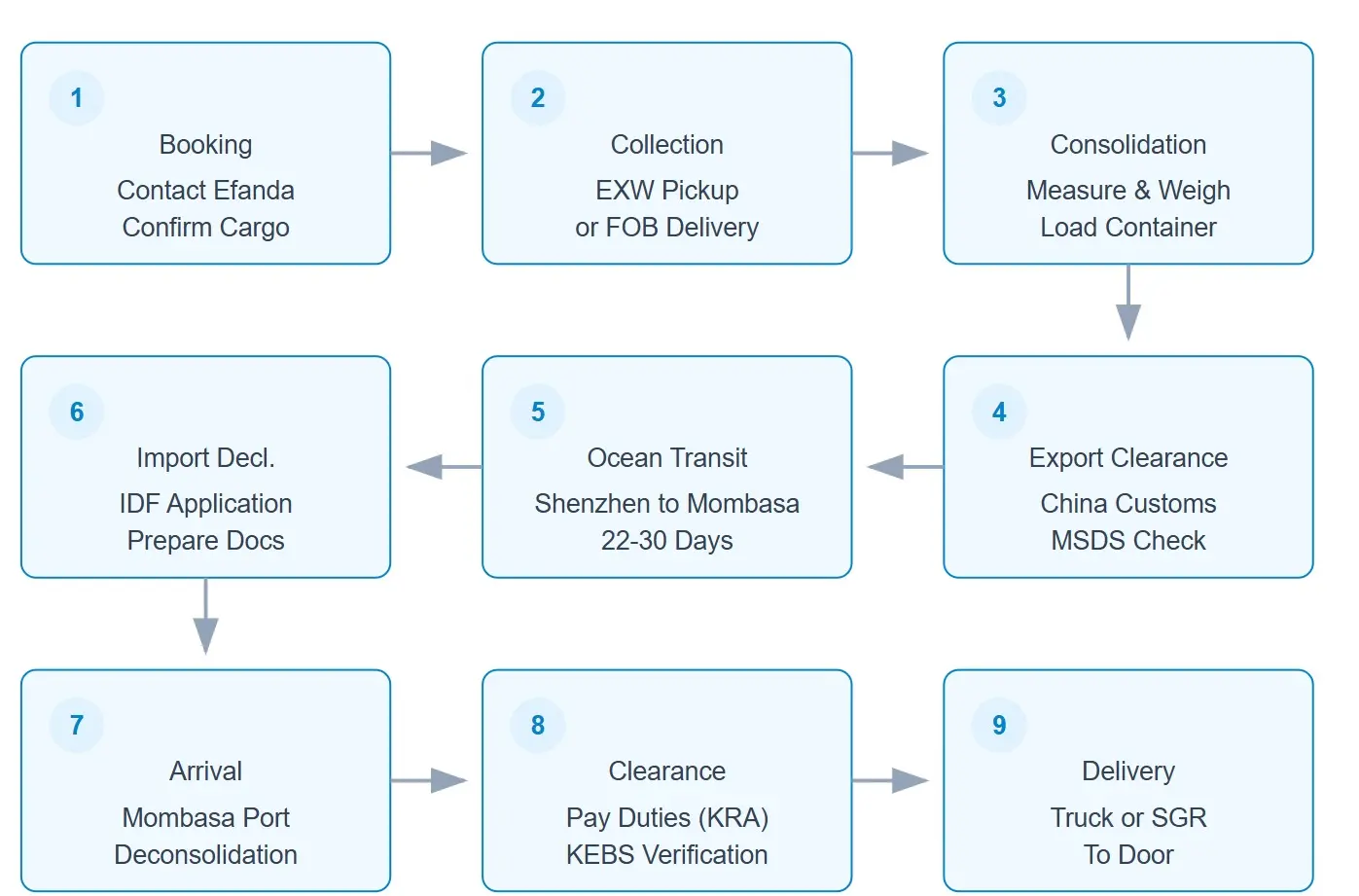
4. Step-by-Step Process for LCL Shipping from China to Kenya
Navigating the logistics chain requires a systematic approach. Here is the exact workflow Efanda Logistics uses to ensure smooth delivery.
Step 1: Booking & Cargo Details
Contact your freight forwarder (Efanda). Provide the Packing List and cargo readiness date. We will book space on the next available vessel.
Step 2: Cargo Collection (Incoterms Matter)
- EXW (Ex Works): We pick up goods from your supplier’s factory.
- FOB (Free on Board): Your supplier delivers goods to our designated warehouse in Guangzhou, Shenzhen, or Yiwu.
Step 3: Warehouse Consolidation
Your goods are measured, weighed, and inspected. We pack them securely into a container with goods from other Kenyan importers.
Step 4: Export Clearance (China)
We handle the Chinese customs declaration. Note: Goods with batteries or liquids require special MSDS handling here.
Step 5: Ocean Transit
The vessel sails. You will receive a copy of the Bill of Lading (B/L) draft for confirmation.
Step 6: Import Declaration (The Critical Phase)
While goods are on the water, your clearing agent in Kenya begins the IDF and customs entry process using the scanned documents.
Step 7: Arrival & Deconsolidation
The vessel docks at Mombasa. The container is moved to a CFS (e.g., Autoports, MCT). The container is stripped (unpacked).
Step 8: Customs Clearance & Tax Payment
You pay the duties generated by the KRA iTax system. Once paid, a Release Order is issued.
Step 9: Final Delivery
Goods are loaded onto a truck or the SGR for delivery to your warehouse in Nairobi, Nakuru, or Kisumu.
5. Customs Clearance & Documents for LCL Shipping to Kenya
Kenya’s customs regulations are stringent. A single missing document can lead to indefinite delays and massive fines. In 2026, the Kenya Revenue Authority (KRA) and KEBS are fully digitized.
Mandatory Documents Checklist
- Bill of Lading (B/L)
- The core transport document. For LCL, this is usually a “House Bill of Lading” issued by the forwarder.
- Commercial Invoice & Packing List
- Must accurately describe the goods, value, and HS Codes.
- IDF (Import Declaration Form)
- Requirement: Must be applied for before the goods leave China.
- Cost: 2.5% of the CIF value (Minimum Ksh 5,000).
- COC (Certificate of Conformity) – The “Golden Ticket”
- Under the PVOC (Pre-Export Verification of Conformity) program, most goods require a COC to prove they meet Kenyan standards.
- Process: An agent (SGS, Intertek, Bureau Veritas) inspects goods in China before shipping.
- Risk: If goods arrive without a COC, you face a penalty of 20% of the CIF value and mandatory local inspection (which you might fail).
- Exemption Letter (if applicable)
- For specific raw materials or machinery that might be exempt from PVOC.
KRA PIN & Tax Obligations
Every importer must have a valid, active KRA PIN. Ensure your tax station is updated on iTax to avoid blocking your entry.
The Role of SGR (Standard Gauge Railway)
For goods destined for Nairobi, the government often mandates the use of the SGR. LCL cargo is usually trucked to the Nairobi ICD (Inland Container Depot) at Embakasi for clearance closer to home, reducing congestion in Mombasa.
6. Major Ports for LCL Shipping from China to Kenya
Origins (China)
- Guangzhou / Shenzhen: The hub for electronics, fashion, and consumer goods. Most LCL consolidations for Africa originate here.
- Shanghai / Ningbo: The center for heavy machinery, industrial equipment, and automotive parts.
- Qingdao: Key for rubber products, tires, and plastics.
- Yiwu: The world’s small commodity capital. Perfect for mixed general merchandise containers.
Destination (Kenya)
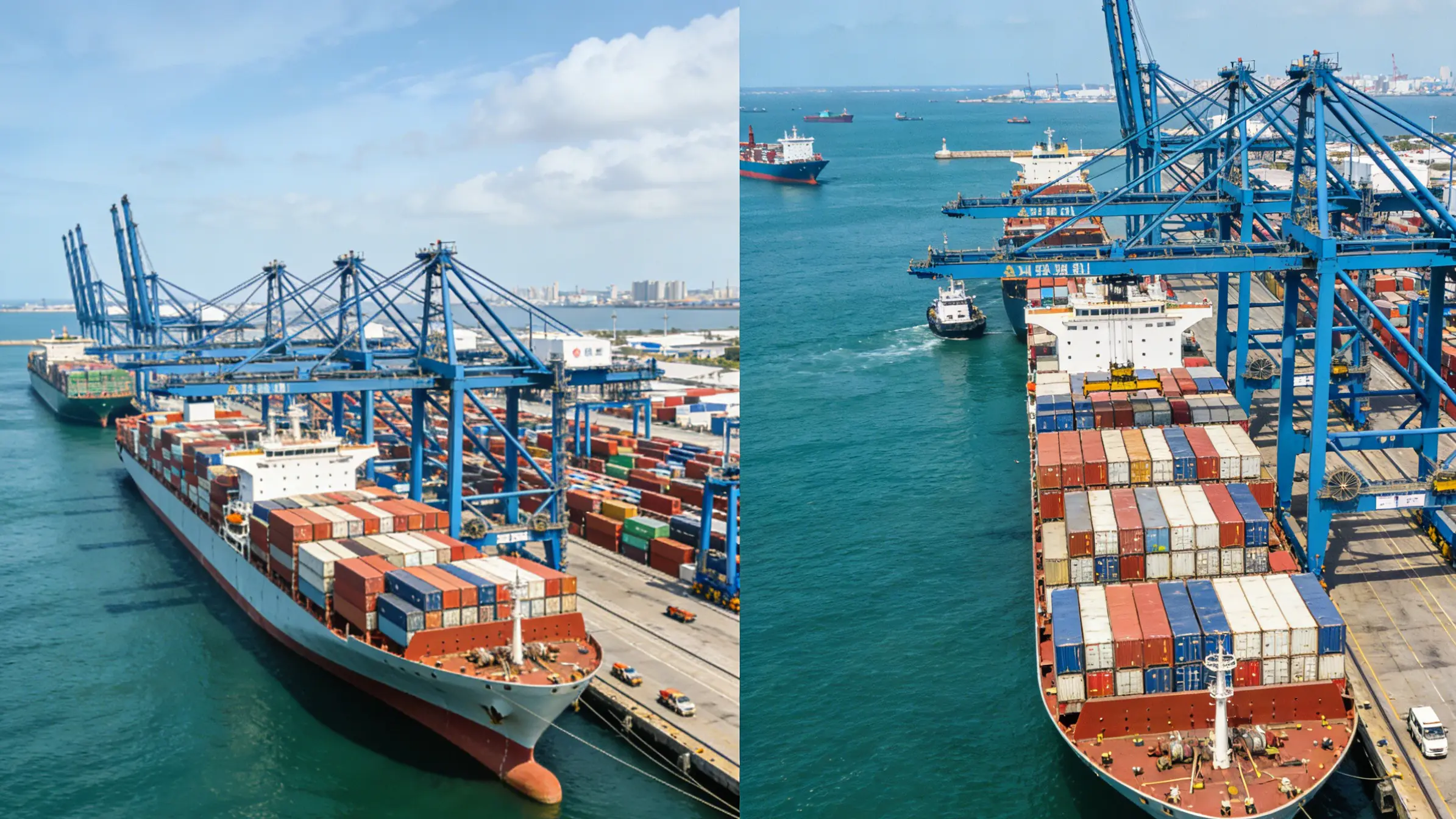
- Port of Mombasa (Kilindini Harbour): The largest port in East Africa. It serves not just Kenya, but the hinterland (Uganda, Rwanda, South Sudan).
- ICD Nairobi (Embakasi): A “dry port” connected by rail. It is highly efficient for Nairobi-based businesses, allowing you to clear customs in the capital rather than traveling to the coast.
7. Expert Tips to Reduce LCL Shipping Costs from China to Kenya
Target Keyword: reduce shipping costs from China to Kenya
- Optimize Packaging (Reduce Dead Space)
- Since you pay per CBM, air is expensive. Ask your supplier to nest products or use vacuum packaging for textiles. Reducing volume by 0.5 CBM can save you $50-$100.
- Consolidate Suppliers
- Buying from 3 different factories? Don’t ship 3 separate LCL shipments. Have them send goods to Efanda’s warehouse in Guangzhou. We will bundle them into one shipment. This saves you three sets of destination handling fees in Mombasa.
- Avoid CIF (Cost, Insurance, Freight)
- Suppliers often offer “Cheap CIF” prices. This is a trap. They mark up the origin costs and use cheap agents who overcharge you on destination fees. Always buy FOB or EXW so you control the forwarder and the costs.
- Ensure Compliance Early
- Confirm HS Codes and COC requirements before production ends. A $200 COC fee is cheaper than a $2,000 penalty.
8. Conclusion
LCL shipping is the engine powering the growth of Kenyan SMEs. It offers the flexibility to start small and scale up without the massive capital required for full containers. However, the path from China to Kenya is paved with regulatory hurdles—from PVOC compliance to SGR logistics.
Success lies in preparation. By choosing the right Incoterms, understanding the costs, and partnering with a forwarder who knows the “Kenyan Way,” you can turn logistics from a headache into a competitive advantage.
Ready to ship?
Contact Efanda Logistics today. Whether you need a quick LCL quote, help with a COC, or a full Door-to-Door solution to Nairobi, our team is ready to move your business forward.
9. FAQs About LCL Shipping from China to Kenya
Q: What is the minimum volume for LCL shipping?
A: Typically 1 CBM. You can ship less (e.g., 0.5 CBM), but most carriers will charge the minimum 1 CBM rate.
Q: Can I ship batteries or liquids via LCL?
A: Yes, but they are classified as Dangerous Goods (DG). You must provide an MSDS (Material Safety Data Sheet). Efanda specializes in handling sensitive cargo like power banks and cosmetics safely.
Q: How much is customs duty in Kenya?
A: It depends on the HS Code. Common rates are 0% (Raw Materials), 10% (Intermediate Goods), or 25% (Finished Goods). Plus, you must pay VAT (16%), RDL (2%), and IDF fee (2.5%).
Q: Do you offer Door-to-Door shipping to Nairobi?
A: Yes! Efanda Logistics offers a comprehensive DDP (Delivered Duty Paid) service. We handle the shipping, customs clearance, duty payment, and trucking directly to your shop in Nairobi. You pay one all-inclusive price per CBM or KG.