Are you looking to import vehicles or heavy machinery from China but worried about the high cost and complexity of container shipping? You are not alone. In 2026, RoRo shipping from China to USA remains the most efficient and cost-effective method for transporting self-propelled cargo. Whether you are shipping a fleet of excavators for a construction project in Texas or importing a personal car to California, understanding the Roll-on/Roll-off process is crucial for protecting your bottom line.
This comprehensive guide covers everything you need to know about RoRo shipping, from current 2026 rates and transit times to critical US customs regulations like EPA Form 3520-1 and DOT Form HS-7.
Quick Answer:
RoRo (Roll-on/Roll-off) is a shipping method where vehicles are driven directly onto the ship and secured under the deck, rather than being loaded into a container. It is generally 20-30% cheaper than container shipping for drivable cargo and offers faster loading times. However, it requires the vehicle to be in running condition and strictly prohibits personal items inside the car.
What Is RoRo Shipping from China to USA? (Definition & Meaning)
Definition of RoRo Shipping
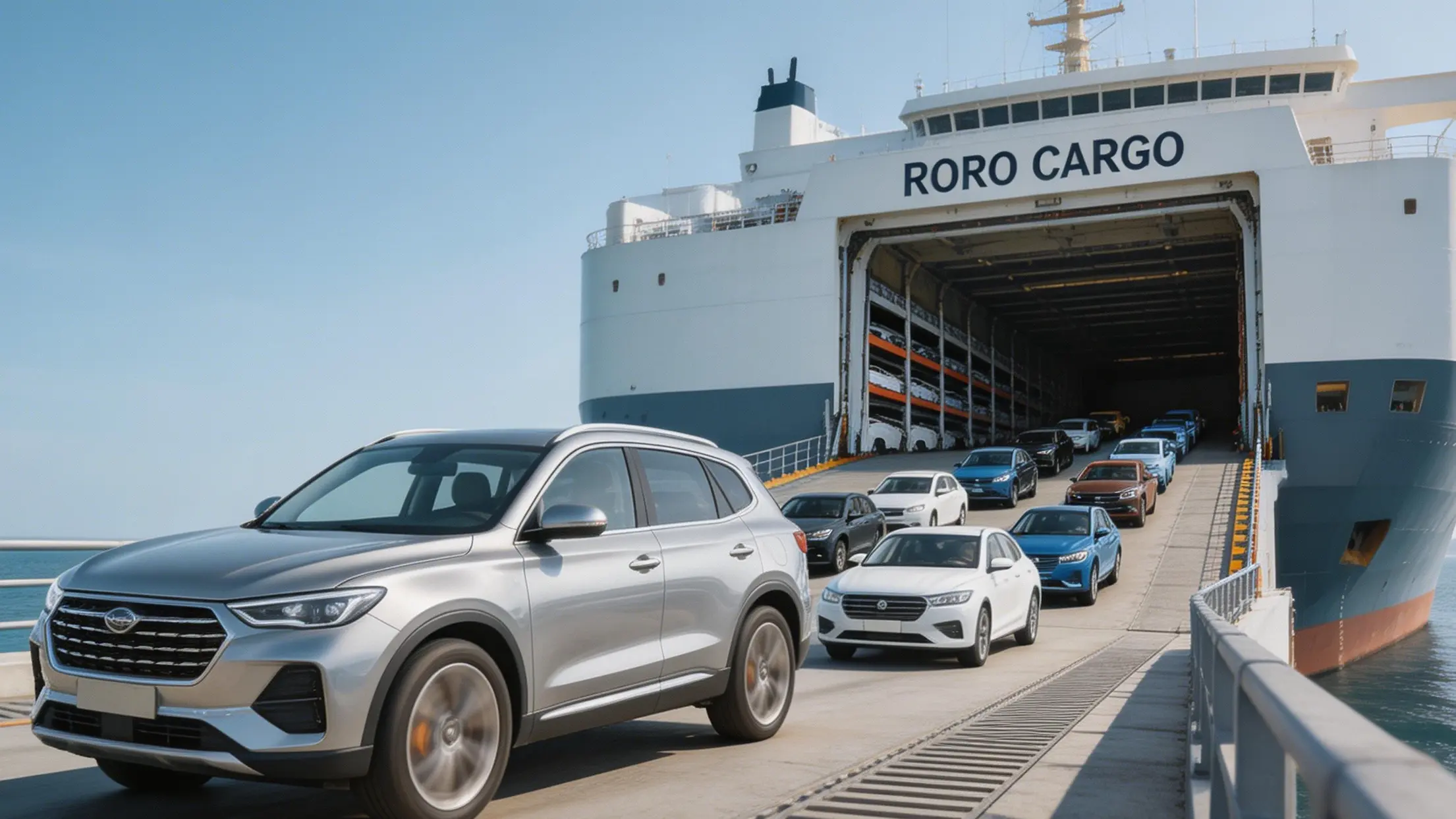
RoRo stands for Roll-on/Roll-off. Unlike traditional container vessels where cargo is lifted by cranes (LoLo – Lift-on/Lift-off), RoRo vessels are designed like massive floating parking garages. They feature built-in ramps that allow vehicles to be driven directly onto the ship and parked on assigned decks.
How RoRo Shipping Works
The process is streamlined for efficiency:
- Port Loading: At Chinese ports like Shanghai or Tianjin, port workers drive your vehicle onto the vessel via the stern ramp.
- Securing Vehicles: Once parked, the vehicle is lashed to the deck using specialized chains and binders. The tires are blocked to prevent movement during rough seas.
- Ocean Transit: Your cargo is stowed under deck, fully protected from wind, salt water, and rain—unlike deck cargo on container ships.
- Roll-off Discharge: Upon arrival at US ports (e.g., Los Angeles or Baltimore), the vehicle is driven off the ship to the terminal yard for customs clearance.
Efanda Tip: For non-drivable static cargo (like boats on cradles or heavy generators), we use MAFI Trailers—low-bed platforms with wheels that can be towed onto the RoRo vessel.
What Vehicles Can Be Shipped via RoRo from China to USA?
RoRo is versatile but has specific eligibility requirements. It is best suited for:
- Cars & SUVs: Both new and used vehicles (sedans, pickup trucks, luxury SUVs).
- Heavy Trucks & Buses: Dump trucks, concrete mixers, and city buses that won’t fit in standard 40ft containers.
- Construction Machinery: Excavators, bulldozers, wheel loaders, and cranes.
- Agricultural Equipment: Tractors, harvesters, and sprayers.
- Static Cargo (via MAFI Trailer): Large industrial equipment, yachts, or disassembled machinery parts.
Note on Electric Vehicles (EVs):
Shipping EVs via RoRo has become stricter in 2026 due to fire risks associated with Lithium-ion batteries. Many carriers now require the State of Charge (SoC) to be below 30% or 50%. If a carrier rejects your EV, Efanda Logistics can arrange specialized container shipping with proper Hazmat declarations.
RoRo Shipping Cost from China to USA (2026 Rates & Factors)
RoRo rates are typically calculated based on CBM (Cubic Meters) or Lane Meters, not just a flat fee per container.
Main Cost Factors
- Vehicle Dimensions: The most critical factor. The formula is Length×Width×Height. Oversized units occupy more deck space and incur higher rates.
- Weight: Standard rates apply up to a certain tonnage. Equipment exceeding 50-80 tons may face “Heavy Lift” surcharges.
- Route: Shipping to the West Coast (Los Angeles) is cheaper than the East Coast (New York/Baltimore) due to shorter distance and no Panama Canal fees.
- Fuel Surcharge (BAF): Adjusted monthly based on global oil prices.
- Marine Insurance: Essential for covering potential damage during transit (usually 0.4%-0.6% of cargo value).
Major Ports Involved
- China Loading Ports: Shanghai (Haitong Terminal is the largest), Guangzhou (Nansha), Tianjin, Qingdao.
- US Discharge Ports:
- West Coast: Los Angeles, Long Beach, Port Hueneme.
- East Coast: Baltimore, Brunswick, Jacksonville, New York, Galveston.
Transit Time: How Long Does RoRo Shipping Take from China to USA?
RoRo vessels often have fewer stops than container ships, leading to competitive transit times.
| Region | Destination Port | Estimated Transit Time |
|---|---|---|
| West Coast | Los Angeles / Long Beach | 15 – 20 Days |
| East Coast | New York / Baltimore / Brunswick | 28 – 35 Days |
| Gulf Coast | Galveston / Houston | 30 – 38 Days |
Factors That May Delay Shipments
- Port Congestion: High volumes at Shanghai or LA can cause berthing delays of 3-7 days.
- Weather: Typhoons in the Pacific can force vessels to alter course.
- Customs Inspections: Intensive exams (VACIS/X-ray) by US Customs can hold cargo for 1-2 weeks.
- Compliance Checks: USDA inspections for soil on tires/undercarriage are strict. Ensure your vehicle is steam-cleaned before shipping.
RoRo vs Container Shipping: Best Way to Ship Cars from China to USA
Is RoRo always the best choice? Not necessarily. Here is a comparison to help you decide.
| Feature | RoRo Shipping | Container Shipping |
|---|---|---|
| Cost | Generally Lower (for single vehicles) | Higher (unless consolidating 2-3 cars) |
| Protection | Protected from elements, but open to crew | Fully enclosed and sealed |
| Personal Items | Strictly Prohibited (Empty car only) | Allowed (can pack goods inside) |
| Handling | Minimal (driven on/off) | Crane lifting (risk of scratches) |
| Suitability | Drivable, Oversized, Heavy Machinery | High-value cars, Non-runners, Auto parts |
| Departure Frequency | Less frequent (1-2 sailings/month) | Frequent (Weekly sailings) |
Verdict: Choose RoRo for standard cars, trucks, and heavy machinery where cost is the priority. Choose Container if you are shipping a luxury vintage car, need to ship auto parts alongside the vehicle, or if the car doesn’t run.
Step-by-Step Guide: RoRo Shipping Process from China to USA
1. Vehicle Booking & Preparation
Provide your freight forwarder with the Year, Make, Model, VIN, and exact dimensions.
- Action: Clean the vehicle thoroughly (undercarriage washing is mandatory to pass USDA inspection).
- Action: Remove all personal belongings. Only the spare tire and factory jack are allowed.
- Action: Ensure fuel level is low (usually between 1/8 and 1/4 tank).
2. Inland Transport to Chinese Port
Efanda Logistics arranges the pick-up from the factory or supplier to the RoRo terminal (e.g., Shanghai Haitong).
3. Export Customs Clearance
We handle the Chinese export declaration. You must provide the Certificate of Title or Bill of Sale to prove ownership.
4. Ocean Transport
The vehicle is loaded, lashed, and shipped. You receive the Bill of Lading (BL).
5. US Customs Clearance & ISF Filing
Crucial Step: The Importer Security Filing (ISF) must be filed 24 hours before the ship departs China. Failure to do so results in a minimum $5,000 fine.
Upon arrival, your customs broker files the Entry Summary (Form 7501).
6. Pickup or Delivery
Once cleared, you can pick up the vehicle at the port or arrange inland trucking to your door.
Electric Vehicle (EV) Shipping from China to USA: 2026 Regulations
Shipping Chinese EVs (like BYD, NIO, or Zeekr) to the USA faces unique challenges in 2026:
- Fire Risk Management: Carriers are extremely cautious. Damaged EVs are strictly banned from RoRo.
- State of Charge (SoC): Must be maintained at compliant levels (typically <30%).
- Tariffs: Be aware of the Section 301 tariffs on Chinese EVs, which can be significant (often 100% duty rate as of recent trade policies).
US Import Requirements & Customs Clearance for Vehicles from China
To successfully clear US Customs (CBP), you must comply with three main agencies. Efanda Logistics guides you through this paperwork.
1. DOT Compliance (Department of Transportation)
You must file Form HS-7.
- The vehicle must meet Federal Motor Vehicle Safety Standards (FMVSS).
- The 25-Year Rule: Vehicles 25 years or older are exempt from FMVSS (Box 1 on HS-7).
2. EPA Requirements (Environmental Protection Agency)
You must file Form 3520-1.
- The vehicle must meet US emission standards.
- 21-Year Rule: Vehicles 21 years or older are exempt from EPA requirements (Code E on 3520-1).
3. Duties and Taxes
- Passenger Cars: 2.5% duty.
- Trucks/Cargo Vans: 25% duty (known as the “Chicken Tax”).
- Motorcycles: Free or low duty depending on cc.
Case Study: Shipping Construction Machinery to Texas
Client: A construction firm in Houston needed to import a 30-ton SANY excavator from Shanghai.
Challenge: Dismantling the excavator to fit into a 40ft Flat Rack container was quoted at $12,000 (freight + dismantling + re-assembly labor).
Efanda Solution: Drawing on our 15 years of experience with heavy lift cargo, we proposed RoRo shipping. Our team supervised the loading in Shanghai to ensure proper lashing.
Result: Total freight cost was $8,500. The client saved $3,500 and avoided the risk of re-assembly errors. We also handled the EPA filing, ensuring the machinery met US Tier 4 emission standards.
Tips to Reduce RoRo Shipping Costs from China to USA
- Ship to the Nearest Port: Inland trucking in the US is expensive ($3-$5 per mile). Choose a discharge port close to your final destination.
- Accurate Dimensions: Measure your cargo precisely. Declaring smaller dimensions than reality will lead to costly re-measurement penalties at the port.
- Book in Advance: RoRo space is limited. Booking 2-3 weeks ahead secures a spot and often a better rate.
- Use a Specialized Forwarder: General forwarders often lack RoRo contracts. Efanda Logistics has direct agreements with major RoRo carriers like Wallenius Wilhelmsen and Hoegh Autoliners.
Expert Insight: According to the Federal Maritime Commission (FMC), ensuring all documentation is accurate before the vessel arrives can prevent costly demurrage charges. Our team verifies every document to ensure seamless clearance.
FAQs about RoRo Shipping from China to USA
Q: Is RoRo cheaper than container shipping?
A: Yes, for single drivable vehicles and heavy machinery, RoRo is typically cheaper and requires less handling. However, if you have 3-4 cars, consolidating them in a 40ft HQ container might be more cost-effective per unit.
Q: Can I pack personal items inside the car?
A: No. RoRo carriers strictly prohibit personal goods inside the vehicle due to customs regulations and theft risk. The car must be empty.
Q: What documents do I need to import a car to the USA?
A: You need the Original Bill of Lading, Bill of Sale, Foreign Registration/Title, DOT Form HS-7, and EPA Form 3520-1.
Q: What is a MAFI trailer?
A: A MAFI trailer is a heavy-duty roll trailer used to transport static (non-drivable) cargo on RoRo vessels. It allows items like boats or generators to be towed on and off the ship.
Q: How do I calculate the import duty for a truck?
A: Imported trucks are subject to a 25% duty rate (Chicken Tax) based on the commercial invoice value. Passenger cars are subject to 2.5%.
Need a quote for RoRo shipping from China to USA?
Don’t let complex regulations stall your shipment. Contact Efanda Logistics today for a precise shipping plan and rate for your vehicle or machinery. We handle the heavy lifting so you don’t have to.