Struggling to balance shipping costs with speed in the unpredictable 2026 market?
With sea freight experiencing rate drops due to overcapacity and air freight facing regional disruptions, choosing between sea freight vs air freight is more complex than simply comparing prices. Importers risk eroding profit margins or facing stockouts if they make the wrong choice. This guide breaks down the true cost, transit times, and strategic factors of Sea Freight vs Air Freight in 2026, helping you optimize your supply chain and reduce expenses.
Key Takeaways
- Sea freight spot rates in 2026 have stabilized, making it highly economical for bulk goods, despite longer transit times.
- Air freight remains the premium choice for speed (1-8 days) but costs significantly more, especially with regional airspace constraints affecting rates.
- The break-even point for choosing air over sea typically lies in cargo weight (under 500kg) and high product value.
- Multimodal solutions and early planning are crucial to mitigating seasonal rate spikes (July-October).
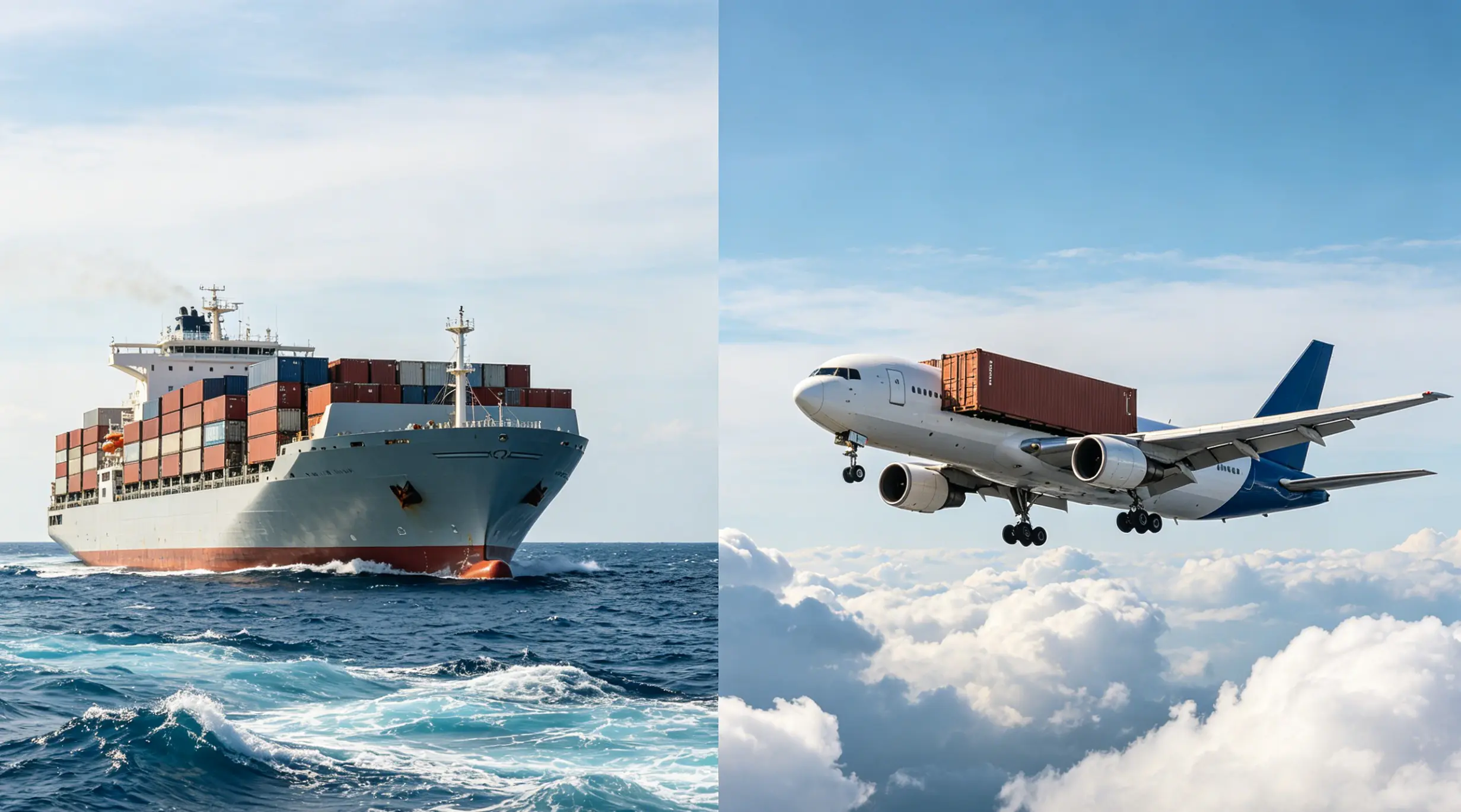
Sea Freight VS Air Freight: Understanding the 2026 Landscape
The 2026 shipping landscape is defined by sea freight affordability driven by fleet overcapacity, contrasting with air freight’s agility amidst regional disruptions. Importers must weigh cost savings against speed to market.
2026 Sea Freight Trends (Cost Efficiency vs Delays)
Sea freight offers substantial cost reductions in 2026 due to increased vessel capacity, but shippers must still account for hidden costs like Demurrage and Detention (D&D) during unexpected port congestion. According to recent BIMCO market analysis, the container shipping industry continues to absorb millions of TEUs in new ship deliveries, driving down the baseline cost per TEU. However, in our daily operations at Efanda Logistics, we’ve noticed that while base ocean freight rates are lower, strict environmental compliance fees (such as the EU’s CBAM) and sudden blank sailings can quickly eat into your savings. To mitigate these risks, we always advise our clients to build a 7-10 day buffer into their supply chain.
Disclaimer: Freight rates are highly volatile. The cost insights provided are based on Q1 2026 market averages and are subject to carrier General Rate Increases (GRI) and Peak Season Surcharges (PSS).
Air Freight Realities (Speed and Regional Volatility)
Air freight guarantees rapid delivery within 1-8 days, yet rates remain hyper-sensitive to geopolitical events, fuel surcharges, and airspace closures. As noted by the International Air Transport Association (IATA), global air cargo demand is projected to grow by roughly 2.4% to 2.6% in 2026, keeping capacity tight on major East-West trade lanes. In our recent shipments from China to Europe, we’ve seen airlines frequently adjust their War Risk and Fuel Surcharges with little notice. Therefore, we recommend reserving air freight strictly for high-value goods (like consumer electronics), perishable items, or emergency stock replenishments where the speed-to-market completely justifies the premium cost.
Sea Freight vs Air Freight: How to Choose the Right Mode
Selecting between sea freight vs air freight depends on calculating your shipment’s chargeable weight, assessing the urgency of delivery, and determining the value-to-weight ratio of your goods.
Factor 1: Cost Comparison & The Break-Even Point
Calculate the cost difference based on volume and weight; shipments under 500kg often justify air freight, while larger volumes are strictly for ocean freight. As a general rule of thumb in 2026, if the cost of air freight is less than 15-20% of the cargo’s retail value, it might be worth the speed. For anything heavier or bulkier, the economics of sea freight are impossible to beat.

Factor 2: Transit Time and Speed to Market
Evaluate inventory carrying costs against freight rates. Faster air delivery reduces the need for extensive warehouse services, whereas sea freight requires longer lead times. If tying up capital in inventory on the water for 40 days severely hurts your cash flow, the higher upfront cost of air freight may actually be more profitable overall.
Factor 3: Cargo Value, Size, and Risk Tolerance
High-value, fragile, or perishable items favor air freight’s secure and fast transit, while heavy, bulky, or low-margin goods demand sea freight. Air freight involves less handling and tighter security, significantly reducing the risk of damage or theft. Conversely, sea freight is built for durability and massive scale.
| Feature | Sea Freight | Air Freight | Best For |
|---|---|---|---|
| Cost | Low (per CBM) | High (per Kg) | Bulk, low-margin goods |
| Speed | 20-50+ Days | 1-8 Days | Urgent, time-sensitive goods |
| Reliability | Moderate (weather/port delays) | High (tight schedules) | Perishables, electronics |
| Carbon Footprint | Lower | Higher | Sustainable supply chains |

Sea Freight vs Air Freight: Cost Analysis & Transit Times in 2026
A comprehensive look at current rates shows sea freight significantly cheaper per CBM, while air freight commands a premium per kg, with transit times diverging sharply between 1-8 days (air) and 30-50+ days (sea).
Breakdown of Shipping Rates in 2026
Sea freight spot rates remain competitive, though seasonal spikes are expected in Q3. Air freight rates vary by route, heavily influenced by capacity redeployments. For instance, a 40HQ container from China to the US West Coast might hover around baseline levels early in the year, but expect a 20-35% surge during the peak season (July-October). Air freight, while stable, requires constant monitoring of fuel surcharges.
Transit Time Comparison (Mode A vs Mode B)
While air freight delivers globally in under a week, sea freight requires 3-6 weeks depending on the route, port congestion, and chosen service (direct vs transshipment). An air shipment from Shenzhen to Frankfurt typically takes 3-5 days for door to door shipping. The same route via sea freight will take approximately 35-45 days.

Why Choose Efanda Logistics for Your Freight Needs?
Efanda Logistics provides tailored freight forwarding solutions, balancing cost and speed to ensure your cargo arrives safely and on budget.
Customized Multimodal Solutions
We combine the speed of air with the economy of sea through innovative sea-air routing, optimizing your supply chain efficiency. If pure air freight is too expensive and sea freight is too slow, our hybrid solutions via strategic transit hubs can cut your transit time in half while saving you up to 30% compared to direct air freight.
Real-Time Tracking and Expert Customs Clearance
Our 24/7 support and deep knowledge of global customs clearance ensure smooth transit, minimizing delays regardless of the transport mode. As seasoned freight forwarders, we know that incorrect documentation is the #1 cause of cargo holds. From managing precise HS Codes and ICS2 declarations to advising on the best Incoterms® for your DDP or FOB shipments, we eliminate the compliance headaches that trigger expensive Demurrage fees and supply chain disruptions.
Sea Freight vs Air Freight FAQs
What is the main difference between sea freight and air freight?
The primary difference is cost and speed. Sea freight is much cheaper for large volumes but takes weeks, whereas air freight is significantly more expensive but delivers within days.
At what weight does air freight become cheaper than sea freight?
Generally, shipments under 150kg to 500kg are more cost-effective via air freight. Once shipments exceed 500kg or 2 CBM, sea freight (LCL or FCL) becomes the economically viable choice.
How much faster is air freight compared to sea freight in 2026?
Air freight is typically 5 to 10 times faster. An international air shipment usually takes 1 to 8 days, while sea freight takes anywhere from 20 to 50+ days.
Are sea freight rates expected to rise in late 2026?
Yes, traditional peak season surges (July through October) are expected to drive up sea freight spot rates by 20% to 35% as importers stock up for holiday sales.
Can I use a combination of both sea and air freight?
Yes, multimodal (sea-air) transport is highly effective. It involves shipping goods by sea to a mid-point hub and then flying them to the final destination, offering a balance of moderate speed and cost savings.