Your supplier quotes CIF, your forwarder quotes DDP, and the importer two streets away buys the same product FOB. All three prices cover identical cartons leaving the same Chinese port, yet they pay for different things, and one of them is quietly carrying an import tax you may never recover. Choosing between FOB, CIF, and DDP when importing from China is not a shipping decision. It is a decision about who controls the freight contract, who carries the risk at each mile, and who is legally the importer in your country.
This guide separates those questions: where risk transfers under each term, why CIF is the most misread rule in container shipping, how the duty base differs between Europe and the United States, the 2026 changes that broke older DDP quotes, and a four-question test for your next order.
1. What Do FOB, CIF, and DDP Actually Change?
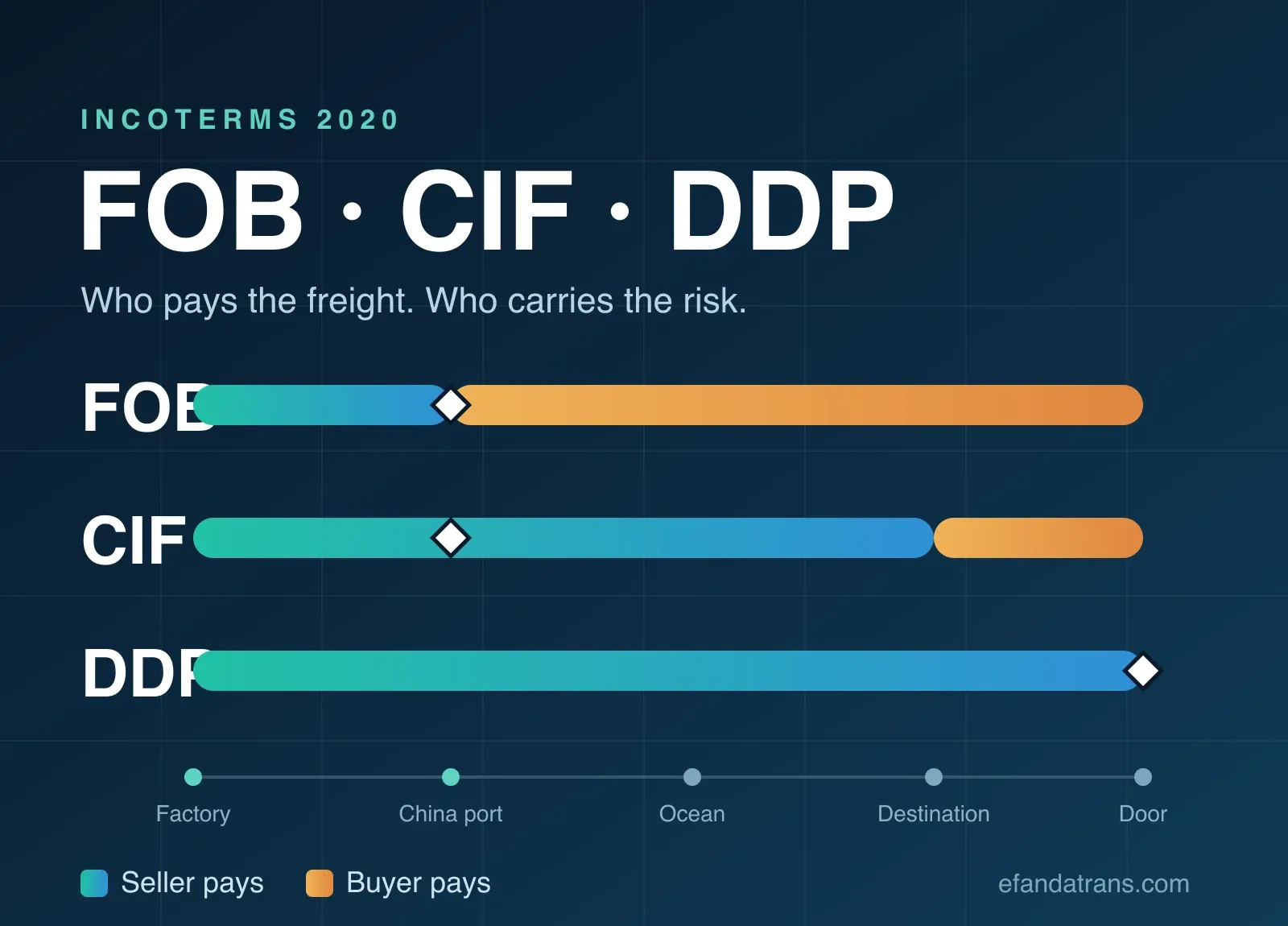
They change exactly three things: who books and pays the main carriage, where risk passes from seller to buyer, and who clears the goods for import as the importer of record. Everything else is decided by what you write next to the three letters, not by the letters themselves.
Incoterms 2020 has eleven rules, and these three cover most shipments from China to a Western market. FOB and CIF apply only to sea and inland waterway transport, which is why they appear on ocean bookings and almost never on air waybills; DDP works on any mode. None of the three governs payment terms, title, product quality or liability for a wrong HS code. Those belong in the sales contract, and assuming Incoterms covers them is how disputes start.
| Question | FOB (named port of shipment) | CIF (named port of destination) | DDP (named place in destination country) |
|---|---|---|---|
| Where does risk pass to the buyer? | When goods are on board the vessel in China | When goods are on board the vessel in China | At the named destination place, after import clearance |
| Who pays export clearance in China? | Seller | Seller | Seller |
| Who books and pays the ocean freight? | Buyer | Seller | Seller |
| Who arranges cargo insurance? | Buyer | Seller, minimum Institute Cargo Clauses (C), 110% of contract value | Seller |
| Who clears import customs? | Buyer | Buyer | Seller, as importer of record |
| Who pays duty and import VAT? | Buyer | Buyer | Seller, then recovers it in the price |
| Typical buyer profile | Repeat importers with their own forwarder | Buyers who want one landed price at the port | Buyers with no import entity, or small parcel flows |
2. FOB: You Own the Freight and the Risk From the Ship’s Rail
Under FOB, the seller delivers the goods on board the vessel you nominated, and from that moment the cargo is your risk and your cost. The seller handles packing, inland transport, export declaration and loading; you pay ocean freight, insurance, destination charges and import.
FOB is the default for importers who buy in volume, and the reason is visibility rather than price. The product price and the freight price arrive as two separate numbers, so you can benchmark each one. When a factory bundles freight into a CIF or DDP unit price, you cannot tell whether the carrier charged 2,400 dollars or 3,600 dollars, and you have no lever if the service is poor. Importers moving more than a few containers a year usually save money by separating the two, because a forwarder’s contract rate beats the margin a factory adds to “free” freight.
There are two traps. The first is the container gap: a container is handed to the terminal three to seven days before the vessel loads, but under FOB risk only passes when the goods are on board. If it is damaged at the terminal in that window, the term says it is still the seller’s cargo while the seller’s insurance may already have ended. The ICC recommends FCA for containerised cargo for this reason, and a buyer’s open policy should start at the origin terminal. The second trap is nomination: because you choose the vessel, you own the consequences of a late booking, including storage at origin, a rolled container and a missed sailing.
3. CIF: The Most Misunderstood Term in Container Shipping
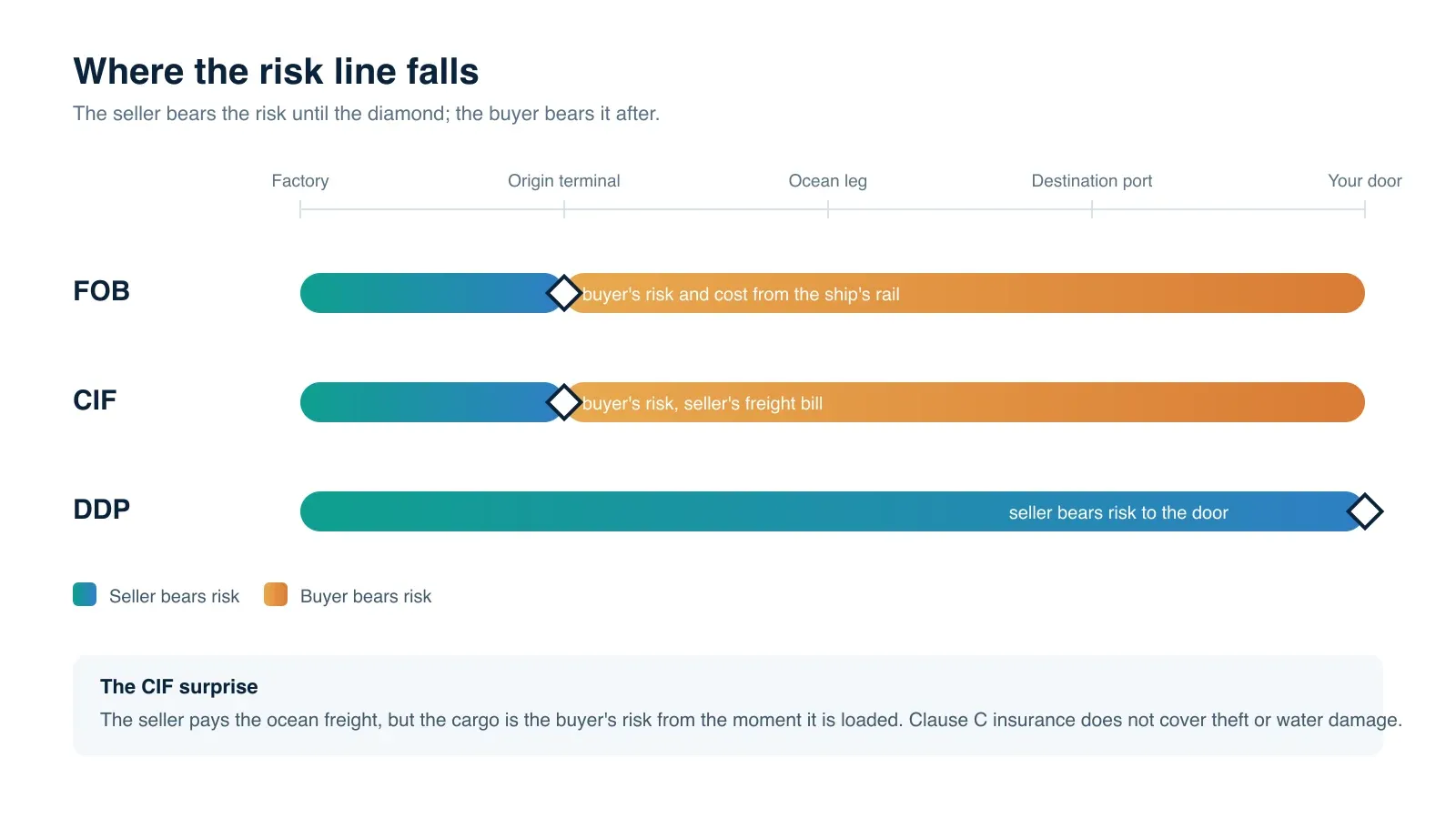
CIF means the seller pays ocean freight and buys insurance to the destination port, but the risk still passes to you when the goods are loaded on board in China. After that point the seller’s obligation is to hand over documents, not to deliver safe cargo.
CIF is CFR plus an insurance obligation, so it extends the seller’s costs to the destination port, not the seller’s liability. If the vessel sinks in the South China Sea, you own the loss and you claim on the policy the seller bought on your behalf. That policy is the second problem: CIF only requires minimum cover, Institute Cargo Clauses (C), for 110 percent of the contract value, in the contract currency. Clause C pays for fire, explosion, stranding, collision and general average. It does not pay for theft, pilferage, non-delivery, fresh water damage, or the handling damage most consumer goods actually suffer. An importer shipping electronics or apparel under a default CIF policy is insured against catastrophes and uninsured against the losses that happen every week.
CIF also stops at the port. Destination terminal handling, deconsolidation for LCL, brokerage, duty, VAT and final delivery are yours, which is why a CIF quote often looks cheaper than DDP until the destination invoice arrives. And because the seller chooses the carrier and routing, you have no say when your container is booked on a slower service or transshipped twice.
CIF has legitimate uses. Documentary credits like it because the seller tenders a complete document set including the insurance certificate, and a buyer with one annual order often gets a better all-in number from an exporter shipping the lane weekly than from a spot booking. Neither reason makes it a risk-transfer term.
4. DDP: The Seller Becomes the Importer of Record
DDP means the seller delivers to a named place in your country, cleared for import, with duty and taxes paid. To do that, someone on the seller’s side must act as importer of record, and that fact creates every DDP risk worth knowing.
The mechanics are simple: the seller books freight, clears export and import, pays duty and VAT, and hands over the goods at your door. Risk passes at destination, so this is the only one of the three terms where the seller carries transit risk all the way. For a buyer with no local entity, no EORI and no VAT registration, it is the only workable structure, and for parcels and trial orders it is often the cheapest way to buy.
The cost hides in the tax. In the EU and UK the importer of record needs a local EORI and VAT registration plus customs records. A Chinese supplier without a European entity generally uses a fiscal representative or a forwarder’s VAT number. When a forwarder is the importer of record, it reclaims the import VAT, and that VAT sits inside the DDP rate you pay. You cannot reclaim it again. On a 30,000 dollar shipment into Germany at 19 percent, that is over 6,000 dollars of tax baked into a price that looked competitive. Ask for three things in writing before accepting a DDP rate: the name of the importer of record, its VAT or EORI number, and whether duty and VAT are included or billed separately.
Liability is the second issue. The importer of record is legally responsible for the declaration even when a supplier completed it. If the value was understated or the HS code chosen to cut duty, the assessment and penalty land on whoever is named as importer, and lending your VAT number to a supplier who “handles everything” is how importers discover a debt they never agreed to. Anti-dumping duties sharpen this: a supplier quoting DDP on goods subject to anti-dumping measures may not have priced them.
The third issue: DDP does not transfer product compliance. CE and UKCA marking, the EU responsible person under GPSR, WEEE and EPR registration, and schemes such as SABER in Saudi Arabia or RADAR in Brazil remain the brand owner’s obligation. DDP moves freight and tax liability; it does not make your product legal to sell.
5. The Duty Base Trap: Why FOB vs CIF Changes Your Tax Bill in Europe but Not in America
In the EU and UK, duty and import VAT are calculated on a value that includes international freight and insurance to the place of import. In the United States, they are calculated on a transaction value that generally excludes them. The same shipment therefore pays more duty under CIF in Hamburg, and the same duty under either term in Los Angeles.
The European rule is Article 71 of the Union Customs Code, which adds transport, insurance and handling costs up to the point of entry to the price actually paid. The US rule is transaction value under 19 CFR 152.103, where international freight and insurance are excluded when identified separately. They are different tax bases, and they change which term is cheaper for you. Our shipping from china to germany quotes show both bases side by side.
The table below runs one shipment through all three terms. The goods are 30,000 dollars FOB Shenzhen, ocean freight to Hamburg is 2,800 dollars, insurance is 95 dollars, duty is 6.5 percent, German import VAT is 19 percent, and destination handling plus delivery to Berlin is 480 dollars.
| Cost line | FOB Shenzhen | CIF Hamburg | DDP Berlin |
|---|---|---|---|
| Goods | 30,000 | included | included |
| Origin handling and export documents | 320 | included | included |
| Ocean freight | 2,800 | included | included |
| Insurance | 95 | seller, Clause C | seller |
| Customs value | 33,215 on a CIF basis | 32,895 on a CIF basis | 32,895 on a CIF basis |
| Duty at 6.5 percent | 2,159 | 2,138 | included |
| Import VAT at 19 percent | 6,812, recoverable | 6,748, recoverable | inside the rate |
| Destination handling and delivery | 480 | 480 | included |
| Cash out of your account | 42,666 | 42,261 at the port, plus your own clearance | 41,800 quoted all-in |
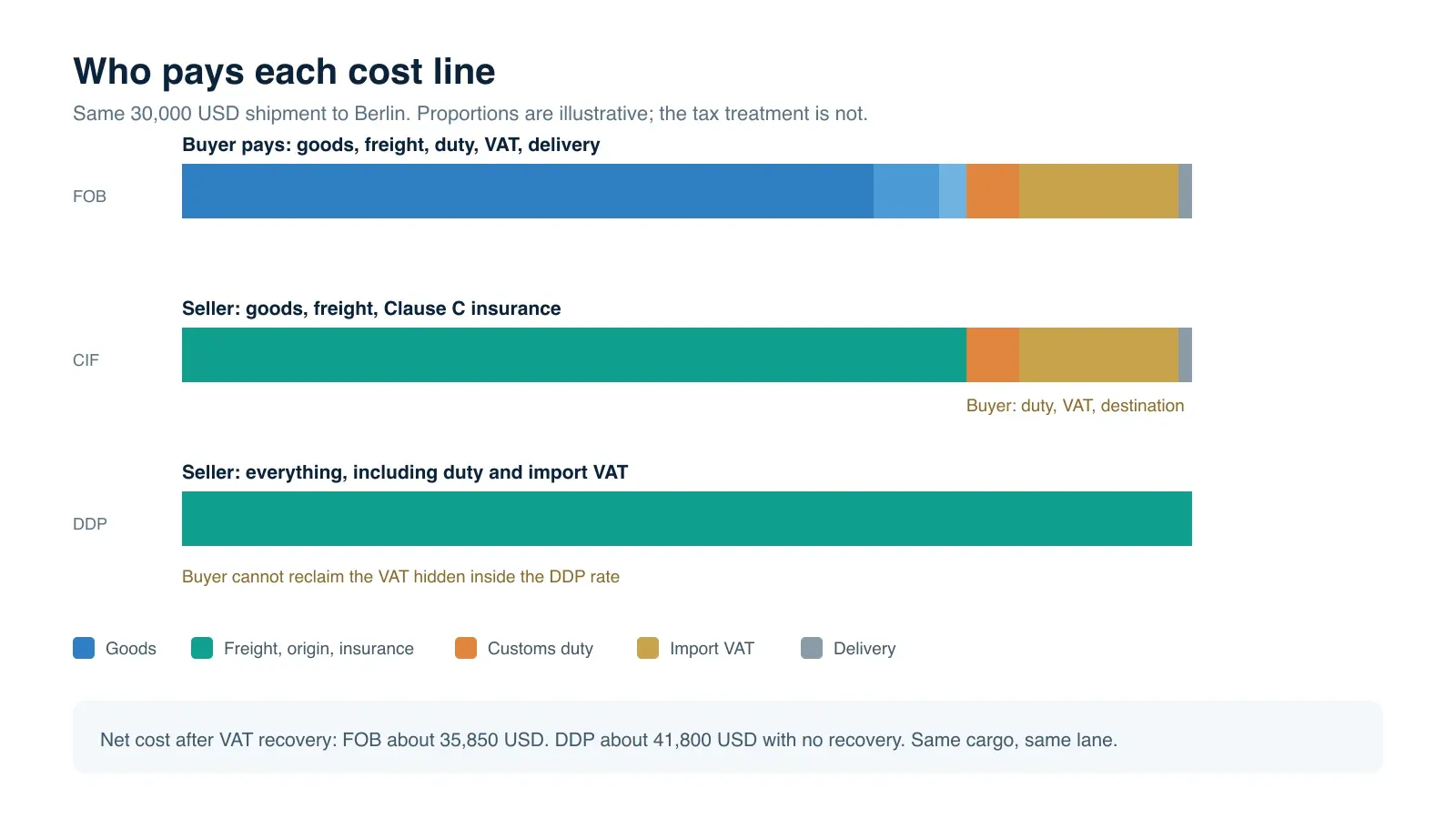
Read the last two rows together, because that is where the decision lives. The FOB shipment needs the most cash, 42,666 dollars, but 6,812 dollars of it is VAT you reclaim on your next return, so the net cost is about 35,854 dollars. The DDP quote looks cheaper at 41,800 dollars, but if the VAT inside it belongs to a forwarder’s registration, none of it comes back to you: the net cost is the full 41,800 dollars. The gap is roughly 5,950 dollars on one container, more than the freight itself. That is not an argument against DDP, but for knowing whose VAT number is on the entry.
6. Which Term Should You Choose? A Four-Question Test
Answer four questions in order and the term usually chooses itself, because the earlier answers decide whether the later options exist.
Do you have a freight rate better than your supplier’s? If you ship regularly and your forwarder holds a contract rate, FOB gives you that rate plus a clean split between product and logistics cost. If you ship twice a year, your spot rate will be worse than the factory’s, and CIF is a reasonable buy.
Can you legally be the importer of record? You need a local entity or registration, an EORI or equivalent, a duty payment facility and customs records. If not, DDP is the honest choice, and the question becomes who lends the registration.
Do you need the duty and VAT cash flow? A VAT-registered business in the EU or UK can use postponed VAT accounting or duty deferment so import VAT never leaves the bank account at the border. That advantage disappears with DDP, because the VAT is already in the price.
How much of the journey do you need to control? Reefer cargo, dangerous goods, out-of-gauge machinery, FBA appointments and delivery windows need a freight contract you control. A supplier cannot fix a missed vessel slot.
| Your situation | Recommended term | Why |
|---|---|---|
| Established importer, 10 or more containers a year | FOB plus your own forwarder | Best rate, full visibility, VAT recovered through your own registration |
| First order, no local company or EORI | DDP | Only structure that works without an importer of record |
| Amazon FBA seller with a local VAT number | FOB, or DDP with your VAT as importer of record | Amazon will not act as importer; the entry must be in your name |
| Buying under a letter of credit | CIF | Banks expect a complete document set including insurance |
| LCL under 5 CBM, samples and trial orders | DDP, or FOB if your forwarder consolidates | Destination CFS charges make small CIF shipments expensive |
| Reefer, DG or project cargo | FOB, or DDP only with a named specialist | Control of equipment, routing and free time is essential |
7. FOB, CIF, and DDP by Mode: FCL, LCL, Air, and Amazon FBA
The term has to match the mode, and two of the three rules do not apply to air at all.
For FCL, FOB is standard for importers with volume, and the decision is mostly about who holds the better contract rate. CIF is defensible when the supplier ships the lane weekly and you accept Clause C cover, but ask for the carrier and sailing date, and buy a top-up policy through cargo insurance services if the cover is thin.
For LCL, CIF is the weakest fit. Groupage cargo attracts destination CFS charges, deconsolidation fees and minimums the CIF price never shows, damage risk in a shared container is higher, and Clause C cover stays minimal. FOB at the origin CFS lets you compare per-CBM rates honestly, and DDP becomes competitive below about 5 CBM, where destination charges dominate.
For air freight, FOB and CIF are not valid rules; they apply only to sea and inland waterway transport. Air shipments use FCA at the origin airport, CIP when the seller pays carriage and insurance, or DDP for a delivered price. A quote that says “CIF Shanghai to Frankfurt” was copied from an ocean template.
For Amazon FBA, DDP dominates because Amazon will not act as importer of record. It works only if the entry is filed under your own VAT number and EORI in the marketplace country, or the VAT inside the rate is lost to you. Since the EU removed low-value duty relief in 2026, per-item duty also applies to small consignments. Our amazon fba shipping team files those entries under the seller’s own registration for this reason.
8. The 2026 Rule Changes That Break Older DDP Quotes
Three changes make any DDP price built on 2024 assumptions unreliable.
The EU removed the 150 euro duty exemption for low-value imports on 1 July 2026. Consignments up to 150 euros now attract a temporary flat duty of 3 euros per item until 1 July 2028, and a 2 euro handling fee applies from 1 November 2026. A DDP parcel rate priced when small consignments entered duty free is now under-priced, and the difference surfaces as a surcharge.
The United States suspended the 800 dollar de minimis exemption for all countries on 29 August 2025. Every commercial parcel now needs an entry, so the low-friction DDP parcel model e-commerce sellers used no longer exists at the old price.
Incoterms itself is mid-revision. The ICC is drafting Incoterms 2030, with publication planned for late 2029, and the 2020 rules remain current until then. Name the edition in every contract, for example “DDP Berlin, Incoterms 2020”, because a contract that says only “DDP” leaves the applicable rules to be argued about later.
9. How to Write the Term Into the Contract Without Leaving Gaps
A term on its own is a heading, not an agreement. The gaps that cost money are in the sentence after the three letters.
- Name the place, not just the port. “FOB Shenzhen” is ambiguous when the factory is in Dongguan; “FOB Yantian, Incoterms 2020” is not. For DDP, give the full address and state whether tail-lift or inside delivery is included.
- Itemise the charges on both ends. Under FOB, confirm who pays terminal handling, documentation, VGM and any inspection fee. Under CIF, confirm these sit inside the unit price. Terminal handling, deconsolidation, demurrage, detention, brokerage and delivery are routinely excluded from CIF and sometimes from DDP.
- Specify the insurance clause, not just “insurance”. Clause C is the CIF default and covers catastrophes only. Ask for Clause A, an insured value of 110 percent of CIF plus duty, and claims payable in your country and currency.
- For DDP, name the importer of record and the VAT number. State whether anti-dumping duty, excise and CBAM costs are included, because suppliers often exclude them silently.
- Keep payment terms and Incoterms separate. A letter of credit should quote the term it expects, usually CIF, and the documents must match it exactly or the bank will reject them.
- Use the same term on the purchase order, the invoice and the booking. A mismatch between the three is the most common cause of a customs query at destination.
Our industry insight: We audit the Incoterm on every new client’s paperwork before quoting, and roughly one file in five has a mismatch: the purchase order says FOB, the supplier’s invoice says CIF, the forwarder was told DDP, and the customs entry names a VAT number belonging to nobody in the transaction. Nothing is wrong with the goods or the price, but the file is unshippable until someone decides who the importer is. That is cheaper to settle before the container leaves Yantian than after it reaches Hamburg with a demurrage clock running.
Once the term is settled, the rest is ordinary forwarding: booking, consolidation, export declaration, carriage, clearance and delivery. We handle it end to end through sea freight, customs clearance and door to door shipping, and we recommend the term that suits your order, not the one easiest to quote.
10. FAQ: FOB, CIF, and DDP for Imports from China
Q: Which is cheaper, FOB or CIF? CIF usually costs more once destination charges are added, because freight is marked up inside the unit price and you still pay terminal handling, duty, VAT and delivery. FOB is cheaper for regular importers holding a contract rate; for a single small order, CIF can win because the supplier’s volume rate beats your spot rate.
Q: Does CIF mean the seller is responsible until the goods arrive? No. Risk passes when the goods are loaded on board at the port of shipment. The seller pays freight and insurance to the destination port but is not liable for loss or damage during the voyage. Buyers who assume otherwise discover the gap when they claim for theft under a Clause C policy.
Q: Is DDP always the easiest option for a new importer? Simplest operationally, not always cheapest or safest. If the rate is built on a forwarder’s VAT registration, the import VAT is not recoverable by you, and if the declaration is wrong the liability still follows the importer of record.
Q: Can I use FOB or CIF for air freight? No. Both apply only to sea and inland waterway transport. For air, use FCA at the origin airport, CIP when the seller pays carriage and insurance, or DDP for a delivered price. A CIF reference on an air waybill usually means the paperwork was copied from an ocean template.
Q: Who pays duty and VAT under DDP? The seller does, through whoever is named as importer of record, and recovers it in the price. A DDP quote therefore cannot be compared directly with an FOB quote: the tax is not waived, it has moved into the invoice.
Q: Does the Incoterm change how much duty I pay? In the EU and UK it can, because duty and import VAT are assessed on a CIF value that includes freight and insurance. In the United States, customs value generally excludes international freight, so FOB and CIF produce the same duty.
Choosing the term is the cheapest risk control available to an importer. If you are unsure which structure fits your next order, send us the product, the destination postcode and whether you hold a local VAT number, and we will quote all three terms through our contact page, with the importer of record named on each one.

Written by the EFANDA Logistics team — a Shenzhen-based freight forwarder established in 2018, moving cargo from China to ports worldwide with end-to-end pickup, consolidation, customs and door delivery.About us