Are you a small business owner in Tanzania looking to import goods from China but don’t have enough cargo to fill a whole container? You are not alone. For many SMEs, LCL shipping from China to Tanzania is the lifeline of their supply chain, offering a cost-effective way to move goods without the heavy price tag of Full Container Load (FCL) or the exorbitant rates of air freight.
In 2026, navigating the logistics landscape has become more complex with fluctuating sea freight rates and stricter regulations like the PVoC (Pre-Shipment Verification of Conformity). At Efanda Logistics, we have handled thousands of LCL shipments to Dar es Salaam. We know that a simple mistake in CBM calculation or missing a Certificate of Conformity (CoC) can cost you thousands of dollars in penalties.
This comprehensive guide is written by our senior freight experts to give you the most up-to-date information on LCL rates, transit times, and customs clearance procedures. Whether you are shipping electronics from Shenzhen or machinery parts from Ningbo, this guide will serve as your roadmap.
LCL Shipping from China to Tanzania: Definition & Benefits
What Is LCL Shipping?
LCL (Less than Container Load) refers to a shipping method where cargo from multiple shippers is consolidated into a single standard container. Think of it as “carpooling” for your goods. Instead of paying for an entire 20ft or 40ft container, you only pay for the space your cargo occupies.
In the logistics industry, LCL is priced based on the “W/M” (Weight or Measure) principle.
- Measure (Volume): Cubic Meters (CBM).
- Weight: 1 CBM is considered equivalent to 1,000 KG.
- Rule: You are charged based on whichever is greater.
- Example: If you ship 2 CBM of cotton (light) weighing 200 KG, you pay for 2 CBM.
- Example: If you ship 1 CBM of steel (heavy) weighing 1,500 KG, you pay for 1.5 CBM (1,500 / 1,000).
LCL vs. FCL Shipping to Tanzania
Choosing between LCL and FCL depends on your cargo volume.
- LCL is best for: Shipments between 1 CBM and 15 CBM.
- FCL is best for: Shipments over 15 CBM. At this point, the cost of LCL per CBM often exceeds the flat rate of a 20ft container.
| Feature | LCL (Less than Container Load) | FCL (Full Container Load) |
|---|---|---|
| Cost | Pay per CBM (Cost-effective for small volume) | Flat rate per container |
| Transit Time | Slower (+5-7 days for consolidation) | Faster (Direct loading/unloading) |
| Risk | Higher (Multiple handling of goods) | Lower (Sealed at factory) |
| Flexibility | High (Ship small batches frequently) | Low (Must wait to fill container) |
When Should You Choose LCL?
Based on our experience at Efanda Logistics, LCL is the ideal strategy for:
- Trial Orders: When testing a new product in the Tanzanian market and you only need 100-500 units.
- Inventory Control: For “Just-in-Time” inventory strategies where you want to avoid high warehouse services costs in Dar es Salaam.
- Capital Efficiency: It frees up cash flow by allowing you to buy smaller quantities more frequently.
LCL Shipping Cost from China to Tanzania: 2026 Rates & Fees
One of the most common questions we get is: “How much is shipping per CBM?” The answer in 2026 is nuanced.

Current LCL Rates (2026 Estimates)
As of early 2026, the approximate ocean freight rate for LCL shipping from China to Tanzania ranges from $80 to $120 per CBM.
- Note: This is the base ocean freight. Total landed cost involves origin and destination fees.
Main Cost Components Breakdown
To avoid “hidden fee” shocks, you must understand the full quote structure. At Efanda, we believe in radical transparency.
1. Origin Charges (China)
These are fees incurred before the ship leaves. If you buy FOB (Free on Board), your supplier pays these. If you buy EXW (Ex Works), you pay these.
- Pickup Fee: Trucking from factory to the consolidation warehouse ($50-$150 depending on distance).
- Export Customs Clearance: Approx. $75 per entry.
- Documentation Fee: Bill of Lading (B/L) fee.
- CFS Charges: Container Freight Station handling fees.
2. Ocean Freight
The cost to move the goods from port to port. Usually quoted as USD/RT (Revenue Ton).
3. Destination Charges (Tanzania)
These are often overlooked by first-time importers. You pay these in Dar es Salaam before collecting goods. According to the Tanzania Ports Authority (TPA), port charges are subject to periodic review.
- Deconsolidation Fee: The cost to unstuff the container at the depot.
- Port Wharfage: Charged by TPA.
- Delivery Order (D/O) Fee: Paid to the shipping line agent.
- Agency Fee: Paid to your local forwarder.
Minimum Chargeable Volume
Standard practice in the industry is a minimum charge of 1 CBM.
- If your cargo is 0.3 CBM, you will still be billed for 1 CBM.
- Pro Tip: If you have 0.8 CBM, try to add more goods to reach 1 CBM since you are paying for it anyway!
Factors That Affect LCL Rates
- Seasonality: During Peak Season (August-October and pre-Chinese New Year), rates can surge by 20-30% due to space scarcity.
- Fuel Adjustment Factor (BAF): Linked to global oil prices.
- GRI (General Rate Increase): Periodic rate hikes by shipping lines.
Transit Time: How Long is LCL Shipping from China to Tanzania?
Time is money. While LCL is cheaper, it is inherently slower than FCL.
Average Transit Time (Port-to-Port)
The sea voyage itself is relatively standard, but LCL adds processing time.
- Shanghai to Dar es Salaam: 30 – 35 days
- Shenzhen / Guangzhou to Dar es Salaam: 25 – 30 days
- Ningbo to Dar es Salaam: 30 – 35 days
- Qingdao to Dar es Salaam: 35 – 40 days
Total Lead Time (Door-to-Door)
You should plan for a total of 40 – 60 days from the factory floor in China to your door in Tanzania.
- China Inland & Consolidation: 3-7 days (Goods must wait in the warehouse until the container is full).
- Ocean Transit: 25-40 days.
- Tanzania Deconsolidation: 3-5 days (Container must be moved to a depot and unloaded).
- Customs Clearance & Delivery: 5-10 days (Depending on PVoC compliance).
Why LCL Takes Longer Than FCL
The extra time comes from the consolidation (stuffing) and deconsolidation (stripping) process. Additionally, if just one shipment in the shared container has customs issues (e.g., undeclared dangerous goods), the entire container is held up. This is a risk inherent to LCL.
Top Ports: Shipping from China to Dar es Salaam via LCL
China Departure Ports
- Shanghai: The world’s busiest port. Best for general merchandise and textiles from the Yangtze River Delta.
- Shenzhen (Yantian/Shekou): The tech hub. Best for electronics, gadgets, and high-tech components.
- Ningbo: Excellent for heavy machinery, hardware, and plastics.
- Guangzhou (Nansha): The gateway for building materials, furniture, and garments.
Tanzania Arrival Ports
- Dar es Salaam (TZDAR): This is the primary entry point, handling over 95% of Tanzania’s international trade. It also serves as a transit hub for landlocked countries like Zambia, Malawi, and Uganda. For official port statistics and updates, you can check the Tanzania Ports Authority website.
- Tanga & Zanzibar: While these ports exist, LCL services are infrequent and usually involve transshipment via Dar es Salaam or Mombasa (shipping from China to Kenya), adding cost and time. We highly recommend shipping to Dar es Salaam for LCL.
Step-by-Step Process: LCL Shipping from China to Tanzania
To ensure a smooth experience, follow this workflow that we use at Efanda Logistics:
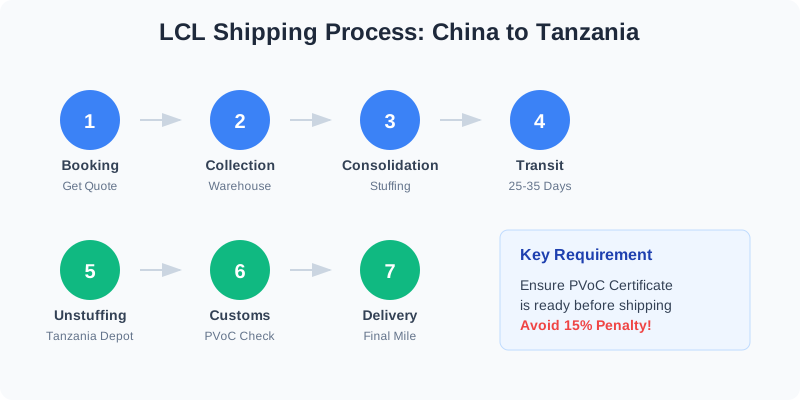
- Booking & Quote: Provide cargo dimensions (Length, Width, Height, Weight) to your forwarder to get an accurate quote.
- Cargo Collection: Supplier sends goods to the designated CFS (Container Freight Station) warehouse in China.
- Measurement & Confirmation: The warehouse remeasures the cargo. This “Warehouse Receipt” weight is final for billing.
- Export Clearance: Your forwarder handles Chinese customs clearance.
- Consolidation: Goods are loaded into a container with other shipments headed to Dar es Salaam.
- Ocean Transit: The vessel sails. You receive the Bill of Lading (B/L).
- Deconsolidation: Upon arrival, the container is moved to a depot and opened.
- Import Clearance: You (or your agent) submit documents to TRA (Tanzania Revenue Authority).
- Duty Payment & Release: Pay duties and taxes. Goods are released.
- Final Delivery: Trucking to your warehouse or shop (part of our door to door shipping service).
Efanda Case Study:
We recently helped a client in Kariakoo import 3 CBM of solar lights from Guangzhou. By consolidating their shipment with another client’s electronics order, we reduced their destination deconsolidation fees by 20%. This shows the power of choosing a forwarder with high LCL volume to Tanzania.
Tanzania Customs Clearance: PVoC, Duties & Documents
This is the most critical section. Non-compliance here leads to the “15% Penalty.”
Mandatory PVoC (Pre-Shipment Verification of Conformity)
According to the Tanzania Bureau of Standards (TBS), most regulated goods must have a Certificate of Conformity (CoC) issued before shipment.
- Regulated Goods: Electronics, automotive parts, chemicals, building materials, toys, etc.
- Process: You must hire an authorized agent (like SGS, Intertek, Bureau Veritas, or CCIC) to inspect goods in China.
- The Penalty: If goods arrive without a CoC, you will be fined 15% of the CIF value and subjected to destination inspection and testing, which causes massive delays. Refer to the TBS PVoC Guidelines for the latest list of regulated products.
Import Duties & Taxes (TRA)
Tanzania is part of the East African Community (EAC) Customs Union.
- Import Duty:
- 0% for Raw Materials & Capital Goods.
- 10% for Semi-finished goods.
- 25% for Finished consumer goods.
- VAT (Value Added Tax): 18% (Calculated on CIF value + Import Duty).
- Railway Development Levy (RDL): 1.5% of CIF value.
- Customs Processing Fee: 0.6% of FOB value.
- Note: You can calculate your estimated taxes using the TRA Tax Calculator.
Required Documents Checklist
Ensure you have these originals or telex releases:
- Bill of Lading (B/L)
- Commercial Invoice (Must precisely match the cargo)
- Packing List
- Certificate of Conformity (CoC)
- Certificate of Origin (Optional, but good for record)
- TIN Number (Taxpayer Identification Number of the importer)
LCL vs. Air Freight to Tanzania: Cost & Time Comparison
Sometimes, LCL isn’t the best choice. Here is a quick comparison to help you decide.
| Factor | LCL Shipping | Air Freight |
|---|---|---|
| Cost | Low ($80-$120 per CBM) | High ($4.50 – $8.00 per KG) |
| Transit Time | 30 – 45 Days | 5 – 7 Days |
| Capacity | Suitable for heavy/bulky items | Strict weight/volume limits |
| Best For | Planned stock, furniture, machinery | Urgent samples, high-value electronics, spare parts |
Decision Rule: If your shipment is under 100KG, Air Freight might be cheaper or competitively priced compared to the minimum LCL charges. If over 150KG, LCL is almost always cheaper.
Cheapest Shipping: How to Reduce LCL Costs to Tanzania
We want you to save money. Here are expert tips from Efanda Logistics:
- Optimize Packaging: LCL is charged by volume. Compressing your packaging (e.g., vacuum sealing textiles, nesting furniture) reduces CBM and directly lowers your cost.
- Consolidate Suppliers: If you buy from 3 different factories, don’t ship 3 separate LCL shipments. Ask us to collect them all into one shipment. You save on destination clearance fees (paying once instead of three times).
- Ship Off-Peak: If possible, avoid shipping in September/October (Pre-Christmas rush) or January (Pre-CNY). Rates are lower in March-June.
- Buy FOB, Not CIF: When you buy CIF, the supplier controls the shipping and often uses a “cheap” agent who overcharges you at the destination (hidden CISF fees). Buying FOB gives you control over the agent and the costs.
FAQs: LCL Shipping from China to Tanzania
Q1: How much does LCL shipping from China to Tanzania cost per CBM?
A: In 2026, rates typically range from $80 to $120 per CBM for ocean freight. However, always factor in local port charges in Dar es Salaam.
Q2: Do I need a Certificate of Conformity (CoC) for LCL shipments?
A: Yes. If your goods are on the TBS regulated list, a CoC is mandatory regardless of shipment size. Missing it incurs a 15% penalty.
Q3: What is the minimum volume for LCL?
A: The industry standard minimum is 1 CBM. Even if you ship 0.1 CBM, you will be charged for 1 CBM.
Q4: Can I ship personal effects via LCL to Tanzania?
A: Yes, but customs clearance for personal effects requires different documentation (e.g., passport, residence permit) and may be subject to different tax rules.
Q5: Does the shipping cost include customs duties?
A: No. Standard LCL quotes are for transport only. Duties and VAT are paid by the importer to the Tanzania Revenue Authority (TRA) upon arrival.
Q6: What is the transit time from Shenzhen to Dar es Salaam?
A: Typically 25 to 30 days port-to-port, plus consolidation and clearance time.
Q7: Is insurance recommended for LCL?
A: Highly recommended. Since LCL involves more handling (stuffing/stripping), the risk of minor damage is statistically higher than FCL. We always advise getting cargo insurance services.