Can you still Import EV from China to USA in 2026? With Chinese manufacturers like BYD, Nio, and Zeekr producing high-tech electric vehicles at unbeatable prices (often 30-40% lower than Western counterparts), this is the most common question we receive at Efanda Logistics. The short answer is: Yes, but it is incredibly difficult and expensive for most. The Section 301 Tariffs EV update has imposed a 100% duty, and strict NHTSA FMVSS compliance China standards make it nearly impossible for individual consumers. However, for commercial importers, research institutions, and exhibition organizers, there are specific legal pathways.
In this guide, our team at Efanda Logistics breaks down the exact steps, costs, and regulatory hurdles for Shipping Electric Cars from China to the USA. We act as your neutral logistics partner—we want you to know the risks before you book a container. (For general cargo, see our guide on Shipping From China to USA).
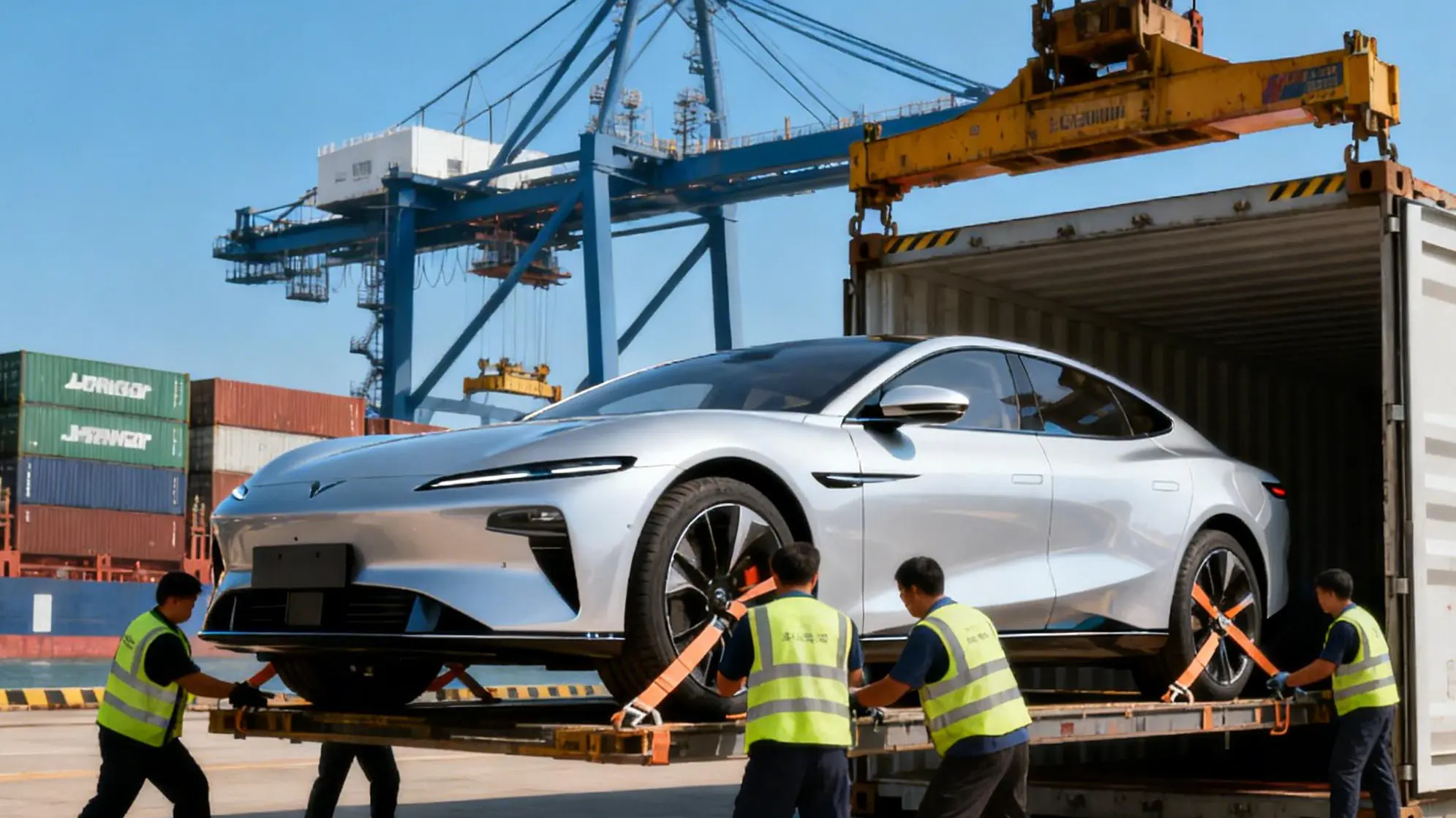
Why Import EV from China to USA? The Allure vs. The Reality
The allure is undeniable. A BYD Seagull costs under $12,000 in China. Even with shipping, it seems like a steal compared to US market prices where the average EV transaction price hovers above $50,000. We see inquiries daily from dealers wanting to import the Zeekr 001 or Nio ET5. However, as veteran freight forwarders with over a decade of experience in the Trans-Pacific trade lane, we must address the “elephant in the room.”
The Warning: 102.5% Tariff & Safety Compliance
Before you sign a purchase order, you must understand two critical barriers that define the 2026 landscape:
- Financial Barrier: The US government has finalized a 100% tariff on Chinese EVs under Section 301. When combined with the standard 2.5% duty, you are paying 102.5% in taxes on top of the car’s value. This policy, reinforced by the Office of the United States Trade Representative (USTR), aims to protect the US auto industry from “unfair trade practices.”
- Regulatory Barrier: Most Chinese Domestic Market (CDM) vehicles do not meet US Federal Motor Vehicle Safety Standards (FMVSS). They cannot be legally registered for road use in the US without massive, often cost-prohibitive modifications. The National Highway Traffic Safety Administration (NHTSA) is extremely strict on this.
Efanda’s Stance: We recommend this process only for:
- Commercial Research/Testing: Manufacturers or tech companies testing battery tech or autonomous driving.
- Show & Display: Rare vehicles for museums or exhibitions.
- Re-export: Transit cargo moving through US ports to Latin America or Canada.
- Off-Road Use: Specific Low Speed Vehicles (LSVs) or closed-campus vehicles.
If you are an individual hoping to drive a Nio ET5 in California, we strongly advise against it. For everyone else, here is how the process works.
NHTSA FMVSS Compliance for China EVs: The Regulatory Barrier
The National Highway Traffic Safety Administration (NHTSA) enforces strict safety standards. This is where 90% of import attempts fail.
Understanding FMVSS Differences
China has its own safety standards (CCC), which are similar to European standards but differ significantly from US FMVSS. Key differences often include:
- Airbag Deployment Timing: US standards require airbags to protect unbelted passengers; China/EU assumes belted passengers.
- Bumper Height & Strength: US bumper standards are unique (FMVSS 215).
- Lighting: Headlight brightness and amber reflector requirements differ (FMVSS 108).
- Software & Data: New commerce rules may restrict “connected vehicles” with Chinese software due to national security concerns.
The Role of Registered Importers (RI)
To legally import a non-conforming vehicle for road use, you must hire a Registered Importer (RI). The RI is responsible for modifying the vehicle to meet US standards before it is released to you.
- The Problem: Modifying a modern EV is nearly impossible. You cannot simply “swap a bumper.” It involves complex software reprogramming, airbag sensor replacement, and crash testing validation.
- The Cost: RI services can cost $15,000 to $50,000+ per vehicle, with no guarantee of success.
EPA (Environment) Rules
Even though EVs have no exhaust, they are still regulated by the Environmental Protection Agency (EPA). You must file EPA Form 3520-1.
- Code Z: Designates the vehicle as a “Zero Emission Vehicle.”
- Consequences: Without this form, Customs and Border Protection (CBP) will seize the vehicle.
Section 301 Tariffs on EVs: The Cost Barrier (2026 Updated)
In May 2024, the USTR (Office of the United States Trade Representative) announced final modifications to Section 301 tariffs. As of 2026, these are fully in effect.
The Cost Breakdown

When you Import EV from China to USA, you pay duties on the value of the car (Commercial Invoice Value).
| Fee Type | Rate | Notes |
|---|---|---|
| Standard Duty | 2.5% | Standard rate for passenger cars. |
| Section 301 Tariff | 100% | The “China EV Tariff” (increased from 25%). |
| Merchandise Processing Fee (MPF) | 0.3464% | Min $31.67 / Max $614.35 per entry. |
| Harbor Maintenance Fee (HMF) | 0.125% | Applies if arriving via ocean freight at US ports. |
| Total Effective Tax | ~103% | Plus shipping and broker fees. |
Calculation Example: Importing a $20,000 BYD
Let’s calculate the landed cost of a $20,000 electric car.
- Vehicle Cost: $20,000
- Standard Duty (2.5%): $500
- Section 301 Duty (100%): $20,000
- MPF & HMF: ~$100
- Ocean Shipping (Est.): $2,500
- Customs Broker & Bond: $500
- Total Landed Cost: $43,600
Insight: The tariff effectively doubles the price of the car, erasing the price advantage of Chinese EVs. This makes “grey market” importing commercially unviable for resale in the US market. For detailed tariff lists, refer to the Federal Register.
Exceptions: Who Can Actually Import EV from China to USA?
Despite the barriers, our team at Efanda Logistics handles EV shipments regularly. Who are these clients?
1. Research & Testing (Box 7 Import)
Automakers and tech companies can import non-conforming vehicles for testing, research, or demonstration purposes.
- Limit: Usually limited to a specific time period (e.g., 3-5 years).
- Restriction: These cars cannot be sold or driven on public roads (except for specific testing routes). They must be exported or destroyed after the period ends.
2. Show or Display
This is for vehicles of “historical or technological significance.”
- Requirement: Production must be limited (usually <500 units worldwide).
- Approval: You must apply to NHTSA before shipping. Most mass-market EVs (like BYD or Tesla China) do not qualify.
3. Re-export (T&E Bond)
We often ship Chinese EVs into US ports (like Los Angeles or Miami) under a Transportation and Exportation (T&E) Bond.
- Process: The cargo enters the US but does not “clear” customs. It moves to a bonded warehouse or directly to another vessel for transport to Mexico, Canada, or Latin America. This is a common route for shipping from china to mexico and shipping from China to Canada via US ports.
- Benefit: Avoids US tariffs entirely.
Step-by-Step Guide: Shipping Electric Cars from China to USA

If you qualify for an exception or are willing to pay the tariffs, here is the operational blueprint for Shipping Electric Cars from China.
Step 1: Sourcing & Incoterms
We recommend buying on EXW (Ex Works) or FOB (Free on Board) terms.
- Why? This gives you control over the logistics. If you buy CIF (Cost, Insurance, Freight), the Chinese supplier chooses the cheapest shipping line, often resulting in hidden fees at the US port.
Step 2: Dangerous Goods (DG) Compliance
Electric vehicles are classified as Dangerous Goods due to their Lithium-Ion batteries.
- UN Number: UN 3171 (Battery-powered vehicle).
- Class: Class 9 Miscellaneous Dangerous Goods.
- State of Charge (SoC): Most shipping lines (e.g., COSCO, Maersk, MSC) require the battery SoC to be between 20% and 30%. If it’s too high, the port will reject it.
- Documentation: You need a valid UN38.3 test report and MSDS.
Step 3: ISF 10+2 Filing (Critical)
Importer Security Filing (ISF) must be filed with US Customs 24 hours before the ship leaves China.
- Data Needed: Seller, Buyer, Ship to Party, HTS Code (usually 8703.80 for EVs).
- Penalty: Failing to file ISF results in a $5,000 fine and hold on your cargo. Read more on the CBP Import Guide.
Step 4: Sea Freight Options
- Ro-Ro (Roll-on/Roll-off): The car is driven onto the ship.
- Pros: Cheaper for single units, less handling damage.
- Cons: Slower schedule, strict “run and drive” requirement. Not available at all Chinese ports for DG cargo.
- Container (FCL): The car is strapped inside a 20ft or 40ft container.
- Pros: Safer for high-value prototypes; allows you to ship spare parts or chargers in the same box.
- Cons: Requires professional blocking and bracing (Efanda specializes in this). If the car moves during transit, it can damage the battery, leading to thermal runaway risks.
Step 5: US Customs Clearance
Upon arrival, your customs broker will submit:
- CBP Form 7501 (Entry Summary).
- EPA Form 3520-1 (Emissions).
- DOT Form HS-7 (Safety Declaration – checking the box for your specific exception).
- Commercial Invoice & Packing List.
Logistics Tips for Importers: Expert Advice
West Coast vs. East Coast
- West Coast (Los Angeles / Long Beach):
- Transit Time: 14-18 days.
- Best For: Speed and importers located in Western/Central US. Be aware of potential congestion during peak seasons.
- East Coast (New York / Savannah):
- Transit Time: 28-35 days via Panama Canal.
- Best For: Importers in the Midwest or East Coast to save on trucking costs.
Battery Safety Documentation
Your supplier must provide a valid UN38.3 Test Report and MSDS (Material Safety Data Sheet) for the battery. Without these, no shipping line will accept the booking. We recently had a client whose shipment was delayed 3 weeks because the supplier provided an expired MSDS. Don’t let this happen to you.
FAQ: Common Questions about Importing EVs
Q: Can I Import EV from China to USA for personal use?
A: Generally, no. Unless the vehicle is 25 years old (which modern EVs are not), it must meet FMVSS standards. The cost to modify a Chinese EV to meet these standards usually exceeds the value of the car.
Q: Does the 25-Year Rule apply to Shipping Electric Cars from China?
A: Yes, the 25-year exemption applies to all vehicles. However, since the modern EV boom in China is recent, there are virtually no eligible electric vehicles yet.
Q: Can I disassemble the car and ship it as auto parts?
A: Do not do this. US Customs considers this “structuring” or smuggling. If the parts can be assembled into a car, it is treated as a car. If caught, you face heavy fines, seizure, and potential criminal charges.
Q: What is the HTS Code for Electric Vehicles?
A: The Harmonized Tariff Schedule code for electric vehicles solely powered by an electric motor is typically 8703.80.0000. You can verify this in the Harmonized Tariff Schedule.
Conclusion & Call to Action
Importing an electric vehicle from China to the USA in 2026 is a “professional’s game.” The combination of Section 301 Tariffs EV (100% duty) and strict NHTSA FMVSS compliance China rules makes it viable only for manufacturers, researchers, and specialized exhibitions.
If you fall into these commercial categories, you need a logistics partner who understands Dangerous Goods handling and complex customs bonds. Efanda Logistics has the experience to handle your EV shipments safely and legally, offering door to door shipping solutions for qualified commercial projects.
Need a quote for Commercial or Research EV Shipping?
Contact Efanda Logistics today for a consultation on your specific project needs. We handle the complexity so you can focus on the innovation.