Are you struggling with unpredictable rates and customs delays when arranging Air Freight Shipping from China to Libya? In our daily operations routing cargo to North Africa, we consistently see importers lose thousands of dollars due to misunderstood volumetric weight calculations and non-compliance with Libya’s Advance Cargo Information (ACI) requirements. This guide provides our firsthand 2026 rates for air freight shipping from China to Libya, realistic transit times to major Libyan airports (MJI, BEN, MRA), a step-by-step customs compliance checklist, and actionable strategies to reduce your total landed cost.
Key Takeaways
- Average Cost: $4.50 to $8.50 per kilogram, varying by weight bracket, service level, and season.
- Transit Time: 3 to 8 days airport-to-airport from major Chinese hubs, depending on routing and destination airport.
- Key Chinese Departure Airports: Guangzhou (CAN), Shenzhen (SZX), Shanghai (PVG), and Hong Kong (HKG).
- Key Libyan Airports: Mitiga International Airport (MJI) in Tripoli and Benina International Airport (BEN) in Benghazi.
- Critical Requirement: Advance Cargo Information (ACI) pre-registration is mandatory before export — cargo without an ACI reference number will not be loaded in China.
How Much Does Air Freight Shipping from China to Libya Cost?
In 2026, air freight shipping from China to Libya costs between $4.50 and $8.50 per kilogram, depending on your chargeable weight bracket, choice between express and economic services, and current fuel surcharge levels. Unlike sea freight where per-unit costs drop sharply with volume, air freight rates follow weight-bracket tiered pricing — heavier shipments unlock lower per-kilo rates.
Standard vs. Express Air Freight Rates
Economic air cargo to Libya (5-8 days) averages $4.50 to $6.00 per kg, while express air freight (3-5 days) ranges from $6.50 to $8.50 per kg. Economic services typically consolidate cargo to fill airline capacity, adding 1-3 days for consolidation at the hub. Express services prioritize your cargo on the next available flight.
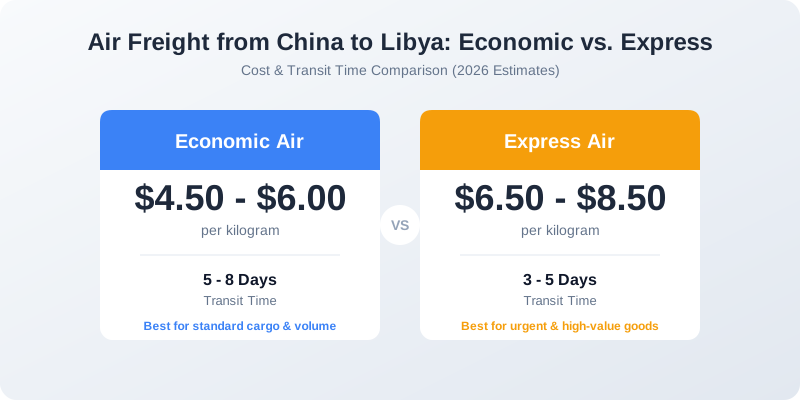
| Service Type | Estimated Transit Time | Cost per KG (USD) | Best For |
|---|---|---|---|
| Economic Air Freight | 5 – 8 Days | $4.50 – $6.00 | Standard commercial goods, larger volumes above 300 kg |
| Express Air Freight | 3 – 5 Days | $6.50 – $8.50 | Urgent medical supplies, high-tech components, time-critical spare parts |
How Weight Brackets Affect Your Rate
Airlines price air cargo in tiered weight brackets — the more you ship, the lower your per-kilogram rate. Below are the typical brackets for China-to-Libya routes in 2026:
| Chargeable Weight Bracket | Economic Rate (USD/kg) | Express Rate (USD/kg) |
|---|---|---|
| +45 kg (Minimum) | $5.50 – $6.00 | $7.50 – $8.50 |
| +100 kg | $5.00 – $5.80 | $7.00 – $8.00 |
| +300 kg | $4.80 – $5.50 | $6.50 – $7.50 |
| +500 kg | $4.50 – $5.20 | $6.50 – $7.00 |
| +1,000 kg | $4.50 – $5.00 | $6.50 – $7.00 |
Rates are indicative as of mid-2026 and subject to fuel surcharge fluctuations. Always request a current quotation before booking.
Understanding Chargeable Weight for Air Cargo

Airlines charge based on whichever is greater: the actual gross weight or the volumetric weight. Per IATA standards, the volumetric divisor is 6000 (calculated as Length × Width × Height in cm ÷ 6000). Here is a real example from a recent shipment we handled:
A client shipped 150 kg of LED lighting panels to Tripoli. The actual weight was 150 kg, but the cartons measured 120 × 80 × 100 cm (0.96 m³ total). Volumetric weight = (120 × 80 × 100) ÷ 6000 = 160 kg. The airline charged for 160 kg — a 10 kg “penalty” for bulky packaging. After we redesigned the packing layout, reducing the volume to 0.84 m³, the chargeable weight dropped to 140 kg, saving the client approximately $90 on that single shipment.
We highly recommend optimizing your packaging to reduce dead air space — this is one of the fastest ways to lower your air freight bill, especially for lightweight, bulky goods like textiles, furniture components, and plastic products.
5 Factors That Influence Your Air Freight Rate
- Fuel Surcharge: Airlines adjust this monthly based on jet fuel indices. In 2026, the fuel surcharge on China-Libya routes typically adds $0.30 to $0.80 per kg to the base rate.
- Peak Season Demand: Rates spike 15-25% during Q4 (October-December) and ahead of Chinese New Year (January-February). Book 2-3 weeks in advance during these periods.
- Routing and Transit Hubs: Direct consolidation routes (e.g., CAN→IST→MJI) are cheaper than multi-stop routings. Every additional handling point increases terminal fees.
- Cargo Nature: Dangerous goods (DG) shipments classified under IATA DGR incur a DG surcharge of $50-$150 per shipment. Temperature-controlled cargo adds reefer container fees.
- Currency Fluctuations: Most air freight from China is quoted in USD or RMB. Libyan Dinar volatility can impact the total landed cost on the consignee side.
Transit Times for Air Freight Shipping from China to Libya
Air freight shipping from China to Libya typically takes 3 to 8 days from major Chinese hubs to Libya’s primary airports, with the exact time depending on the departure airport, transit hub routing, and destination customs clearance efficiency.

Choosing the Right Chinese Departure Airport
Your choice of departure airport directly impacts both transit time and cost. Here is a comparison of the key cargo hubs for the China-Libya corridor:
| Airport | IATA Code | 2025 Cargo Volume | Best For | Typical Transit to Libya |
|---|---|---|---|---|
| Guangzhou Baiyun | CAN | 2.0M tons | Southern China manufacturing (electronics, apparel) | 5-8 days |
| Shenzhen Bao’an | SZX | 1.7M tons | High-tech goods, e-commerce shipments | 5-8 days |
| Shanghai Pudong | PVG | 3.7M tons | Industrial equipment, automotive parts | 4-7 days |
| Hong Kong | HKG | 4.2M tons | High-value electronics, DG cargo, time-critical | 4-7 days |
| Beijing Capital | PEK | 2.0M tons | Northern China industrial goods | 6-9 days |
For most shippers in southern China’s manufacturing hubs (Guangdong province), Guangzhou (CAN) and Shenzhen (SZX) offer the best balance of proximity and flight frequency. Shanghai (PVG) and Hong Kong (HKG) provide the most direct connections to Middle Eastern transit hubs, shaving 1-2 days off total transit time at a slightly higher cost.
Common Transit Hubs and Airlines
There are no direct scheduled cargo flights from China to Libya. All air freight must transit through a major Middle Eastern or European hub. Below are the routes we use most frequently:
| Origin (China) | Transit Hub | Destination (Libya) | Typical Carriers | Transit Time |
|---|---|---|---|---|
| PVG / HKG | Doha (DOH) | Tripoli (MJI) | Qatar Airways Cargo | 4-7 days |
| CAN / SZX | Istanbul (IST) | Benghazi (BEN) | Turkish Cargo | 5-8 days |
| PVG / CAN | Dubai (DXB) | Misrata (MRA) | Emirates SkyCargo | 5-8 days |
| PEK / PVG | Cairo (CAI) | Tripoli (MJI) | EgyptAir Cargo | 6-9 days |
Turkish Cargo and Qatar Airways Cargo offer the most consistent schedules on these routes, with 2-4 weekly departures to Libyan airports. Emirates SkyCargo provides reliable service to Misrata, though frequency is lower.
Mitiga International Airport (MJI – Tripoli)
Serving western Libya, Mitiga (MJI) is the primary gateway for air freight to Tripoli, handling over 70% of the country’s commercial air cargo imports. It offers the most frequent connections from Middle Eastern hubs and the fastest customs processing times of 3-5 days door-to-airport. It handles the majority of consumer goods, electronics, pharmaceuticals, and industrial equipment heading to the capital region and surrounding areas.
Benina (BEN) and Misrata (MRA) Airports
Benina (BEN) serves the eastern region including Benghazi, while Misrata (MRA) handles central Libya. Shipments to these airports generally take 5-8 days due to routing via regional transit hubs. Choosing the correct discharge airport based on your consignee’s location is critical: selecting Benina for a Tripoli-bound shipment adds 3-5 days and approximately $200-$400 in inland trucking costs across 1,000+ km of Libyan roads.
Air Freight vs. Sea Freight: China to Libya Comparison
Many importers ask whether air freight is worth the premium over sea freight. The answer depends entirely on your cargo type, urgency, and total cost sensitivity. Below is a side-by-side comparison:
| Factor | Air Freight | Sea Freight |
|---|---|---|
| Transit Time | 3-8 days | 25-40 days |
| Cost per KG | $4.50 – $8.50 | $0.80 – $1.50 |
| Minimum Shipment | 45 kg | 1 CBM (LCL) or 20ft container (FCL) |
| Best For | High-value, time-sensitive, perishable | Bulk, heavy, low-urgency goods |
| Risk of Damage | Low (minimal handling) | Moderate (multiple handling points) |
| Customs Complexity | Moderate (ACI mandatory) | Moderate (ACI mandatory, plus port storage fees) |
When air freight makes financial sense despite the higher cost: A shipment of 200 kg of smartphone accessories worth $40,000 costs roughly $1,100-$1,500 by air. The same shipment by sea costs $300-$500 but ties up capital for 30-40 days. For many importers, the carrying cost of inventory and the speed-to-market advantage of air freight more than offset the premium — especially during product launches or when restocking best-selling items.
For heavy industrial goods or bulk commodities, sea freight remains the cost-optimal choice.
Customs Clearance for Air Freight Shipping from China to Libya
Clearing air freight shipping from China to Libya requires mandatory pre-registration via the Advance Cargo Information (ACI) system, strict documentation compliance, and LSMO conformity certification — all before the cargo leaves China.

Step 1: Advance Cargo Information (ACI) Registration
Since mandatory enforcement began in late 2024, every shipment must be pre-registered on the official Libyan Customs ACI Portal to obtain an ACI reference number before export. In our experience, failing to secure and list this exact ACI number on your Air Waybill (AWB) will result in the airline refusing to load your cargo in China, or forced re-export at your expense upon arrival. The ACI registration must include accurate HS codes, CIF values, and consignee details — discrepancies between the ACI filing and physical documents are the single most common cause of clearance delays we see in Libya.
Step 2: Mandatory Import Documentation
The following documents are required for every air shipment to Libya:
- Commercial Invoice: Must state accurate values, currency, Incoterms, and HS codes for each line item.
- Packing List: Dimensions, gross/net weight, and quantity per package — must exactly match the invoice.
- Air Waybill (AWB): The consignee name must match the importer of record registered with Libyan Customs.
- Certificate of Origin (COO): Required to determine applicable duty rates. Must be certified by the local chamber of commerce.
- Import License: Required for commercial importers, issued by the Libyan Ministry of Economy and Trade.
All documents should be provided in Arabic or accompanied by certified Arabic translations. Even minor discrepancies — a typo in the consignee name, a mismatched weight, or an incorrect HS code — can trigger a 3-7 day hold for manual inspection.
Step 3: LSMO Conformity and Duty Payment
Consumer goods and electronics require certification from the Libyan Standards and Metrology Organization (LSMO). All customs duties and taxes are calculated on the CIF value (Cost + Insurance + Freight) and must be paid in full before cargo release. Libya applies a flat customs duty rate, but specific product categories — notably electronics, vehicles, and luxury goods — may attract additional levies. We strongly recommend confirming the exact HS code classification and associated duty rate with your freight forwarder before shipping.
Common Customs Pitfalls and How to Avoid Them
- Missing or incorrect ACI number on AWB: Always verify the ACI reference appears on the AWB and matches the portal registration exactly.
- HS code mismatches: Libyan customs uses the Harmonized System but may apply local sub-classifications. A product classified under one HS code in China may fall under a different code in Libya.
- Undervaluation on commercial invoice: Libyan customs cross-references declared values against market rates. Undervaluation leads to fines, confiscation, or mandatory revaluation — all of which add delays.
- Wrong consignee information: The importer of record must hold a valid Libyan import license. Using an unlicensed consignee will result in cargo rejection.
What Are the Best Goods to Ship by Air to Libya?
Air freight shipping from China to Libya is most cost-effective for high-value, time-sensitive, or perishable goods where the speed premium is justified. Conversely, certain items face strict import restrictions and should be carefully vetted before booking.
Electronics and High-Tech Components
Electronics dominate China-Libya air freight due to high market demand, favorable value-to-weight ratios, and the risk of theft or damage during long sea transits. Typical shipments include smartphones, laptops, LED displays, PCB boards, networking equipment, and consumer electronics accessories. However, note two critical compliance points:
- Lithium batteries (UN 3480/UN 3481): Require IATA Dangerous Goods declaration, UN 38.3 test summary, and compliant packaging. Not all airlines accept standalone lithium batteries on Libya-bound routes.
- Telecommunications equipment: Libya enforces stricter import controls on GPS-enabled devices, satellite communication gear, and radio frequency equipment as of 2026. Confirm admissibility with your forwarder before purchasing inventory.
Medical Supplies and Pharmaceuticals
Libya’s healthcare sector relies heavily on imported pharmaceuticals and medical devices from China. Temperature-sensitive products — vaccines, insulin, diagnostic reagents — require cold chain logistics with active temperature monitoring throughout the transit. Key documentation includes Certificate of Analysis (CoA), Good Manufacturing Practice (GMP) certification, and registration with Libya’s National Center for Drug and Food Control (NCDSS). Plan for an additional 5-10 business days for health authority clearance beyond standard customs processing.
Automotive Parts and Industrial Equipment
Just-in-time automotive parts, machinery spares, and urgent industrial components account for a growing share of China-Libya air freight. A single day of production downtime can cost far more than the air freight premium, making express air service the logical choice. For heavier components (50-200 kg per piece), we recommend verifying that the item fits within standard aircraft unit load device (ULD) dimensions before booking, as oversize cargo may require main-deck freighter aircraft at a significant cost premium.
Restricted and Prohibited Items for Libya
Before shipping, confirm your goods are not on Libya’s restricted or prohibited import list. Common restricted categories include:
- Firearms, ammunition, and military equipment (prohibited)
- Narcotics and psychotropic substances (prohibited)
- Certain telecommunications and surveillance equipment (restricted, requires special license)
- Used tires and certain recycled materials (restricted)
- Products originating from Israel (prohibited under Libyan trade regulations)
- Pork products and alcohol (restricted, subject to cultural/religious import bans)
When in doubt, share the full product specification with your freight forwarder for a compliance check before committing to inventory.
6 Practical Tips to Reduce Your Air Freight Costs
- Consolidate shipments to reach higher weight brackets. Combining multiple smaller orders into one shipment of 300 kg or more can reduce your per-kilo rate by 10-20%.
- Optimize packaging to minimize volumetric weight. Use cartons sized to the product (not one-size-fits-all), eliminate unnecessary inner packaging, and avoid palletizing light cargo. As shown in our LED panel example above, packaging optimization alone can cut chargeable weight by 10-15%.
- Book during off-peak periods. Rates are lowest from March to June and September to early November. Avoid Q4 and the pre-Chinese New Year rush when capacity tightens and rates surge.
- Choose the right Incoterms. For first-time importers, DDP (Delivered Duty Paid) eliminates surprise fees at the Libyan airport. Under CIF, you bear the risk of destination charges you cannot predict.
- Pre-clear documentation before cargo departs. Submit all documents to your forwarder for review 48 hours before the cargo reaches the airport. Catching an HS code error at this stage costs nothing; catching it during Libyan customs inspection costs days of demurrage.
- Insure your cargo at 110% of CIF value. Air freight has a lower loss rate than sea freight, but Libya’s current operating environment means occasional physical inspections can result in handling damage. All-risk cargo insurance is a small fraction of the shipment value.
Why Choose Efanda Logistics for Air Freight Shipping from China to Libya?
Efanda Logistics offers direct consolidations from Guangzhou and Shenzhen to Tripoli, handling every aspect of air freight shipping from China to Libya — from ACI registration to final delivery.
Nationwide China Consolidation Services
We collect goods from multiple suppliers across China — whether from Yiwu, Guangdong, Zhejiang, or Fujian — consolidating them through our warehouse services to optimize chargeable weight and reduce your total air freight bill. Our consolidation center in Shenzhen provides free storage for up to 14 days, allowing you to batch shipments into higher weight brackets without paying premium minimum-charge rates on each individual order.
DDP and Door-to-Door Solutions to Libya
We provide full door to door shipping under DDP terms, managing Chinese export clearance, airline booking, Libyan customs clearance (including ACI registration, duty payment, and LSMO compliance), and final trucking delivery to your Libyan address. This eliminates the need for you to coordinate with a separate Libyan customs broker or manage duty payments remotely.
ACI Documentation and Compliance Expertise
With hundreds of China-to-Libya shipments processed, our documentation team handles ACI pre-registration, HS code classification, and Arabic document translation as standard — not as an add-on. We verify every set of shipping documents before cargo departs China, catching discrepancies that would otherwise cause costly delays at Mitiga or Benina airports.
Contact Efanda Logistics today for a tailored air freight quotation from China to Libya.
Frequently Asked Questions (FAQ)
How long does air freight shipping from China to Libya take?
It generally takes 3 to 8 days airport-to-airport, depending on the Chinese departure airport, transit hub routing, and the final destination in Libya. The fastest corridor (PVG→DOH→MJI) averages 4-5 days.
What is the cost per kg for air freight to Tripoli?
The average cost ranges from $4.50 to $8.50 per kg, determined by your chargeable weight bracket, express vs. economic service level, and current fuel surcharge. Shipments above 300 kg unlock lower per-kilo rates.
What is the ACI requirement for Libyan imports?
The Advance Cargo Information (ACI) system is a mandatory pre-registration process. Importers must declare shipment details to Libyan Customs via the official portal and obtain an ACI reference number before cargo departs China. Without this number, airlines will not load your cargo.
Do I need an import license to ship to Libya?
Yes, commercial importers must hold a valid import license issued by the Libyan Ministry of Economy and Trade. The consignee on the AWB must match the licensed importer of record.
How is volumetric weight calculated for air cargo?
Volumetric weight = (Length × Width × Height in cm) ÷ 6000. Airlines charge on whichever is greater: actual gross weight or volumetric weight. Optimizing your packaging to reduce dead space directly lowers your freight cost.
Which Chinese airport is best for shipping to Libya?
Guangzhou (CAN) and Shenzhen (SZX) are the most practical for southern China manufacturers. Shanghai (PVG) and Hong Kong (HKG) offer faster transit times (4-7 days) via more direct Middle Eastern connections.
Are there direct cargo flights from China to Libya?
No. All air freight must transit through a Middle Eastern or European hub — most commonly Doha (Qatar Airways), Istanbul (Turkish Cargo), or Dubai (Emirates SkyCargo).
What items are prohibited for import into Libya?
Prohibited items include firearms and ammunition, narcotics, Israeli-origin products, and certain surveillance equipment. Restricted items requiring special licenses include telecommunications gear and pharmaceuticals. Always verify admissibility with your forwarder before shipping.