1. Why Choose DDP Sea Shipping from China to Nigeria?
Are you a Nigerian importer tired of the endless paperwork associated with international trade? If terms like Form M, SONCAP, and PAAR give you a headache, you are not alone. In 2026, the complexity of Nigeria’s import regulations continues to be a major barrier for small and medium-sized enterprises (SMEs). This is where DDP Sea Shipping from China to Nigeria comes in as a game-changer.
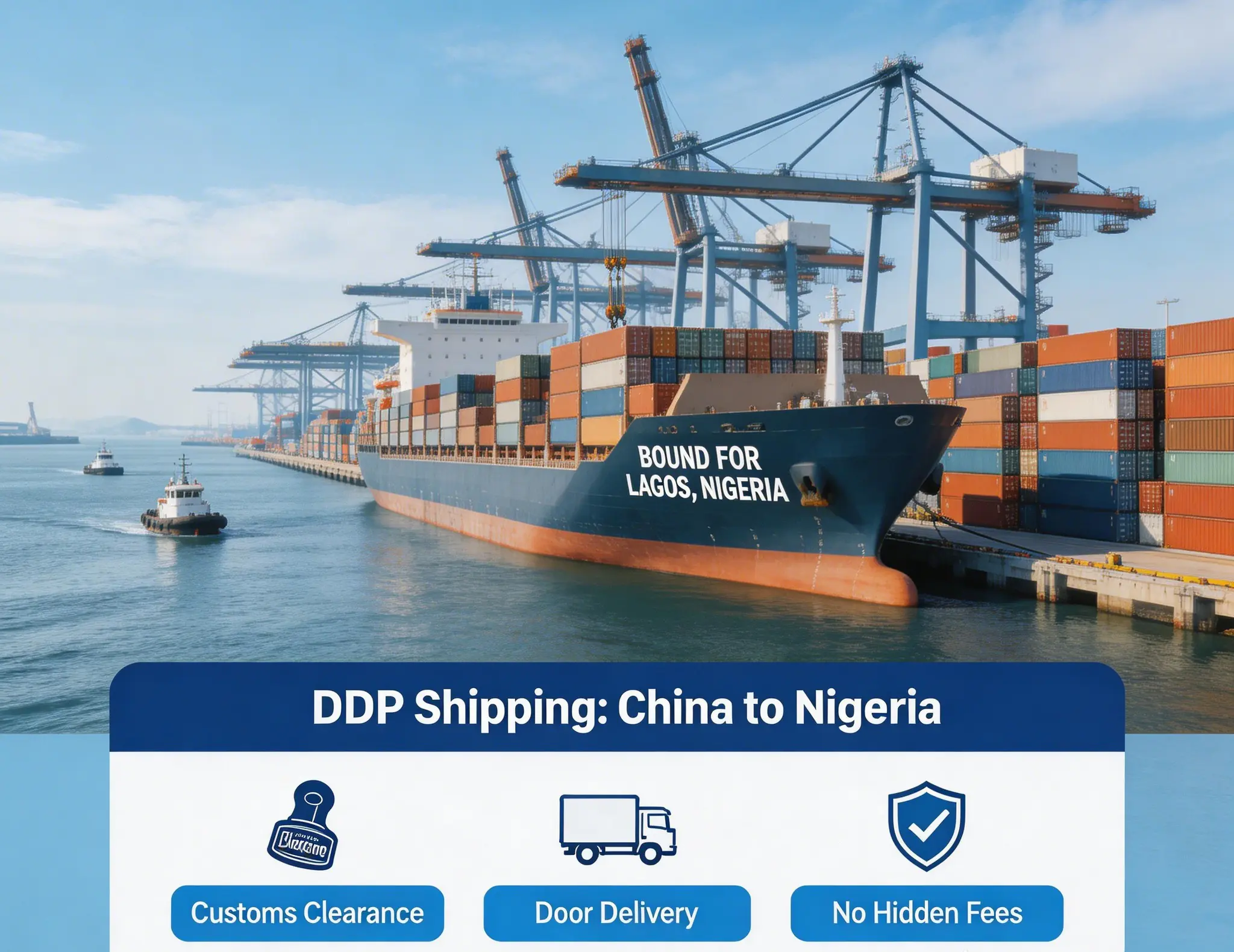
DDP (Delivered Duty Paid) is more than just a shipping term; it is a comprehensive logistics solution designed to simplify your life. According to the International Chamber of Commerce (Incoterms® 2020), DDP places the maximum obligation on the seller (or forwarder). Under this arrangement, the freight forwarder handles everything—from picking up goods at your supplier’s factory in Guangzhou or Yiwu to delivering them directly to your warehouse in Lagos or Onitsha. You pay a single, all-inclusive price, and we handle the risks, the customs clearance, and the delivery.
At Efanda Logistics, we have seen a 40% year-on-year increase in DDP shipments to Nigeria. Why? Because in a volatile market where the Naira exchange rate fluctuates daily, knowing your exact landed cost upfront is invaluable. Whether you are importing electronics, textiles, or machinery, this guide will walk you through everything you need to know about DDP sea shipping in 2026, helping you save time, money, and stress.
2. How DDP Door to Door Shipping Works: Step-by-Step Process
Understanding the DDP process is crucial for planning your inventory and managing customer expectations. Here is the step-by-step journey of your cargo when you choose our door to door shipping service.
Step 1: Cargo Consolidation
Most DDP shipments are LCL (Less than Container Load). Your suppliers send goods to our specialized warehouse services centers in Guangzhou, Yiwu, or Shenzhen.
- Action: We receive, inspect, and repackage your goods to ensure they can withstand the sea voyage. We apply a unique “Shipping Mark” to every carton (e.g.,
EFANDA-LAG-001) to prevent loss. - Benefit: You can buy from multiple suppliers (e.g., shoes from one, bags from another), and we combine them into a single shipment to save costs.
Step 2: Export Documentation
Once your cargo is ready, we handle the Chinese export procedures. This includes filing the necessary export declarations with Chinese Customs. You do not need to provide an export license; we use ours. We also verify that your goods do not violate the Nigeria Customs Service (NCS) prohibition list.
Step 3: Ocean Freight
Your goods are loaded into a container and shipped via premium carriers like COSCO or MAERSK. The vessel departs for Apapa or Tincan Island Port in Lagos.
- Route: Direct sailings are preferred to minimize transit time, though some vessels may transship via hubs like Singapore or Dubai (handling shipping from China to UAE cargo).
- Safety: We use high-quality containers to prevent water damage during the 30+ days at sea.
Step 4: Destination Clearance
This is the most critical stage. Upon arrival in Lagos, our dedicated clearing agents take over.
- The Magic of DDP: You do not need to register for Form M or process a PAAR. Our team uses our bulk import permits to clear the container as a consolidated shipment.
- Duty Payment: We pay the Customs Duty, VAT, and all port charges on your behalf. This shields you from sudden tariff hikes or exchange rate spikes during the voyage.
Step 5: Final Delivery
Once cleared, the container is transferred to our Lagos warehouse for deconsolidation.
- Pickup: You can pick up your goods immediately.
- Delivery: We can arrange last-mile delivery to your doorstep in Lagos, or waybill it to other cities like Abuja, Kano, or Port Harcourt using reliable local trucking partners.

3. Real-World Success Story: How an Alaba Market Electronics Dealer Saved 15%
In late 2025, a client importing solar inverters from Shenzhen to Alaba International Market faced a common dilemma: fluctuating exchange rates made their Form M processing unpredictable. By switching to Efanda’s DDP service, they transformed their supply chain.
The Challenge
The client previously used standard freight. Their container got stuck at Apapa Port for 3 weeks due to a PAAR discrepancy, incurring over $1,200 in demurrage and detention charges. Worse, the Naira devalued by 5% during the delay, increasing their duty payable significantly.
The Efanda Solution
We switched them to our DDP LCL Consolidation service:
- Consolidation: We combined their 12 CBM of inverters with compatible tech goods (cables, panels) in our Guangzhou warehouse.
- Fixed Rate: We quoted a flat rate of $250/CBM, locking in their cost in USD.
- Speed: The container moved via a direct COSCO sailing and cleared in just 5 days upon arrival.
The Result
- Total Savings: The client saved roughly $1,800 (avoided demurrage + currency fluctuation protection).
- Time Saved: Goods hit the market 14 days faster than their previous average.
- Lesson: In the Nigerian market, predictability is often more valuable than the lowest theoretical freight rate.
4. DDP Sea Freight Rates Breakdown: What is Included?
One of the biggest advantages of DDP is the transparent pricing structure. Rates are typically quoted in USD per CBM (Cubic Meter). But what exactly does that rate cover?
All-in Pricing Structure
When we quote you a DDP rate (e.g., $240/CBM), it is an “All-in” price. This means no hidden fees upon arrival.
Inclusions
- Ocean Freight: The cost of moving the container from China to Nigeria.
- Customs Duty: The import tariffs levied by the Nigeria Customs Service.
- VAT (7.5%): The mandatory Value Added Tax on imported goods.
- Port Handling Charges: Terminal Handling Charges (THC) and wharfage fees at Apapa/Tincan.
- Clearing Agency Fee: The service fee for our clearing agents.
- Documentation: Costs for Bill of Lading, Manifest, and other paperwork.
Exclusions
- Cargo Insurance: While DDP covers the duty, it does not automatically cover the value of the goods in case of total loss (e.g., fire, vessel sinking). We strongly recommend adding cargo insurance services for a small premium (usually 3-5% of goods value).
- Delivery to Remote States: Delivery within Lagos is often subsidized or free for large volumes, but transporting goods to Northern or Eastern Nigeria attracts an additional trucking fee.
- Forklift Fees: For extremely heavy items (e.g., industrial generators > 500kg), warehouse handling fees may apply at the pickup point.
Understanding Volumetric Weight
A common confusion for new importers is “Volumetric Weight”. Shipping rates are based on the greater of actual weight or volumetric weight.
- Sea Freight Formula: 1 CBM = 363 kg (Standard) or sometimes 500 kg depending on the carrier.
- The Trap: If you ship foam mattresses (huge volume, light weight), you pay for the space (CBM). If you ship lead batteries (small volume, heavy weight), you might pay a “Heavy Cargo” surcharge if it exceeds the density limit. Always provide your Packing List to Efanda for an accurate quote.
2026 Price Range Estimates
- General Cargo (Clothes, Shoes, Bags): $220 – $260 per CBM.
- Sensitive Goods (Batteries, Cosmetics, Liquids): $280 – $350 per CBM due to hazardous handling fees.
- Note: Rates fluctuate based on shipping line surcharges and exchange rates. Always confirm the latest rate before shipping.

5. Transit Time Analysis: DDP Sea Freight vs Air Freight
Time is money. While sea freight is cheaper, it requires patience. Understanding the logistics performance of Nigerian ports is key; the World Bank Logistics Performance Index often highlights the challenges in port efficiency, which is why working with an experienced forwarder is vital.
Sea Freight Timeline
- Consolidation: 3-7 days (waiting for the container to fill).
- Sailing: 35-45 days.
- Clearing: 7-14 days (depending on port congestion).
- Total: Expect 50-65 days from the time you drop off goods at our China warehouse to receiving them in Lagos.
Air Freight Comparison
If you are shipping high-value, low-weight items (like smartphones or jewelry), air freight might be better.
- Transit Time: 3-7 days.
- Cost: Charged per KG, significantly higher than sea freight.
Verdict: Use DDP Sea Shipping for bulk inventory restocking. Use Air Freight for samples, emergency stock, or high-margin electronics.
6. Pros and Cons: Is DDP Better for Customs Clearance?
Advantages
- Simplicity: You don’t need to interact with Customs officers or banks for Form M.
- Cost Certainty: You can calculate your profit margin instantly because the landed cost is fixed.
- Flexibility: Perfect for LCL. You don’t need to fill a whole container to get a good rate.
- Risk Reduction: We bear the risk of demurrage (port storage fees) if the clearance is delayed.
Disadvantages
- Higher Unit Cost for FCL: If you are shipping 10+ containers a month, setting up your own Form M/PAAR might be cheaper in the long run. DDP includes a premium for the service convenience.
- Limited Control: Since the goods are cleared under our name, you don’t get the original customs assessment notice in your company’s name (which some large multinationals require for audits).
7. Prohibited and Restricted Items for Shipping from China to Nigeria
Not everything can be shipped via standard DDP channels. Nigeria has a strict prohibition list enforced by the NCS.
Allowed Goods
- General: Textiles, Shoes, Bags, Furniture, Kitchenware, Auto Parts, Machinery, Electronics (non-battery).
Restricted/Special Handling
- Batteries: Lithium batteries and Power Banks require special “Dangerous Goods” declaration. We have specific containers for these.
- Liquids/Cosmetics: Must provide an MSDS (Material Safety Data Sheet).
- Brand Copies: Shipping counterfeit Nike, Gucci, or Apple products is risky. While some agents accept them, they carry a high risk of seizure. Efanda advises against shipping infringing goods.
Strictly Prohibited (Do Not Ship)
- Narcotics and psychotropic substances.
- Arms, ammunition, and military hardware.
- Fresh/Frozen food (unless in a reefer container).
- Fake currency or sensitive political material.
8. Risks in DDP Shipping and the Need for Cargo Insurance
While DDP is safe, it is not risk-free.
Customs Seizure Risk
The biggest risk in DDP is “Groupage Seizure.” If one importer in the container ships contraband (e.g., drugs), Customs may seize the entire container.
- Mitigation: Efanda inspects every package before loading. We do not accept undocumented goods from unknown senders.
Cargo Damage
LCL shipments involve stacking boxes from different shippers. Heavy machinery might sit next to fragile lamps.
- Mitigation: Proper packaging is your responsibility. Use wooden crates for fragile items. And again, get cargo insurance.
Hidden Charges
Some dishonest agents quote a low sea freight rate (e.g., $150/CBM) but demand a “Release Fee” of $100/CBM in Lagos.
- Efanda Promise: Our DDP rates are final. No ransom fees at destination.
9. Why Choose Efanda for Your China to Nigeria Shipping Needs?
Shipping from China to Nigeria requires a partner who understands both the Chinese export market and the Nigerian import terrain.
- Own Warehousing: We operate secure warehouses in Guangzhou and Yiwu with 24/7 surveillance.
- Expert Clearance Team: Our Lagos team has over 10 years of experience navigating Apapa and Tincan ports. We know how to solve problems before they become delays.
- Transparent Tracking: We provide weekly updates on your shipment status.
- Compensation Policy: In the rare event of loss, we have a clear claims process to reimburse you based on the declared value.
- Pan-African Network: Beyond Nigeria, we have established routes for shipping from China to Ghana, shipping from China to Kenya, shipping from China to Uganda and shipping from China to South Africa, making us your ideal partner for cross-border expansion.
10. FAQ: Common Questions About DDP Shipping from China to Nigeria
Q: Can I pay in Naira or do I have to pay in USD?
A: We offer flexible payment options. You can pay in RMB (WeChat/Alipay) to our China office, USD to our Hong Kong account, or Naira to our Nigerian bank account at the prevailing parallel market rate. This flexibility helps you manage your FX exposure.
Q: What happens if my goods are seized by Customs?
A: This is the #1 fear for importers. If you declared your goods correctly (e.g., you didn’t hide contraband inside shoes) and they are seized due to a container issue on our end, Efanda’s Compensation Policy covers you. We reimburse the declared value of the lost goods. However, if you shipped prohibited items (like drugs) without telling us, you bear the full liability.
Q: Is DDP cheaper than standard shipping?
A: For LCL (small volumes), DDP is almost always cheaper and definitely easier. For FCL (full containers), standard shipping might be cheaper if you have your own clearing license, but DDP offers peace of mind.
Q: What is the minimum CBM for DDP sea freight?
A: Our minimum chargeable volume is 0.1 CBM. If your goods are smaller, we charge the minimum fee.
Q: Do you deliver to states outside Lagos (e.g., Abuja, Port Harcourt)?
A: Yes. We land the goods in Lagos first, clear them, and then arrange interstate trucking to your location.
Q: How do I calculate the CBM of my shipment?
A: Measure the Length, Width, and Height in meters. Multiply them (L x W x H). For example, a box of 0.5m x 0.5m x 0.4m = 0.1 CBM.
Q: Can I ship branded items?
A: Please consult our customer service before sending branded items. We need to verify if they are original or require special authorization.
Q: Can I ship directly from Alibaba suppliers to your warehouse?
A: Absolutely. Just provide your supplier with our warehouse address and your unique shipping mark. We will notify you once we receive the goods.
Ready to ship? Contact Efanda Logistics today for a quote and experience the smoothest shipping from China to Nigeria service in the market.