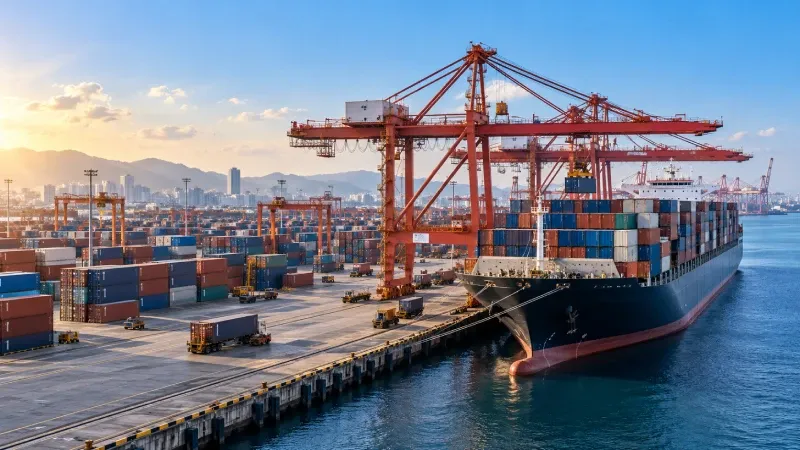
Why do three forwarders quote the same 20ft container from Shenzhen to Apapa at $2,900, $3,600 and $4,800? FCL shipping from China to Nigeria is the backbone of the fastest-growing import lane into West Africa: Nigeria brought in ₦11.01 trillion of goods from China in the first half of 2026, which is 39.27% of everything the country imported that half year, according to National Bureau of Statistics data reported in September. Full containers move most of that volume, and the difference between a well-planned shipment and an improvised one is rarely the ocean freight number itself. It is what happens before the vessel sails and after it berths.
This guide covers what FCL costs by origin port and container size in 2026, how long the door-to-door journey takes, which Nigerian port fits your cargo and destination, and the Form M, PAAR and SONCAP chain that decides whether your box clears in three working days or sits at Apapa while demurrage accrues. If you are still weighing sea against air, our shipping from China to Nigeria overview compares sea, air and door-to-door options side by side.
Rate disclaimer: All figures reflect market conditions as of October 2026 and are indicative only. Ocean freight on the China–West Africa corridor reprices weekly with demand, capacity, fuel and equipment availability. Always confirm a live quote, and expect most quotes to hold for only 2–3 weeks.
What Is FCL Shipping from China to Nigeria? (Container Types Explained)
Full Container Load (FCL) means you book an entire container for your own cargo. The box is loaded and sealed at your supplier or at a consolidation warehouse in China, and that seal is not broken until it reaches Nigeria. Because no other shipper’s goods share the space, you get fewer handling touches, lower damage risk, and a Bill of Lading (B/L) naming you as sole consignee.
Most China-to-Nigeria FCL shipments use one of three standard dry containers:
| Container Type | Usable Volume | Max Payload | Best Cargo Profile for Nigeria |
|---|---|---|---|
| 20GP (20ft Standard) | ~28 CBM | ~28,000 kg | Tiles, cement, steel, machinery, auto spare parts |
| 40GP (40ft Standard) | ~58 CBM | ~26,000–28,000 kg | Mixed wholesale goods, appliances, general merchandise |
| 40HQ (40ft High Cube) | ~68 CBM | ~26,000 kg | Furniture, foam, plastics, textiles, bulky light goods |
Volumes above are usable capacity; rated volumes are about 33, 68 and 76 CBM for the 20GP, 40GP and 40HQ. The box that pays for itself most often on this lane is the 20GP, because so much Nigeria-bound cargo is dense: building materials, tiles, ceramics and machine parts all hit the payload ceiling before the cubic capacity fills.
Our industry insight:
Importers often order a 40HQ “to be safe”, then pay for a half-empty container on a lane where heavy cargo is the norm. A Lagos buyer moving 26 tonnes of tiles needs a 20GP regardless of the rate difference; a furniture importer moving 60 CBM at 5,000 kg is wasting money on anything smaller than a 40HQ.
FCL Shipping Rates from China to Nigeria in 2026 (By Port and Container Size)
Indicative all-in port-to-port rates from South China to Lagos in Q4 2026 run about $2,900–$3,700 for a 20GP and $3,150–$4,300 for a 40GP or 40HQ, while a complete door-to-door DDP shipment typically lands between $4,500 and $8,500 per container once destination charges, duty and VAT are inside the price. The corridor band is wider still, roughly $2,500–$4,000 for a 20ft and $3,800–$6,000 for a 40ft, because peak weeks and equipment shortages can move the same box by 40% or more.
| Origin Port (China) | 20GP to Lagos | 40GP / 40HQ to Lagos | Typical Direct Transit |
|---|---|---|---|
| Shenzhen / Yantian | $2,900–$3,500 | $3,150–$4,100 | 32–40 days |
| Guangzhou / Nansha | $3,000–$3,600 | $3,300–$4,250 | 30–38 days |
| Ningbo-Zhoushan | $2,950–$3,550 | $3,250–$4,200 | 33–42 days |
| Shanghai | $3,000–$3,600 | $3,300–$4,300 | 35–45 days |
| Qingdao / Tianjin | $3,200–$3,900 | $3,600–$4,800 | 38–48 days |
Figures are indicative all-in port-to-port levels for October 2026 and include origin handling, documentation and fuel surcharges. They exclude destination terminal charges, duty and VAT.
Four variables explain nearly all of the spread:
- Scope. “Port to port”, “to warehouse” and “DDP with duty and VAT paid” are three different products. Comparing one against the other is the most common budgeting error on this lane.
- Timing. Chinese New Year, Golden Week and the Q4 restocking peak tighten space and add $300–$700 per container.
- Equipment and congestion. Lagos terminals periodically run short on empty equipment and yard space.
- Naira settlement. Duty and levies are assessed in Naira at the CBN rate on the day of entry, so the exchange rate moves your landed cost after the freight is fixed.
What Lands on Your Desk: A Realistic 20GP Landed Cost
Take a $17,000 FOB order in a 20GP from Shenzhen to a Lagos warehouse, with $2,900 freight and $100 insurance. CIF is $20,000, and the customs bill sits on top of it.
| Cost Component | Amount (USD) | Basis |
|---|---|---|
| Goods (FOB China) | $17,000 | Supplier invoice |
| Ocean freight (20GP) | $2,900 | Shenzhen → Apapa |
| Marine insurance | $100 | 0.5% of CIF |
| Import duty | $4,000 | 20% of CIF (typical band; 0–35% by HS code) |
| Surcharge (port levy) | $280 | 7% of the duty amount |
| ETLS levy | $100 | 0.5% of CIF (ECOWAS) |
| Import levy (FCS) | $680 | 4% of FOB value |
| VAT | $1,879 | 7.5% of CIF + duties + levies |
| Origin and Lagos handling | $950 | Pickup, THC, clearing, delivery |
| Total landed cost | ~$27,889 | ~$10,889 of it is freight, handling and tax |
Two things follow from that table. First, taxes and levies alone come to about $6,939, or 34.7% of the CIF value, and they are due before the container leaves the terminal. Second, the 4% import levy that replaced the old 1% CISS has been applied and suspended in turns since it was introduced in August 2025, so confirm with your broker whether it is being collected on your entry date before you lock a budget.
There is one genuine 2026 bright spot if you import vehicles. The 2026 Fiscal Policy Measures, in force since 1 July 2026, cut import duty on fully built passenger cars from 70% to 40%, halved the National Automotive Council levy and introduced a Green Tax Surcharge on higher-emission vehicles. Duties were also reduced on 127 critical items. If vehicles are part of your mix, see our guide to how to import and ship cars from China to Nigeria.
Our industry insight:
Ask for the quote broken into origin charges, ocean freight, destination charges and duties. A forwarder who can only give one big number is usually quoting the cheapest possible scope. On this lane, destination handling, clearing agent fees and trucking routinely add $600–$1,200 per container.
FCL vs LCL Shipping from China to Nigeria: Where the Break-Even Sits
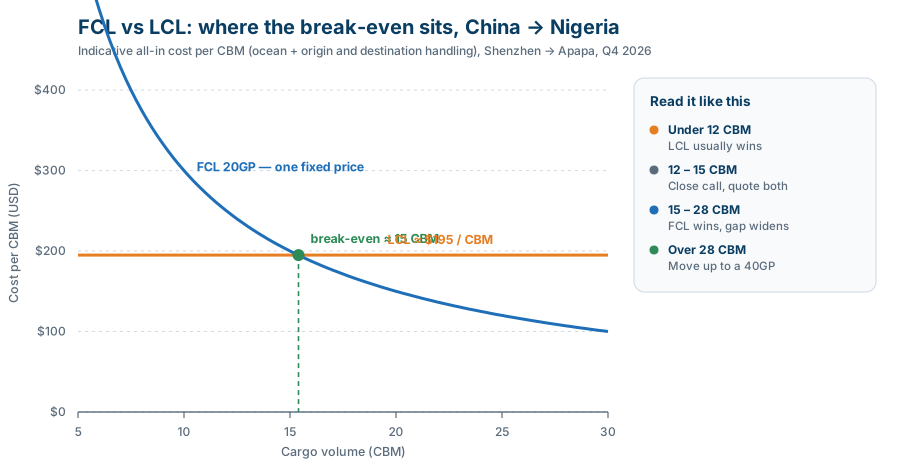
Below roughly 12 CBM, LCL is usually cheaper. Between 12 and 15 CBM it is genuinely close and worth quoting both ways. Above 15 CBM, a dedicated 20ft container almost always wins on total landed cost, and the advantage widens with every extra cubic metre. LCL on this lane is charged per CBM or per weight-tonne, whichever is greater, at roughly $80–$150 per CBM port to port, or $220–$350 per CBM on an all-in DDP door-to-door basis.
| Factor | Choose LCL | Choose FCL |
|---|---|---|
| Cargo volume | Under 12 CBM | 15 CBM and above |
| Cash flow | Pay only for the space you use | Full container cost upfront |
| Transit predictability | Waits for consolidation and deconsolidation | Sails on your schedule, sealed end to end |
| Cargo security | Shared with other shippers | Sole use of the box |
| Nigeria handling | CFS deconsolidation, extra touches, per-CBM fees | Terminal to truck, one move |
| Best fit | Trial orders, mixed SKUs, e-commerce restocks | Full production runs, project cargo, building materials |
Two Nigeria-specific points tip the decision further toward FCL. LCL cargo is deconsolidated at a Container Freight Station (CFS) in Lagos, which adds days before your goods are available for entry, and every extra handling step is a chance for shortage. Because dense cargo dominates this lane, LCL’s weight-to-volume charging often erases the saving on goods that look small on paper. For a deeper side-by-side, read our FCL vs LCL shipping comparison.
How Long Does FCL Shipping from China to Nigeria Take?
Direct FCL sailings from Chinese ports to Lagos take roughly 30–45 days port to port depending on origin, and a realistic door-to-door shipment runs 40–55 days including factory pickup, export clearance, Lagos clearing and inland delivery. Peak-season congestion and heavy-rain yard pressure at Apapa and Tin Can can push the outer edge to 60 days.
| Route (Port to Port) | Typical Transit |
|---|---|
| Guangzhou / Nansha → Lagos | 30–38 days |
| Shenzhen / Yantian → Apapa | 32–40 days |
| Ningbo-Zhoushan → Tin Can Island | 33–42 days |
| Shanghai → Lagos | 35–45 days |
| Qingdao / Tianjin → Lagos | 38–48 days |
| Door-to-Door Stage | Estimated Duration |
|---|---|
| Factory pickup, consolidation and loading | 2–4 days |
| Export customs clearance in China | 1–3 days |
| Ocean transit | 30–45 days |
| Nigerian customs clearance and terminal release | 3–7 days |
| Inland trucking to your warehouse | 1–3 days |
| Total door to door | 40–55 days |
Plan inventory with a 55-day buffer, not a 40-day one. The delays that hurt importers on this lane are almost never at sea. They happen at origin when a quantity or invoice value changes after the documents were issued, and at the terminal when paperwork is still being corrected as the vessel berths. In 2026 the land side has been the bigger risk: truck congestion on the Mile 2 to Wharf to Apapa corridor, rain-related yard pressure that stretched Tin Can waiting times, and an ongoing NPA decongestion programme all added days to inland movement this year.
Choosing the Right Ports: Chinese Origins and Nigerian Destinations
Match the Chinese origin port to where your factory is, and the Nigerian port to where your buyer is. Rate differences between ports are usually smaller than the inland trucking and waiting costs of choosing wrong.
| Chinese Origin Port | Manufacturing Cluster It Serves | Typical Inland Trucking |
|---|---|---|
| Shenzhen (Yantian / Shekou) | Electronics, appliances, e-commerce stock (Dongguan, Huizhou) | $100–$300 |
| Guangzhou (Nansha) | Building materials, ceramics, furniture, textiles (Foshan, Zhongshan) | $150–$350 |
| Ningbo-Zhoushan | Zhejiang hardware, small commodities, auto parts, tools | $100–$400 |
| Shanghai | Machinery, chemicals, high-value goods (Yangtze Delta) | $150–$400 |
| Qingdao / Tianjin | Heavy industry, steel, agricultural products (North China) | $200–$600 |
On the Nigerian side, four gateways matter for container imports:
| Nigerian Port | Strengths | Best For |
|---|---|---|
| Lagos Port Complex (Apapa) | Largest general-cargo and container gateway; deepest market of clearing agents and hauliers | Lagos mainland, Ikeja, Ogun State industrial buyers |
| Tin Can Island (Lagos) | Established container and vehicle terminal, strong trucking links to Lagos mainland | Vehicle imports, wholesale goods moving to mainland markets |
| Lekki Deep Sea Port | Nigeria’s deepest port with a 16.5 m channel and roughly 1,200 m of quay, operational since April 2023 and now taking HMM–ONE alliance and MSC feeder calls | Larger vessels, Lagos Free Zone and Lekki corridor consignees, cargo that benefits from a less congested yard |
| Onne (Port Harcourt) | Multipurpose complex with berths at roughly 7.5–10 m draft serving Nigeria’s south-east and east | Buyers in Port Harcourt, Aba, Owerri and the south-east, who avoid the Lagos truck run |
The practical rule: quote door to door, not port to port, before you choose. Clearing at Lekki and trucking 60 km to a warehouse in Ogun State can cost more in the end than clearing a slightly higher rate at Apapa a few kilometres from the delivery address. If you distribute onward into the region, plan the lane differently again, as on our shipping from China to Ghana route for re-export flows.
Nigeria Customs Clearance for FCL: Form M, PAAR, SONCAP and Duty
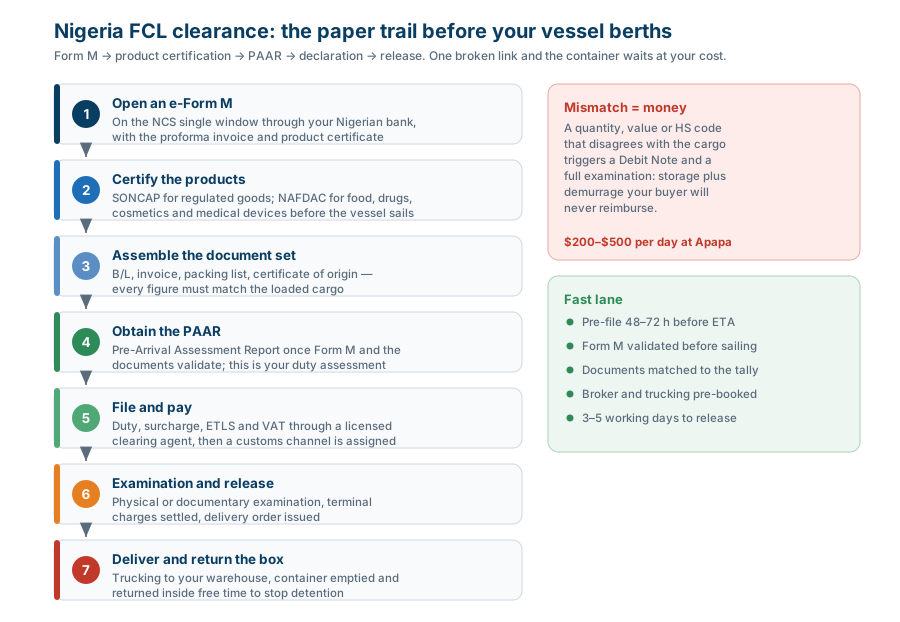
A full container cannot leave any Nigerian port without a validated Form M, a Pre-Arrival Assessment Report (PAAR) and, for regulated products, a SONCAP certificate or NAFDAC registration. The documents must agree with the physical cargo down to the carton count; a discrepancy triggers a Debit Note, a full examination and days of storage at your expense.
| Document | Who Issues It | Why It Matters |
|---|---|---|
| e-Form M | Your Nigerian bank, on the NCS single window | Mandatory import declaration tied to the proforma invoice and the goods |
| Product Certificate / SONCAP | Standards Organisation of Nigeria through accredited firms | Required for regulated goods before the vessel sails, not after arrival |
| NAFDAC registration | NAFDAC | Food, drugs, cosmetics, medical devices and packaged water |
| PAAR | Nigeria Customs Service | The duty assessment that a licensed agent files a declaration against |
| Commercial invoice, packing list, B/L | Supplier, forwarder, carrier | The documentary spine: values, quantities and weights must match |
| Certificate of origin | Exporter / chamber | Supports origin treatment and valuation checks |
Clearance with a complete, consistent document set typically takes 3 to 5 working days after arrival, and pre-filing 48 to 72 hours before the vessel berths is the fastest way to hit that range. Where imports go wrong is almost always paperwork logic: a packing list that says 150 cartons when the container holds 156, an invoice value that does not match the Form M, or an HS code chosen to look cheaper than the actual product. Those mismatches turn a documentary check into a full examination.
Duty is calculated on the CIF value in Naira. Under the ECOWAS CET 2022 to 2026 tariff book the components stack in a fixed order: import duty at 0–35% of CIF depending on HS code, a 7% surcharge on the duty amount, a 0.5% ETLS levy on CIF, the 4% FOB import levy, and 7.5% VAT on the sum of all of the above. If you do not present a Nigerian-issued insurance certificate, Customs applies a 1.5% insurance benchmark to the FOB value, which quietly raises the assessment base. Getting the HS code right makes all of this predictable; getting it wrong makes it expensive.
Our industry insight:
We have watched full containers sit for eleven days at Apapa because a supplier changed a quantity on the packing list after the invoice was issued and nobody re-checked the pair. The fix costs nothing: before the vessel sails, put the invoice, packing list and B/L side by side and confirm every figure against the loading tally. Our customs clearance team does this as a standard pre-sailing check.
Demurrage, Detention and Terminal Charges at Lagos Ports
Nigerian terminals typically grant only 3 to 7 free days before demurrage starts, and shipping lines allow 5 to 7 days of container detention after delivery. Once free time expires, import storage and demurrage at Apapa have been running in the $200–$500 per day range per container, while cargo pulled for examination can also attract storage of around $25 per CBM per day.
Demurrage and detention are two different charges, often invoiced by different parties:
- Demurrage is charged by the terminal for the container occupying space beyond the free period.
- Detention is charged by the carrier for the box being out of circulation after delivery until it is returned empty.
Both escalate daily. A five-day document delay can add more to your landed cost than the entire origin handling fee, and none of it appears in a port-to-port quote.
How to stay out of it:
- Validate the Form M and complete SONCAP or NAFDAC certification before the vessel sails, not while it is berthing.
- Send draft documents to your clearing agent 48 to 72 hours before ETA so the declaration can be pre-filed.
- Cross-check invoice, packing list and B/L against the loading tally before departure.
- Pre-book trucking and confirm your warehouse can receive and unload on the release date.
- Return the empty container on the carrier’s schedule and photograph the interchange receipt.
Real-life scenario: A Lagos distributor importing hardware cleared a 20GP in four working days because his agent had the PAAR in hand before the vessel berthed, and the truck was booked and waiting. The same month, an importer with an invoice value that did not match the Form M spent nine days in examination and paid more in storage than the container had cost to ship. Same route, same vessel class, same terminal: the difference was preparation.
FOB, CIF or DDP? Choosing the Incoterm for Nigeria Imports
FOB is the default for experienced Nigerian importers because it keeps the Form M, the clearing agent and the freight relationship under your control. CIF looks simpler and usually is not. DDP removes the operational burden by putting a forwarder in the middle, at the price of visibility into individual cost lines.
| Incoterm | Pays Ocean Freight | Handles Nigeria Clearance and Duty | Best For | Risk |
|---|---|---|---|---|
| EXW | Buyer | Buyer | Importers with their own Chinese pickup and agents | High |
| FOB | Buyer | Buyer | Established importers with a bank Form M and a clearing agent | Medium |
| CIF | Seller (to port) | Buyer | Buyers who want a simple ocean number and nothing else | Medium-High |
| DDP | Forwarder | Forwarder | First shipments, e-commerce, teams with no clearing capability | Low |
The CIF trap on this lane is predictable: a CIF quote covers the ocean leg and often nothing at the destination. Terminal handling, delivery order fees, clearing agent charges, duty and VAT all arrive as separate invoices, and because the consignee is still you, the Form M and SONCAP obligations are still yours. If you want one predictable number, ask for door-to-door shipping under DDP terms instead, which is how our DDP sea shipping from China to Nigeria service is structured. If you hold your own Form M and want the lowest all-in cost as volumes grow, stay on FOB and keep every cost line visible.
Step-by-Step: How to Ship a Full Container from China to Nigeria
- Confirm the cargo profile. Volume, gross weight, HS code, and whether the goods are regulated. This decides container size and certification.
- Quote both modes and both scopes. FCL and LCL, port to port and door to door, so you can see what each layer costs.
- Book space early. West Africa services tighten four to six weeks before peak season; book before the factory confirms its finish date.
- Consolidate multiple suppliers. Our Guangzhou and Yiwu warehouse services merge several suppliers into one container and let you verify quantities before loading.
- Open or validate the Form M and certifications while cargo is still moving to port; SONCAP and NAFDAC approvals do not happen overnight.
- Load, seal and document. Photograph the seal, container number and loading tally; that photograph settles most quantity disputes later.
- Insure the cargo. Marine cover at a fraction of a percent of CIF is the cheapest risk transfer in the shipment. See cargo insurance services for what should be in scope.
- Pre-file and pre-book the declaration and the trucking before the vessel berths.
- Clear, release and deliver to your warehouse or onward to your buyer.
- Return the empty box inside free time and file the interchange receipt.
FAQ: FCL Shipping from China to Nigeria
How much does a full container cost from China to Nigeria in 2026?
All-in port-to-port rates in Q4 2026 run about $2,900–$3,700 for a 20GP and $3,150–$4,300 for a 40GP, and the corridor band stretches from $2,500 to $6,000 depending on season and equipment availability. A door-to-door DDP shipment typically lands between $4,500 and $8,500.
How long does FCL shipping from China to Nigeria take?
Direct sailings take 30–45 days port to port from Chinese ports to Lagos. Door to door, plan 40–55 days including pickup, export clearance, Lagos clearing and delivery, with a buffer in peak season.
Is FCL cheaper than LCL for a 20 CBM shipment to Nigeria?
Yes. At 20 CBM the per-CBM cost of a dedicated 20ft container is lower than LCL, and you skip CFS deconsolidation delays. The break-even sits around 15 CBM; below 12 CBM, LCL usually wins.
What documents do I need to clear an FCL shipment in Nigeria?
A validated e-Form M, a PAAR, commercial invoice, packing list, Bill of Lading, certificate of origin, and SONCAP or NAFDAC approval for regulated products. Every figure must match the physical cargo.
Do I need a Form M if I use DDP shipping?
On a structured DDP service the forwarder’s clearing company acts as importer of record and handles the Form M and product certification, which is why first-time importers use it. If you hold your own Form M, FOB puts you in full control of the compliance record.
What duties and taxes apply to a container import into Nigeria?
Import duty of 0–35% of CIF depending on HS code, a 7% surcharge on the duty amount, a 0.5% ETLS levy on CIF, a 4% import levy on FOB value, and 7.5% VAT on the combined total, settled in Naira at the CBN rate on the day of entry.
Which Nigerian port should my container go to?
Apapa and Tin Can Island for the Lagos mainland and Ogun State belt, Lekki Deep Sea Port for the Lagos Free Zone and Lekki corridor, and Onne for south-east buyers. Compare door-to-door numbers, not port-to-port rates.
Can I ship a full container door to door with duty paid?
Yes. A DDP service covers factory pickup, export declaration, ocean freight, Nigerian clearance, duty and VAT payment, and delivery under one price, which makes landed-cost planning far simpler.
Shipping Your Container to Nigeria Without Surprises
A container shipment to Nigeria touches more moving parts than most importers expect: container selection, space booking, Form M, product certification, pre-filing, Naira-settled taxes, terminal free time and inland trucking. Each is manageable alone; the cost appears when they are sequenced badly.
Efanda Logistics has arranged international freight since 2018, with headquarters in Shenzhen and consolidation warehouses in Guangzhou and Yiwu. On the China to Nigeria lane we handle factory pickup, consolidation, export declaration, ocean freight, customs clearing at Apapa, Tin Can, Lekki and Onne, duty and VAT settlement, and final delivery under one transparent quote with no hidden fees. Our clearing team pre-checks every document against the cargo before the vessel sails.
Rates and transit times on this corridor move with the market, so ask us for a fresh, dated quote based on your exact cargo, HS code and delivery address. Send your carton count, gross weight and volume, and we will tell you which container actually fits and what the shipment costs door to door.
Written by the EFANDA Logistics team — a Shenzhen-based freight forwarder established in 2018, moving cargo from China to ports worldwide with end-to-end pickup, consolidation, customs and door delivery.About us