
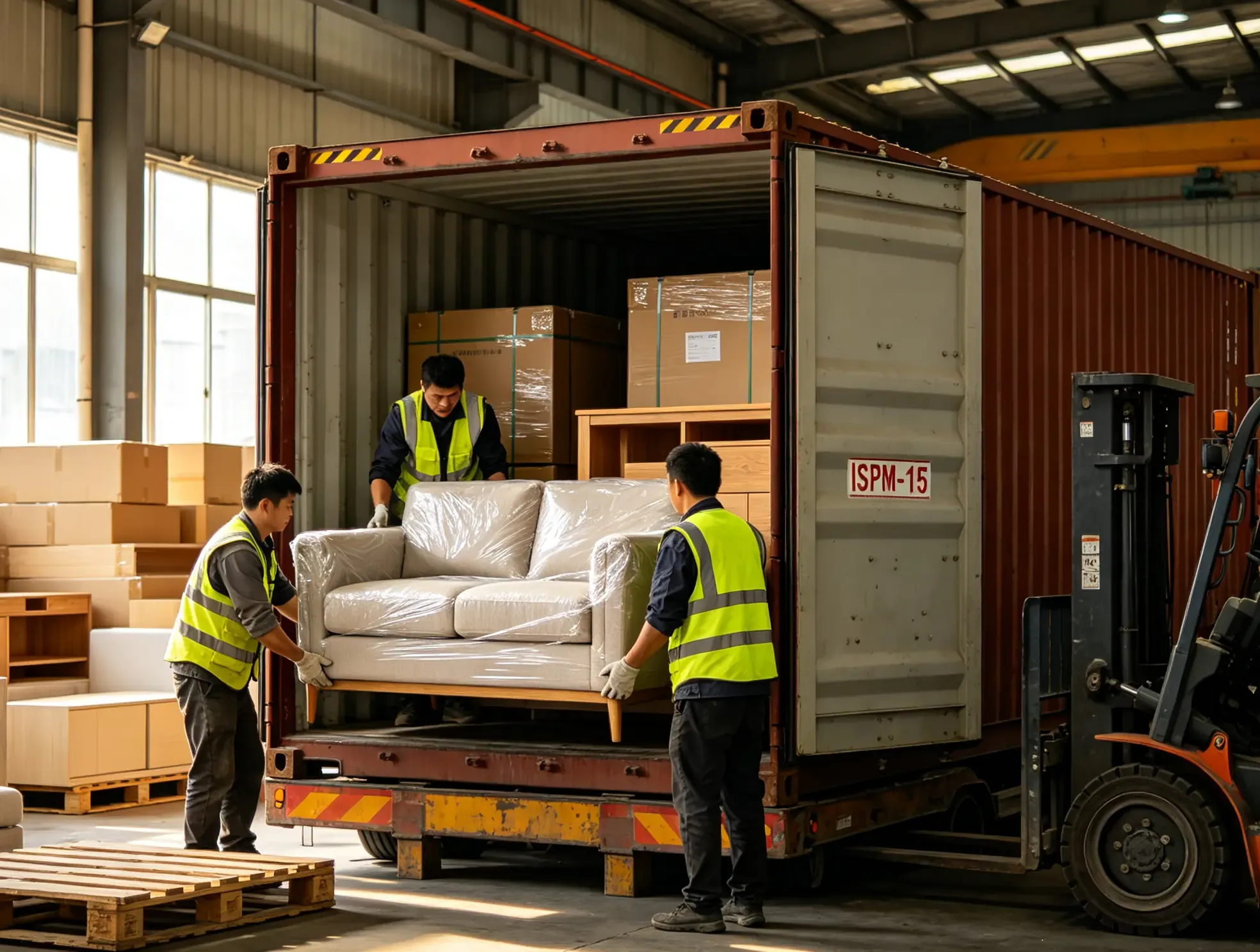
How do you ship furniture from China to the USA without overpaying on freight, getting stuck in customs, or receiving damaged goods? For furniture retailers, interior designers, hotel project buyers, and Amazon sellers, this question is critical because one miscalculation in volume, packing, or HS classification can erase your margin. Furniture is not standard general cargo: it is bulky, often fragile, and governed by material-specific import rules that vary dramatically from electronics or apparel.
This guide walks through the full process from a Shenzhen-based logistics perspective. You will learn how to choose between FCL and LCL, calculate CBM accurately, navigate US customs compliance, control costs, and select a freight forwarder who understands furniture. For a broader view of all service options on this trade lane, see our dedicated Shipping From China to USA page. Whether you are moving a single container of flat-pack bedroom sets or managing a multi-supplier hotel project, the principles below will help you protect your investment and avoid common pitfalls.
What Makes Shipping Furniture from China Different?
Furniture shipping differs from general cargo because volume, fragility, and compliance rules dominate cost and risk rather than simple weight-based pricing. Most furniture is light relative to its size, which means carriers bill primarily by cubic meter, not kilograms. A fully assembled sofa can occupy two to three times more space than the same unit shipped knock-down, directly multiplying your freight cost.
The second difference is handling sensitivity. Wood veneers scratch, glass cracks, upholstery molds, and marble chips. Each material needs a different packing protocol. Finally, furniture triggers specialized customs requirements: solid wood may need ISPM-15 treatment, composite wood must meet TSCA Title VI formaldehyde limits, and upholstered pieces can fall under CPSC flammability rules. These requirements are not optional add-ons; missing one can halt your shipment at the port.
Which Shipping Method Is Best for Furniture from China to the USA?
Sea freight FCL or LCL is best for most furniture, while air freight only suits urgent samples or small high-value pieces. The decision comes down to volume, budget, and damage tolerance.
FCL (Full Container Load) gives you exclusive use of a container. It is usually the safest and most cost-effective option above 15 CBM. A 20-foot container holds roughly 28 CBM, a 40-foot container around 58 CBM, and a 40-foot high-cube (40HQ) around 68 CBM. Because the container is sealed at the factory, there is less handling, lower damage risk, and more predictable scheduling.
LCL (Less than Container Load) shares container space with other shippers. It works for volumes between 2 and 15 CBM, but your cargo is handled more often during consolidation and deconsolidation, which raises damage risk and adds 5–10 days to transit. For a detailed breakdown of the trade-off, read our comparison of FCL vs LCL shipping.
Air freight is rarely practical for full furniture sets because it is billed by chargeable weight and can cost 5–10 times more than sea freight. Reserve it for samples, prototypes, or single high-value showroom pieces. See current options in our air freight shipping from China to USA guide.
| Method | Best Volume | Cost Level | Transit Time | Damage Risk | Best For |
|---|---|---|---|---|---|
| FCL Sea Freight | 15+ CBM | Lowest per CBM | West Coast 18–25 days; East Coast 30–40 days | Low | Bulk orders, hotel projects, full home sets |
| LCL Sea Freight | 2–15 CBM | Moderate per CBM | 5–10 days longer than FCL | Medium | Small retailers, mixed samples, replenishment |
| Air Freight | Under 2 CBM | High | 5–10 days | Low-Medium | Samples, urgent replacements, luxury pieces |
| Express Courier | Small parts | Very high | 3–7 days | Medium | Hardware, fabric swatches, small spare parts |

How Much Does It Cost to Ship Furniture from China to the USA?
Total landed cost typically ranges from $1,500 for a small LCL shipment to $6,000 or more for a full container, depending on volume, route, Incoterm, and compliance needs. The ocean freight rate is only one line item. A realistic budget must include origin handling, export packing, destination port charges, customs clearance, duties, inland trucking, and insurance.
The table below shows 2026 reference ranges from major Chinese ports to the USA. These figures are market estimates as of mid-2026 and can move with fuel surcharges, peak-season general rate increases (GRI), and port congestion. If your priority is budget, our guide to the cheapest shipping from China to USA explains how to lower per-unit cost.
| Cost Component | West Coast (LA/LB) | East Coast (NY/NJ) | Notes |
|---|---|---|---|
| LCL per CBM | $80–$180 | $100–$220 | Billed by packed volume; minimum charges apply |
| 20ft FCL | $2,200–$3,500 | $3,500–$5,500 | ~28 CBM capacity |
| 40HQ FCL | $3,200–$5,000 | $5,000–$7,500 | ~68 CBM capacity |
| Air Freight | $5–$12/kg chargeable | $5–$12/kg chargeable | Based on dimensional weight |
| Export Packing | $50–$200/CBM | $50–$200/CBM | Standard carton to custom plywood crate |
| US Customs Clearance | $150–$350 | $150–$350 | Plus customs broker fees |
| Customs Bond (continuous) | $400–$600/year | $400–$600/year | Required for formal entries |
| Inland Delivery | $300–$800 | $300–$800 | Varies by distance and access |
Do not ignore hidden costs. Demurrage and detention accrue if a container sits at the terminal too long. Chassis fees, customs exam fees, storage, liftgate service, and white-glove residential delivery can add hundreds more. Ask your forwarder for an itemized quote that separates optional services from mandatory ones. For updated market data, see shipping container rates from China to USA.
How Do You Calculate Furniture Shipping Volume (CBM)?
CBM is calculated by multiplying the packed length, width, and height in meters for each carton or crate and summing the totals. Accurate measurement is the foundation of every furniture shipping decision because carriers bill by volume, not by the number of pieces.
Use the formula:
CBM = Length (m) × Width (m) × Height (m)
For example:
| Item | Packed Dimensions | CBM |
|---|---|---|
| 3-seater sofa (KD) | 1.8 m × 0.9 m × 0.6 m | 0.97 |
| Dining table set in crate | 1.6 m × 1.0 m × 1.1 m | 1.76 |
| Queen bed frame (KD) | 1.9 m × 0.4 m × 0.3 m | 0.23 |
| Wardrobe (KD, 2 cartons) | 1.2 m × 0.6 m × 1.5 m each | 2.16 |
Always ask suppliers for packed dimensions, not product dimensions. Then add a 10–15% buffer for irregular shapes and loading inefficiency. If your actual volume exceeds the booked space, you may face reclassification to a larger container or unexpected LCL charges.
Chargeable weight matters only when cargo is dense. For most furniture, volume rules. But if you are shipping stone-top tables or metal filing cabinets, the carrier may compare actual weight against volumetric weight and bill whichever is higher.
What Is the Best Way to Package Furniture for International Shipping?
The best packaging uses multi-layer protection—foam, corner guards, stretch film, reinforced cartons, and ISPM-15-certified wooden crates when needed. The goal is to survive repeated handling, container vibration, and humidity over a multi-week ocean journey.
Standard export packing for furniture should include:
- Heavy-duty corrugated cartons sized to the furniture
- Foam corner protectors on all exposed edges
- PE film or bubble wrap to prevent scratches
- Palletization to keep cargo off the container floor
- Plastic strapping or shrink wrap to prevent shifting
High-value or fragile pieces need upgraded protection:
- Custom plywood crates (must be ISPM-15 heat-treated if solid wood is used)
- Foam cushioning and cardboard separators for glass and marble
- Tilt/tip indicators for fragile display cabinets
- Desiccant packs to control moisture
Different materials need different care:
- Solid wood: corner guards and breathable moisture barriers
- Upholstered furniture: breathable wrapping and mold-prevention treatment
- Glass/marble: full wooden crate with internal bracing
- Metal: anti-rust film or oil coating
Whenever possible, request knock-down (KD) packing. Disassembling tables, beds, and sofas into flat panels can reduce volume by 40–60%, which directly lowers freight cost and reduces damage risk because flat panels are easier to secure.
Before shipment, send your supplier a packing specification checklist covering carton quality, foam thickness, corner protection, pallet requirements, and photo documentation after loading. This small step prevents disputes if damage occurs.
Which Incoterm Should You Choose for Furniture from China?
DDP is best for first-time importers who want one accountable partner, while FOB offers experienced buyers more cost control and transparency. The Incoterm defines who pays for freight, insurance, customs, and final delivery. We compare the two main options in our FOB vs CIF guide and explain delivery-paid terms in DDP shipping explained.
| Incoterm | Seller Responsibility | Buyer Responsibility | Best For |
|---|---|---|---|
| EXW | Makes goods available at factory | Everything from factory pickup | Experienced buyers with China-side resources |
| FOB | Delivers goods loaded on vessel at origin port | Ocean freight, insurance, US customs, delivery | Experienced importers seeking cost control |
| CIF | Pays freight + minimum insurance to destination port | Destination charges, customs, inland delivery | Buyers who want simple ocean pricing |
| DDP | Handles everything to buyer’s door including duties | Almost nothing | First-time importers or hands-off buyers |
Under FOB, you control the ocean carrier and forwarder, but you also manage US customs and inland trucking. Under DDP, your freight forwarder handles the entire chain, giving you predictable landed cost and single-point accountability. Many furniture importers start with DDP and move to FOB once they understand the process.
What US Customs Compliance Is Required for Furniture Imports?
Furniture imports to the USA require correct HTS classification, ISF 10+2 filing, a customs bond, and compliance with ISPM-15, TSCA Title VI, and CPSC rules depending on material. This is the area where most first-time importers stumble, and mistakes are expensive.
Start with the correct HTS code. Common furniture classifications include:
| HTS Code | Description |
|---|---|
| 9401.61 | Seats with wooden frames, upholstered |
| 9403.30 | Wooden furniture for offices |
| 9403.50 | Wooden bedroom furniture |
| 9403.60 | Other wooden furniture |
| 9403.89.6015 | Household furniture of other materials |
Always verify the final code on hts.usitc.gov because duty rates and trade remedies vary by exact classification.
Next, file ISF 10+2 at least 24 hours before the vessel departs China. Late or inaccurate filings can trigger penalties up to $10,000 and customs holds.
For customs entry, you need a customs bond. A continuous bond costs roughly $400–$600 per year and is worthwhile if you import more than once. Duties on furniture typically range from 0% to 10%, but China-origin goods may also be subject to Section 301 tariffs. Wooden bedroom furniture from China has additional anti-dumping duties.
Do not forget the less obvious fees:
- MPF (Merchandise Processing Fee): 0.3464% of value, minimum $31.67, maximum $614.35
- HMF (Harbor Maintenance Fee): 0.125% of value for ocean shipments
Material-specific regulations include:
- TSCA Title VI: formaldehyde emission limits on composite wood products
- CPSC: flammability standards for upholstered furniture and children’s furniture
- ISPM-15: heat treatment or fumigation for solid wood packaging materials
Finally, prepare a clean document set: commercial invoice, packing list, Bill of Lading, certificate of origin, fumigation certificate (if solid wood packing is used), and any product compliance certificates.

How Long Does It Take to Ship Furniture from China to the USA?
Total door-to-door time usually ranges from 35 to 60 days by sea, depending on production, consolidation, ocean transit, customs clearance, and final delivery. Air freight can cut this to 7–14 days but at a much higher cost.
A typical sea-freight timeline looks like this:
| Stage | Duration |
|---|---|
| Production + export packing | 15–45 days |
| Origin consolidation / container loading | 3–7 days |
| Ocean transit to US West Coast | 18–25 days |
| Ocean transit to US East Coast | 30–40 days |
| US customs clearance | 2–7 days |
| Inland delivery to warehouse or project site | 2–7 days |

Delays often come from outside the ocean leg. Peak season from August through October, Chinese New Year factory shutdowns, customs exams, port congestion on the West Coast, and limited access at project sites can each add days. Booking space 2–3 weeks ahead and preparing documents early are the best ways to protect your timeline. For the specific Pacific route, see how long a cargo ship takes from China to the Port of Los Angeles.
How Do You Choose a Freight Forwarder for Furniture Shipping?
Choose a forwarder with proven furniture experience in China, transparent itemized quotes, US customs brokerage capability, and consolidation services close to your suppliers. A generalist forwarder can move a box; a furniture specialist understands CBM optimization, ISPM-15 fumigation, and multi-supplier coordination.
A China-based forwarder is often the better choice for furniture because major production clusters are in Guangdong (Foshan, Dongguan, Shenzhen), Zhejiang, Fujian, and Jiangsu. Proximity means faster factory pickup, better supplier communication, and stronger carrier rates.
Verify these credentials before booking:
- NVOCC, FIATA, or IATA licensing
- US customs broker partnership or in-house clearance team
- ISPM-15 fumigation capability
- Cargo insurance options
- References from furniture importers
Watch for red flags:
- Vague “all-in” quotes with no line-item breakdown
- No experience with wooden furniture or fumigation
- Slow or unclear communication
- No dedicated account contact
Ask direct questions: Is US customs clearance included? Are demurrage and detention covered? What is the damage-claims process? Can you consolidate goods from multiple suppliers in Shenzhen? The answers will tell you whether the forwarder is a true partner or just a rate quote.
How Can You Reduce Furniture Shipping Costs?
You can reduce costs by maximizing knock-down packing, consolidating suppliers into full containers, booking in off-peak periods, and negotiating rates through a specialized freight forwarder. Small changes in how you buy and pack can save thousands.
Five practical ways to lower landed cost:
- Order KD or flat-pack furniture. Disassembly can cut volume by 40–60%, which directly reduces ocean freight.
- Consolidate multiple suppliers into one FCL shipment. A single full container is almost always cheaper per CBM than multiple LCL bookings.
- Avoid peak season. Rates typically rise from August through October and again before Chinese New Year.
- Compare FCL and LCL break-even points. If you are close to 15 CBM, the security and speed of FCL may be worth the small premium.
- Optimize the loading plan. Work with your forwarder to reduce dead space and stack efficiently.
There are also places where cutting corners costs more than it saves. Never skimp on export packing for fragile pieces, never skip cargo insurance on high-value shipments, and never guess at HTS codes. The savings you think you are making will disappear the moment customs holds your container or a sofa arrives cracked.
Special Scenario: Shipping Furniture to Amazon FBA from China
Furniture shipped to Amazon FBA must meet Amazon’s pallet, labeling, and packaging requirements in addition to standard import compliance. This channel is popular for e-commerce sellers moving ready-to-assemble chairs, small tables, shelving units, and home décor.
Key FBA requirements include:
- Cartons must not exceed 50 lb unless a single item is heavier
- Pallets must be 40″ × 48″ four-way access wood or plastic
- Each carton needs an FBA shipment label and box content label
- Furniture must be adequately padded to survive Amazon’s inbound handling
For final delivery, furniture usually moves by LTL (less-than-truckload) rather than small parcel because of size and weight. Common reasons for FBA rejection include overweight cartons, missing labels, insufficient packaging, and incorrect pallet dimensions.
If you are an Amazon seller, it is worth working with a forwarder who offers FBA prep in China, including labeling, palletizing, and quality checks before the ocean leg begins.
Common Mistakes to Avoid When Shipping Furniture to the USA
The most common mistakes are underestimating CBM, using the wrong HTS code, skipping ISPM-15 treatment, and buying insufficient cargo insurance. Each of these errors is avoidable with preparation.
- Underestimating volume. Suppliers may quote product dimensions instead of packed dimensions. Always confirm outer carton or crate measurements.
- Wrong HTS classification. An incorrect code can trigger customs exams, penalties, or reclassification at a higher duty rate.
- Missing ISPM-15 marks. If your wooden crates or pallets lack the proper heat-treatment stamp, customs may require fumigation or destruction at your expense.
- Inconsistent documentation. The commercial invoice, packing list, and Bill of Lading must all describe the cargo consistently.
- Ignoring carrier liability limits. Ocean carriers limit liability, often to a few hundred dollars per container. All-risk cargo insurance is the only way to cover the full value of your furniture.
- Poor supplier communication. Put packing requirements in writing and request photos before the container is sealed.
FAQ
Is it cheaper to ship furniture knock-down or fully assembled?
Knock-down is almost always cheaper. Disassembling sofas, beds, and tables into flat panels can reduce shipping volume by 40–60%, which lowers both ocean freight and damage risk.
How long does shipping furniture from China to the USA take?
By sea, expect 35–60 days door-to-door. Air freight takes 7–14 days but is usually reserved for samples or urgent high-value pieces.
What is the cheapest way to ship furniture from China to the USA?
For most furniture, LCL or FCL sea freight is the cheapest option. Consolidating multiple suppliers into a single FCL container and ordering KD packing will usually produce the lowest per-unit cost.
Do I need fumigation for wooden furniture shipped from China?
Solid wood furniture and solid wood packaging require ISPM-15 treatment through heat treatment or fumigation. Engineered woods such as MDF, plywood, and particleboard generally do not require fumigation.
What documents are needed to import furniture into the USA?
You typically need a commercial invoice, packing list, Bill of Lading, ISF filing, customs bond, certificate of origin, and any product compliance certificates such as TSCA Title VI or CPSC documentation.
Can I ship used furniture from China to the USA?
Yes, but used furniture faces stricter customs scrutiny and may require additional cleaning or treatment certificates. It is generally more complex than shipping new commercial furniture.
What is the best freight forwarder for furniture from China to the USA?
The best forwarder is one with furniture-specific experience in China, transparent itemized quotes, US customs brokerage support, and consolidation capability near major furniture production hubs.
How do I calculate CBM for furniture?
Multiply the packed length, width, and height in meters for each carton or crate, then sum the results. Add a 10–15% buffer for irregular shapes and loading inefficiency.
Does furniture from China face extra US tariffs?
Yes. China-origin furniture may be subject to Section 301 tariffs in addition to normal duty rates. Wooden bedroom furniture from China also faces anti-dumping duties.
Should I buy cargo insurance for furniture shipments?
Yes. Carrier liability is limited and often does not cover the full value of furniture. All-risk cargo insurance protects against transit damage, theft, and total loss.
Conclusion
Learning how to ship furniture from China to the USA comes down to four fundamentals: choose the right shipping method for your volume, calculate CBM accurately, comply with US customs and material regulations, and work with a freight forwarder who specializes in furniture logistics. Skip any of these and you risk cost overruns, customs delays, or damaged goods.
Rates and transit times change with market conditions, so always confirm current pricing before booking. For an end-to-end solution from supplier pickup in Foshan or Dongguan through US customs clearance and final delivery, consider Efanda Logistics. Headquartered in Shenzhen since 2018, Efanda offers transparent, itemized quotes, dedicated logistics specialists, and full-service support including multi-supplier consolidation, ISPM-15 fumigation, customs brokerage, and cargo insurance. Visit Efanda or call +86 18929345880 to discuss your furniture shipment and receive a tailored quote.

Written by the EFANDA Logistics team — a Shenzhen-based freight forwarder established in 2018, moving cargo from China to ports worldwide with end-to-end pickup, consolidation, customs and door delivery.About us