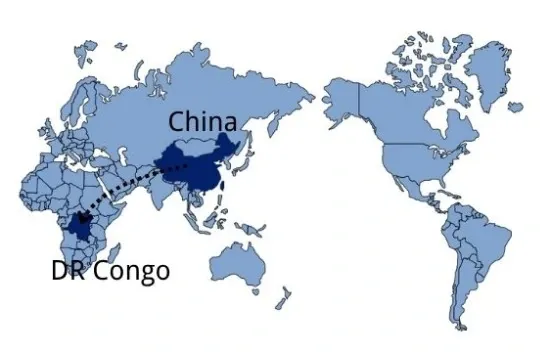
Shipping from China to DR Congo is one of the more demanding lanes in Africa, and the reason is geography rather than paperwork. The Democratic Republic of the Congo is the continent’s second-largest country by land area, it has almost no direct deep-water container access, and its two economic centres — Kinshasa in the west and the copper-cobalt belt around Lubumbashi and Kolwezi in the southeast — sit more than 2,000 km apart. Cargo for one of them rarely takes the same route as cargo for the other. Choosing the wrong routing is the single most common reason importers overpay, or wait six weeks longer than the importer next door.
China is the DRC’s largest source of imports, supplying roughly a quarter of a goods import bill worth around USD 31 billion in 2024 — machinery, vehicles, electronics, textiles, construction materials, foodstuffs and the mining equipment that keeps Katanga running. Most of that cargo moves through Matadi, with a growing share routed overland from east and south African ports.
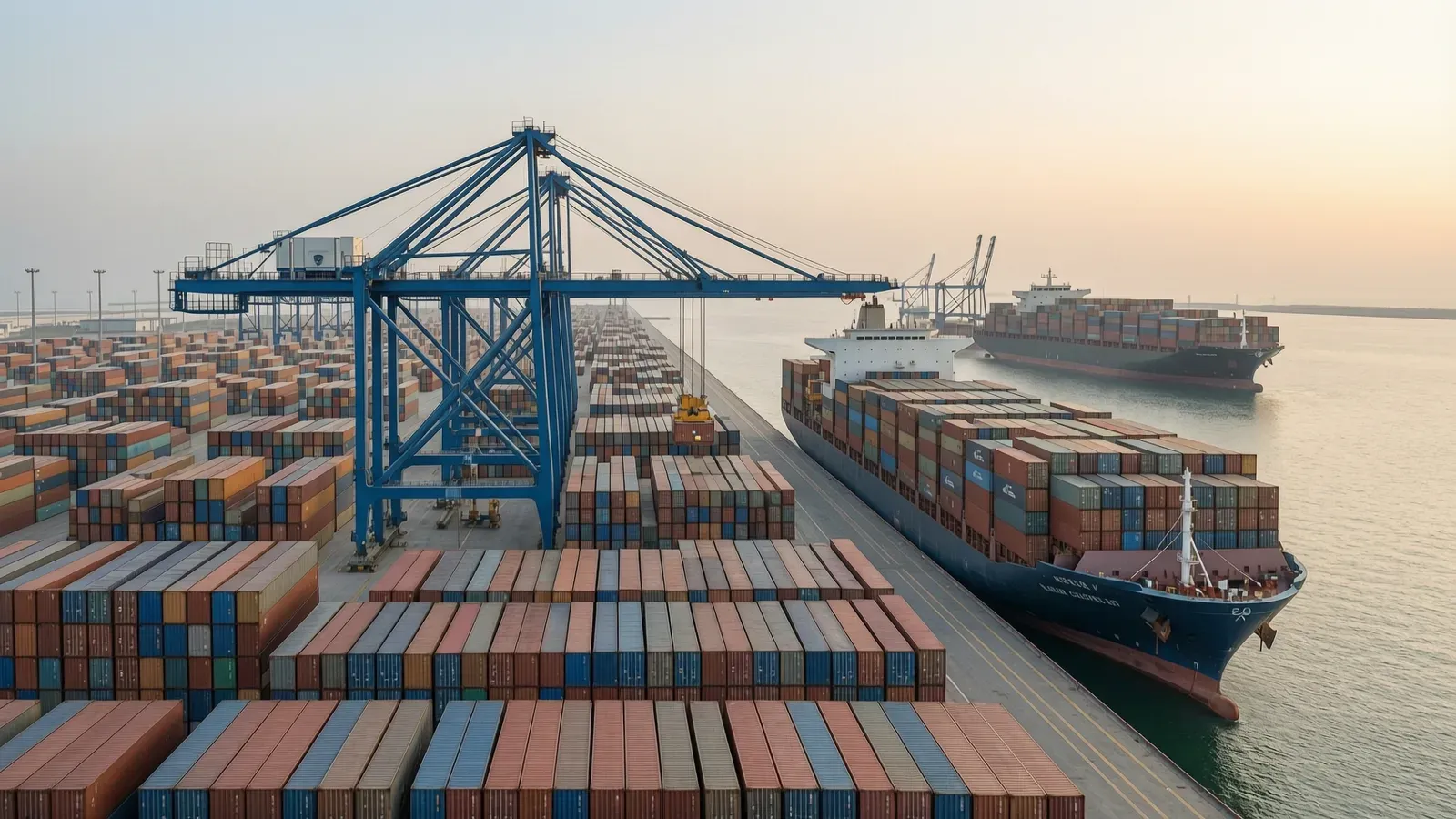
This guide is written from the operating side of the lane: which ports actually work, what Matadi’s draft limit does to your rate and transit time, how Katanga cargo should be routed, what DGDA and OCC clearance requires, what duty and VAT will cost, and where importers most often lose money. Note that this page covers the Democratic Republic of the Congo (DRC) — capital Kinshasa, port of Matadi — not the neighbouring Republic of the Congo, whose capital is Brazzaville and whose main port is Pointe-Noire.
Sea Freight From China to DR Congo
Sea freight from China to DR Congo is the default for anything above roughly 10–15 CBM: building materials, cement, tiles and sanitary ware, machinery, furniture, textiles and wholesale consumer goods. It is the cheapest mode per tonne by a wide margin, and it is the only mode that can absorb a 40HQ of mixed cargo without destroying your margin.
The structural constraint is the Congo River. Matadi sits roughly 150 km upstream from the Atlantic and is a river port with a draft limit of about 8–9 metres, so ocean-going container vessels cannot sail all the way in. Most boxes are therefore discharged at a deep-water hub — Pointe-Noire in Congo-Brazzaville, Luanda in Angola, or Abidjan and Tema further west — and relayed to Matadi by smaller vessel. That relay is inexpensive per container, but it adds handling, a second set of terminal charges and roughly five to eight days. The Matadi Gateway Terminal has improved berth productivity and gate turnaround in recent years, and a new deep-water port at Banana is being phased in on the coast, but neither removes the river constraint entirely.
When to Choose Sea Freight
- Your shipment is above 10–15 CBM and landed cost per unit matters more than speed
- A 35–50 day transit fits your inventory plan or your project schedule
- You need a full container, a shared LCL slot, or breakbulk and RoRo capacity
- The goods are non-perishable and can tolerate humidity and multiple handling points
Typical cargo on this lane: cement and construction materials, ceramic tiles and sanitary ware, generators and solar kits, mining consumables and spare parts, motorcycles and three-wheelers, textiles and footwear, packaged food, and household goods for the Kinshasa retail market.
Sea freight vs air freight from China to DR Congo
| Factor | Sea Freight | Air Freight |
|---|
| Cost per kg | Lowest | Highest |
|---|
| Transit time | 35–50 days to Matadi | 5–10 days to Kinshasa |
|---|
| Minimum sensible load | 10 CBM or 1 tonne | 50–100 kg |
|---|
| Cargo restrictions | Broadest | Battery, liquid and DG limits |
|---|
| Best for | Volume and heavy goods | Urgent and high-value goods |
|---|
Key Ports and Routes
Chinese origin ports used on this lane: Shanghai, Ningbo, Shenzhen (Yantian and Shekou), Guangzhou/Nansha, Qingdao, Tianjin and Xiamen. Wholesalers in Yiwu and Guangzhou usually consolidate at a south China warehouse first, which is cheaper than shipping from several ports.
DR Congo destination ports and corridors:
- Matadi — the main container gateway, operated as the Matadi Gateway Terminal, serving Kinshasa and the lower Congo.
- Boma — smaller terminal, used for breakbulk, project cargo and some conventional shipments.
- Banana — the new deep-water port on the Atlantic coast, being phased into service; ask what capacity is genuinely available before routing cargo through it.
- Pointe-Noire (Congo-Brazzaville) — deep-water alternative with a road and rail connection to Brazzaville and a ferry crossing to Kinshasa.
- Durban, Dar es Salaam, Beira, Walvis Bay and Lobito — the practical gateways for Katanga, with onward trucking to Lubumbashi and Kolwezi.
Indicative sea freight transit times, China to DR Congo
| Origin port | Destination | Transit time |
|---|
| Shanghai | Matadi | 38–46 days |
|---|
| Ningbo | Matadi | 36–44 days |
|---|
| Shenzhen | Matadi | 35–42 days |
|---|
| Guangzhou | Matadi | 36–44 days |
|---|
| Qingdao | Matadi | 38–48 days |
|---|
| Shanghai | Pointe-Noire, then road to Kinshasa | 32–40 days |
|---|
For Katanga, count the sea leg and the road leg separately:
Indicative routings to Lubumbashi and Kolwezi
| Sea leg | Transit | Onward trucking |
|---|
| Shanghai → Dar es Salaam | 26–34 days | 8–14 days to Lubumbashi |
|---|
| Ningbo → Durban | 24–30 days | 10–16 days to Lubumbashi |
|---|
| Shenzhen → Beira | 28–36 days | 12–18 days to Lubumbashi |
|---|
| Shanghai → Lobito Corridor | 30–38 days | 6–12 days to Kolwezi |
|---|
Road conditions on the Katanga corridors vary by season, and border formalities at Kasumbalesa or Sakania can add one to three days. Anyone quoting you a flat 40 days to Lubumbashi without mentioning trucking is quoting a sea leg, not a delivery.
FCL, LCL and RoRo
FCL (full container load). A 20GP, 40GP or 40HQ used exclusively for your cargo. Lowest cost per CBM above roughly 15 CBM and the least damage risk. Standard for cement, tiles, machinery and retail stock into Kinshasa.
LCL (less than container load). Your cargo shares a container and is deconsolidated at a Matadi or Kinshasa warehouse. Sensible below 10–15 CBM, but LCL attracts destination charges — CFS handling, documentation, delivery order — that can be a surprisingly large part of the total on a small shipment. Ask for those charges separately, in writing.
RoRo (roll-on/roll-off). For cars, vans, trucks and wheeled machinery. No container and no packing, usually the cheapest way to move one vehicle, with the caveat that RoRo capacity to this coast is limited and schedules are less frequent than to East Africa.
Air Freight From China to DR Congo
Air freight from China to DR Congo is the fastest option and the right one when a stock-out costs more than the freight. Kinshasa N’djili (FIH) is the primary cargo airport, with Lubumbashi (FBM) handling the Katanga market directly and Goma (GOM) serving the east under tighter security conditions. Direct freighter capacity into Kinshasa is thinner than into Lagos or Nairobi, so most air cargo travels on scheduled belly capacity through Addis Ababa, Nairobi, Johannesburg, Dubai, Doha or Istanbul.
Air is the correct mode for electronics and phones, spare parts for a stopped production line, pharmaceutical and medical supplies, cosmetics and fashion drops, mining instrumentation, documents and samples. It is rarely correct for cement, tiles, furniture or anything above roughly 500 kg that can wait five weeks.
When to Choose Air Freight
- The cargo is urgent, high-value or small enough that freight is a minor part of unit cost
- You need to restock a retail or e-commerce catalogue ahead of a selling season
- A machine is down and a component is blocking production or a mining operation
- You are testing a new supplier with a small trial order before committing to a container
Key Airports and Routes
Chinese origin airports: Guangzhou (CAN), Shenzhen (SZX), Shanghai Pudong (PVG), Hong Kong (HKG), Beijing (PEK) and Yiwu (YIW) for small-commodity consolidations.
DR Congo destination airports: Kinshasa N’djili (FIH), Lubumbashi Luano (FBM), Goma (GOM) and Kisangani (FKI) for smaller regional consignments.
Indicative air freight transit times, China to DR Congo
| Origin airport | Destination airport | Transit time |
|---|
| Guangzhou (CAN) | Kinshasa (FIH) | 5–9 days |
|---|
| Shenzhen (SZX) | Kinshasa (FIH) | 6–9 days |
|---|
| Shanghai (PVG) | Kinshasa (FIH) | 5–8 days |
|---|
| Hong Kong (HKG) | Lubumbashi (FBM) | 7–10 days |
|---|
| Guangzhou (CAN) | Lubumbashi (FBM) | 6–10 days |
|---|
These windows are door to door: they include pickup, export clearance, the flight, arrival handling, DGDA clearance and local delivery. Customs inspection at FIH on a first-time importer can easily add two or three days, which is why the paperwork matters more on air shipments than on sea.
Types of Air Freight Services
- Standard air freight — scheduled consolidation, the best balance of cost and speed for regular commercial cargo
- Express air freight — priority uplift and fast clearance for urgent spare parts and high-value goods
- Consolidated air freight — per-kilo pricing for small consignments from Yiwu and Guangzhou consolidators
- Charter uplift — for oversized, hazardous-class-compliant, or project cargo with a fixed deadline
Air freight is charged on chargeable weight — the greater of actual weight and volumetric weight at 1 CBM to 167 kg. Light, bulky cargo is expensive by air for exactly this reason.
Door to Door Shipping from China to DR Congo
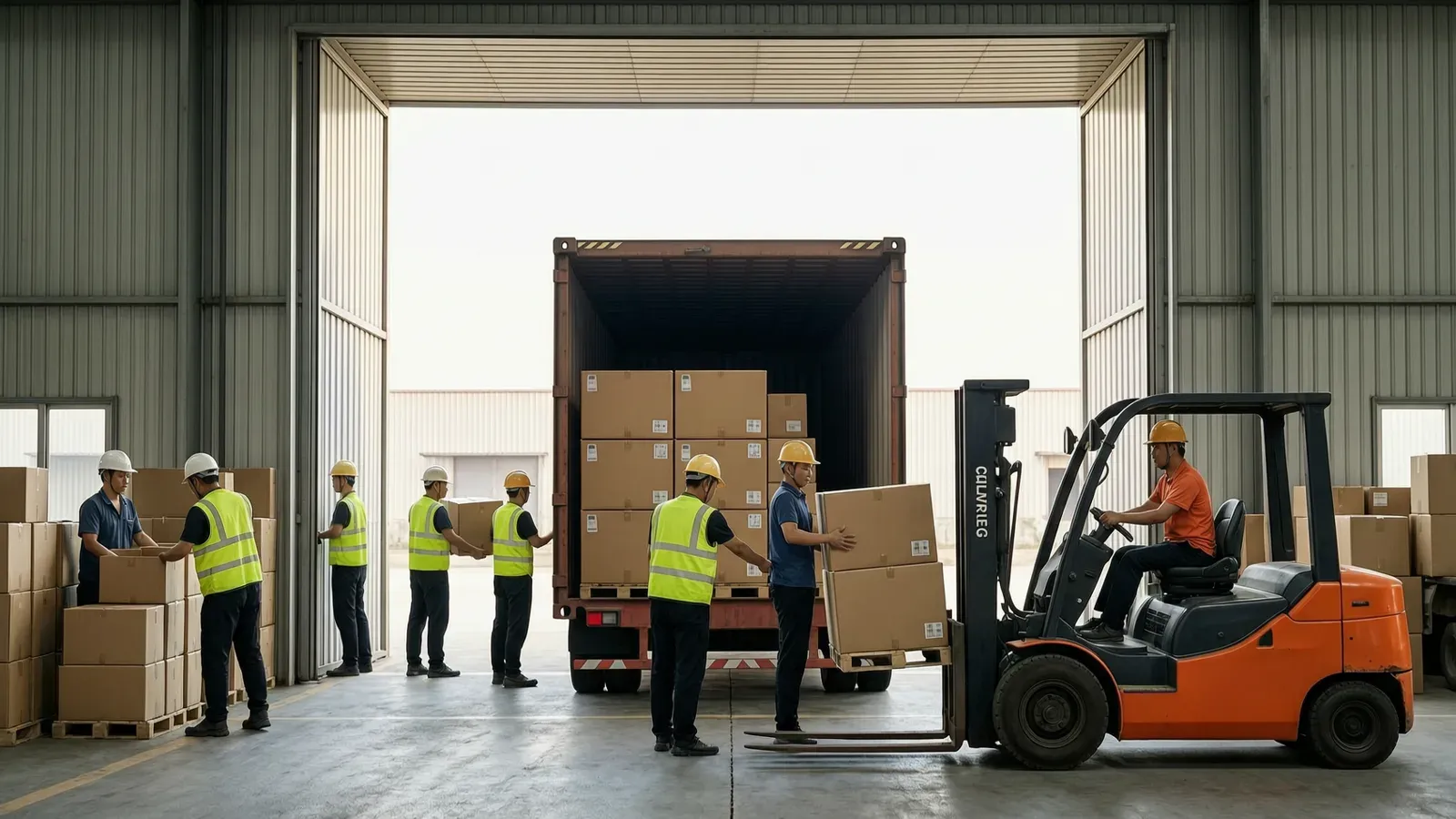
Door-to-door shipping from China to DR Congo bundles the whole chain into one contract: pickup at your supplier, export declaration in China, ocean or air freight, DGDA import clearance, duty and VAT handling, and delivery to your warehouse or shop. For importers without a registered company in the DRC, or without staff who can sit in a Matadi or Kinshasa clearance office, it is usually the difference between a shipment that arrives and one that sits accruing storage.
How Door to Door Shipping Works
- We collect the cargo from your supplier in China and consolidate it at a Shenzhen or Guangzhou warehouse
- Export declaration and certificate of origin are prepared, and the pre-shipment inspection file is opened where required
- Freight is booked — sea to Matadi for volume, air to Kinshasa for urgency
- On arrival, the DIB and import licence are matched to the manifest, and DGDA and OCC formalities are completed
- Duty and VAT are settled, and the cargo is delivered to your address in Kinshasa, Matadi, Lubumbashi, Kolwezi or Goma
Benefits of Door to Door Shipping
What door-to-door changes for a DR Congo importer
| Benefit | Description |
|---|
| One contract, one invoice | No splitting freight, clearance and trucking across three suppliers |
|---|
| Fewer clearance surprises | Duty and VAT estimated before departure, not at the counter |
|---|
| Faster release | Documents pre-checked against DGDA and OCC requirements |
|---|
| Lower hidden cost | Storage and demurrage avoided by sequencing clearance with arrival |
|---|
| Visibility | One advisor reporting milestones from booking to delivery |
|---|
Why Choose Door to Door Shipping
DR Congo clearance is not complicated in principle — it is demanding in detail. The DIB must match the invoice, the invoice must match the manifest, the inspection attestation must exist before the container is loaded, and the import licence must be issued through an authorized commercial bank. One mismatch means inspection, storage and delay. A door-to-door contract moves that risk to the forwarder, who sees the file before the vessel sails rather than after it berths.
Shipping Costs From China to DR Congo
Shipping cost from China to DR Congo splits into four parts, and importers who only compare the ocean freight number are comparing the smallest of them. The four are: origin charges in China, international freight, destination charges at Matadi or FIH, and inland trucking to the final city. On a 40HQ to Kinshasa, the last two often sum to more than the ocean leg.
Rates below are indicative as of November 2026 and move with fuel surcharges, peak season, carrier capacity and Congo River congestion. Always confirm current pricing before you budget.
Sea Freight Cost From China to DR Congo
Indicative ocean freight, China to Matadi (as of November 2026)
| Container type | Estimated cost | Best for |
|---|
| 20GP | USD 3,000 – 4,800 | Heavy, dense cargo |
|---|
| 40GP | USD 4,500 – 6,500 | General commercial cargo |
|---|
| 40HQ | USD 4,800 – 7,000 | High-volume, light cargo |
|---|
| LCL | USD 140 – 220 per CBM | Small shipments under 10–15 CBM |
|---|
Two things push this lane above the East Africa averages. First, the feeder relay: your container is handled twice before it reaches Matadi. Second, destination charges — Matadi terminal handling, shipping-line release, OCC fees and trucking to Kinshasa — are structurally higher than at a deep-water port, because every container is handled more times on a shorter road.
Air Freight Cost From China to DR Congo
Air freight is priced on chargeable weight and moves in narrow bands because capacity into Kinshasa is limited.
Indicative air freight, China to Kinshasa (as of November 2026)
| Chargeable weight | Estimated cost | Suitable cargo |
|---|
| Around 100 kg | USD 6 – 9 per kg | Samples, electronics, spare parts |
|---|
| Around 300 kg | USD 5 – 8 per kg | Commercial cargo, fashion, cosmetics |
|---|
| 500 kg and above | USD 4 – 7 per kg | Bulk air shipments, seasonal restocks |
|---|
Air freight usually becomes competitive with sea freight on landed-cost terms only below roughly 100–150 kg, or when a stock-out or a stopped machine costs more per week than the air premium. Above that weight, sea with a slightly earlier booking almost always wins.
Local Charges and Inland Trucking
Ask any forwarder to quote the destination side separately. On this lane you will see Matadi terminal handling and lift-on/lift-off, shipping-line documentation and release fees, OCC inspection charges, clearance fees, and either trucking to Kinshasa (typically 5–7 hours via the RN1, with a road in variable condition) or a much longer haul to Katanga. A quotation that gives you one all-in number without these lines is not a cheaper quotation — it is an incomplete one.
Shipping Time From China to DR Congo
Transit time from China to DR Congo depends on four variables: the mode, the port pair, the feeder relay schedule at Matadi, and how quickly the clearance file is complete. Vessel delays are rarely the main problem; paperwork is.
Sea Shipping Time From China to DR Congo
Port-to-port transit, China to Matadi
| Route | Transit time | Notes |
|---|
| Shenzhen → Matadi | 35–42 days | Fastest south China option |
|---|
| Ningbo → Matadi | 36–44 days | Feeder via Pointe-Noire or Luanda |
|---|
| Shanghai → Matadi | 38–46 days | Most frequent sailings |
|---|
| Guangzhou → Matadi | 36–44 days | Consolidation-friendly |
|---|
| Qingdao → Matadi | 38–48 days | For northern China suppliers |
|---|
Add 3–7 days for clearance and delivery to a Kinshasa warehouse, and add 8–16 days of trucking if the destination is Lubumbashi or Kolwezi. River congestion at Matadi during peak import periods can add several days on its own — this is the reason we quote 35–50 days rather than a single number.
Air Shipping Time From China to DR Congo
Air transit runs 5–10 days door to door. Flights are frequent, but routing through Addis Ababa, Nairobi, Johannesburg or Dubai adds a connection and a handling point. First-time importers should budget 2–3 extra days for their first clearance.
Summary: Cost vs. Time Comparison
Choosing a mode for DR Congo
| Mode | Cost level | Transit time | Best use case |
|---|
| Sea freight to Matadi | Low | 35–50 days | Volume, heavy cargo, building materials |
|---|
| Sea + overland to Katanga | Medium | 40–55 days | Lubumbashi, Kolwezi, mining and project cargo |
|---|
| Air freight to Kinshasa | High | 5–10 days | Urgent, high-value, low-weight cargo |
|---|
| Door to door | All-inclusive | 40–60 days | Importers without a local clearing entity |
|---|
Customs Clearance & Documents Required
Customs clearance is where DR Congo shipments are won or lost. The formalities themselves are predictable: DGDA assesses duty and VAT, OCC controls quality and standards, and consignments valued at USD 2,500 or more require pre-shipment inspection by the appointed inspection company — historically BIVAC, now operating as Bureau Veritas through the Verigates programme — documented by the DIB and its verification attestation. What goes wrong is mismatched paperwork: an invoice that does not match the manifest, a DIB raised after the cargo has shipped, or a licence that was never issued through the bank.
Key Documents Required
Core import documents for DR Congo
| Document | Purpose | Issued by |
|---|
| Commercial invoice | Declares value, terms and HS codes — French or with a French translation | Exporter |
|---|
| Packing list | Quantity, weight, dimensions and packaging | Exporter |
|---|
| Bill of lading / air waybill | Title and contract of carriage | Carrier |
|---|
| Certificate of origin | Confirms manufacture origin, supports preferential treatment | Chamber of commerce |
|---|
| DIB / import licence | Import declaration, authorized through a commercial bank | Bank and DGDA |
|---|
| Inspection attestation | Pre-shipment inspection for consignments from USD 2,500 | Bureau Veritas (Verigates) |
|---|
| Insurance certificate | Cargo cover, often required for bank-financed imports | Insurer |
|---|
Product-specific extras are common: phytosanitary certificates for food and agricultural goods, conformity or CE documentation for electrical and electronic items, specific authorizations for pharmaceuticals, telecoms equipment, chemicals and used vehicles. Confirm these before the container is loaded, not after arrival.
DR Congo Import Duties and Compliance
Duty is assessed on CIF value — cost, insurance and freight. Import duty generally falls in the 5–20 percent range depending on the tariff heading, VAT is 16 percent on most goods, and OCC inspection fees plus a small number of product-specific levies apply on top; some consumer categories also attract excise duty. Reduced rates exist for certain raw materials and capital goods, and rates change with the national budget.
Two compliance points catch importers repeatedly:
- The importer of record must be registered. You need an import-export number and an import licence issued through an authorized commercial bank under the central bank’s foreign-exchange rules. If you do not have an entity in the DRC, plan the clearance through a registered importer-of-record arrangement before you ship.
- The inspection attestation must precede shipment. Goods that arrive without a valid inspection file are inspected on arrival instead, which costs time and money and can lead to a reassessment.
Common Mistakes When Shipping From China to DR Congo
Most avoidable losses on this lane come from five recurring errors.
Common mistakes and their cost
| Mistake | Impact | How to avoid it |
|---|
| Routing Katanga cargo via Matadi | Weeks of extra transit and costly cross-country trucking | Use Durban, Dar es Salaam, Beira or Lobito for Lubumbashi and Kolwezi |
|---|
| Booking the inspection too late | Cargo held on arrival, storage and demurrage | Raise the DIB and inspection file before the vessel sails |
|---|
| Under-declaring value | Reassessment, fines, confiscation risk | Declare the true transaction value on a consistent basis |
|---|
| Ignoring destination charges | Landed cost 25–40 percent above the quoted rate | Ask for Matadi handling, OCC and trucking as separate lines |
|---|
| Shipping without a registered importer | Cargo cannot be cleared at all | Set up the importer-of-record arrangement in advance |
|---|
Why Professional Support Matters
A forwarder who knows this coast will tell you three things before you book: which routing suits your destination city, what the destination charges are, and what documents must exist before loading. That advice costs nothing at quotation stage and saves several thousand dollars at arrival. It also protects you against the quiet failure mode of this lane — a container that reaches Matadi correctly but cannot be cleared because the licence was issued to the wrong entity.
A Practical Checklist for First Shipments
- Confirm the HS code and current duty rate in writing before you place the order
- Decide the destination city first, then the routing — not the other way round
- Insist on a destination-cost breakdown in the quotation
- Keep invoices, packing lists and the B/L consistent to the letter — French translation included
- Allow 10–14 days of buffer on your first shipment and hold it in the plan, not in a spreadsheet footnote
How to Choose the Right Freight Forwarder
The right forwarder for DR Congo cargo is not necessarily the cheapest quote. On a lane with a river port, a feeder relay and a documentation-heavy clearance process, the difference between a good and a mediocre forwarder shows up in week five, not on the invoice.
What to check before you sign
| Criteria | Why it matters |
|---|
| Genuine DR Congo experience | Knows Matadi’s draft limits, feeder schedules and DGDA practice |
|---|
| Destination partners on the ground | Clearance and delivery without third-hand coordination |
|---|
| Multiple routings | Can route Katanga via east or south coast as conditions change |
|---|
| Itemized destination costs | Landed cost is visible before you commit |
|---|
| Documentation discipline | DIB, inspection and licence handled in the right order |
|---|
| Transparent communication | Realistic windows and proactive delay notices |
|---|
Why Work With EFANDA Logistics
EFANDA Logistics has been moving cargo out of China since 2018, with its head office in Shenzhen and origin teams in Guangzhou, Ningbo and Yiwu. We handle sea, air and door-to-door freight to DR Congo and to more than 40 other destinations, with one advisor per account and pricing that itemizes every charge rather than blending it into a single number.
EFANDA’s Core Advantages
What you get on a China to DR Congo shipment
| EFANDA strength | What it changes for you |
|---|
| China origin coverage | Pickup from Yiwu, Guangzhou, Shenzhen, Ningbo and Qingdao under one booking |
|---|
| Lane-specific routing advice | Matadi for Kinshasa, east or south coast for Katanga |
|---|
| Documentation support | DIB, OCC inspection file and certificate of origin prepared before loading |
|---|
| Clearance coordination | DGDA formalities handled with registered local partners |
|---|
| Consolidation and warehousing | LCL, re-packing and quality checks at origin |
|---|
| One advisor, no call centre | Direct access to the person handling your shipment |
|---|
A Reliable Partner for Long-Term Growth
Importers who ship regularly to the DRC usually settle into a rhythm: one container a month to Matadi, air for the urgent gaps, and a Katanga lane booked separately when the mining side of the business needs it. That rhythm only works with a forwarder who quotes consistently, warns you when a route is degrading, and does not rediscover your paperwork at every sailing.
If you are planning your first shipment from China to DR Congo, or you are tired of quotations that hide the destination side, send us your cargo details. You will get a costed plan with transit windows, duty estimates and the document list for your specific product — no obligation, no hidden fees. Start with a free quote at Efanda Logistics.