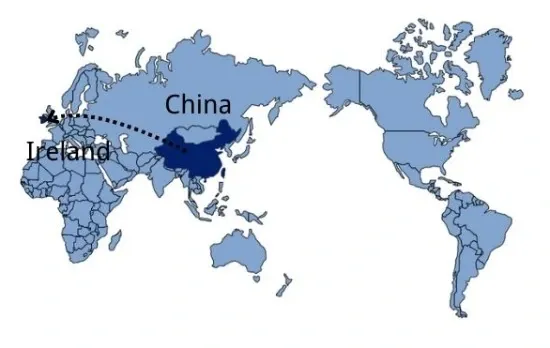
Shipping from China to Ireland looks like a short European leg on a map, and that is exactly why so many importers misjudge it. Ireland is an island inside the EU customs union with no direct China container call, so every box is relayed at a continental hub and fed in on a second vessel, or landed in Britain and trucked across on a transit document. Each of those handovers is a place where a week disappears — and where a document that was fine for Rotterdam turns out to be wrong for Dublin.
This guide is written from the operating side of the route: how sea and air freight from China to Ireland is priced, which port pairs actually work, what the feeder and landbridge options cost in time, how EU customs duty and 23 percent VAT land on a shipment, why postponed VAT accounting matters more here than the freight rate, where anti-dumping bites, and what importers most often get wrong. China is one of Ireland’s largest trading partners outside the EU and the UK, and the cargo mix runs from machinery, electronics and furniture to medical device components, toys, apparel and e-bikes — each with a different duty rate and a different compliance file.
Sea Freight From China to Ireland
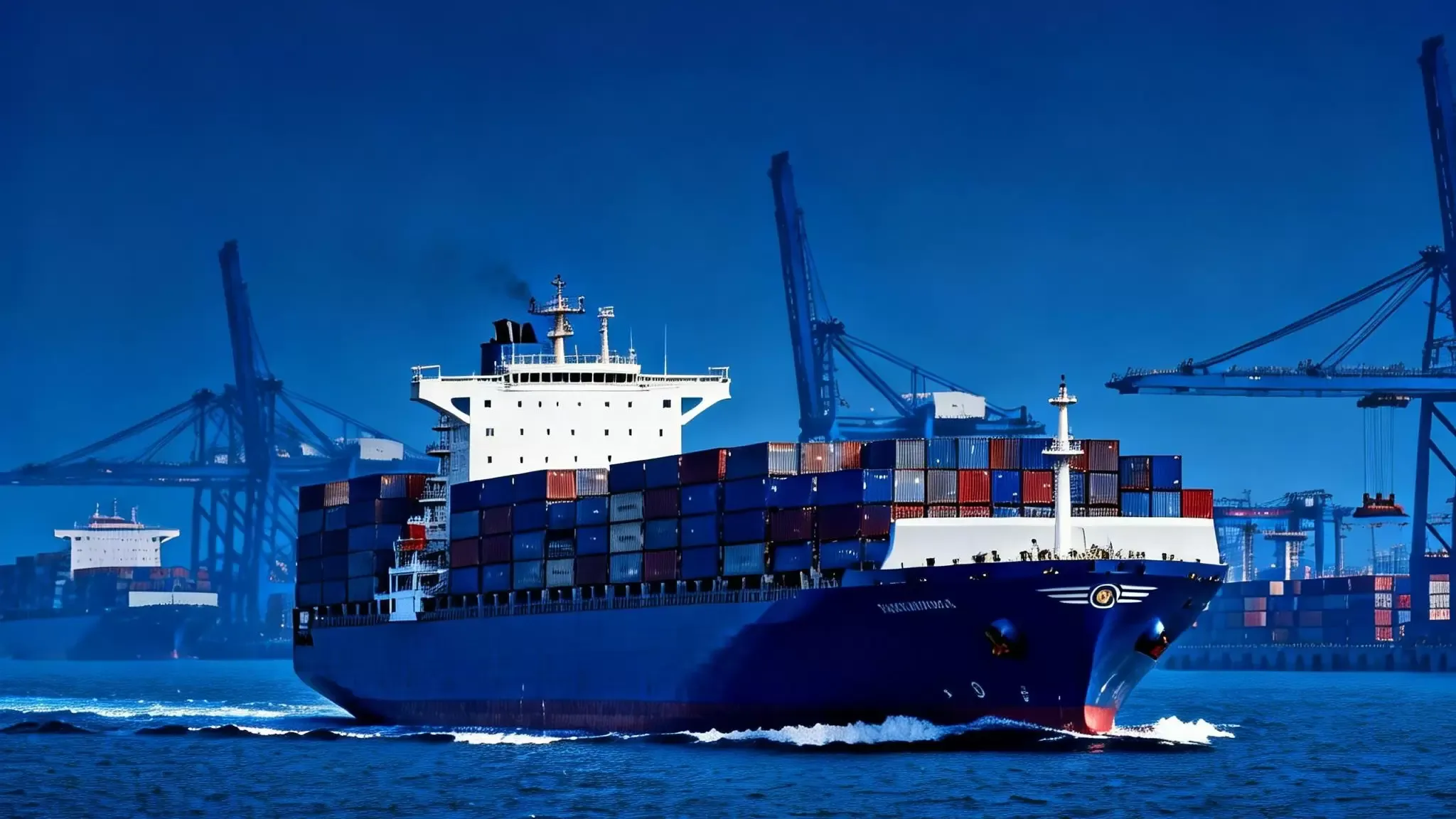
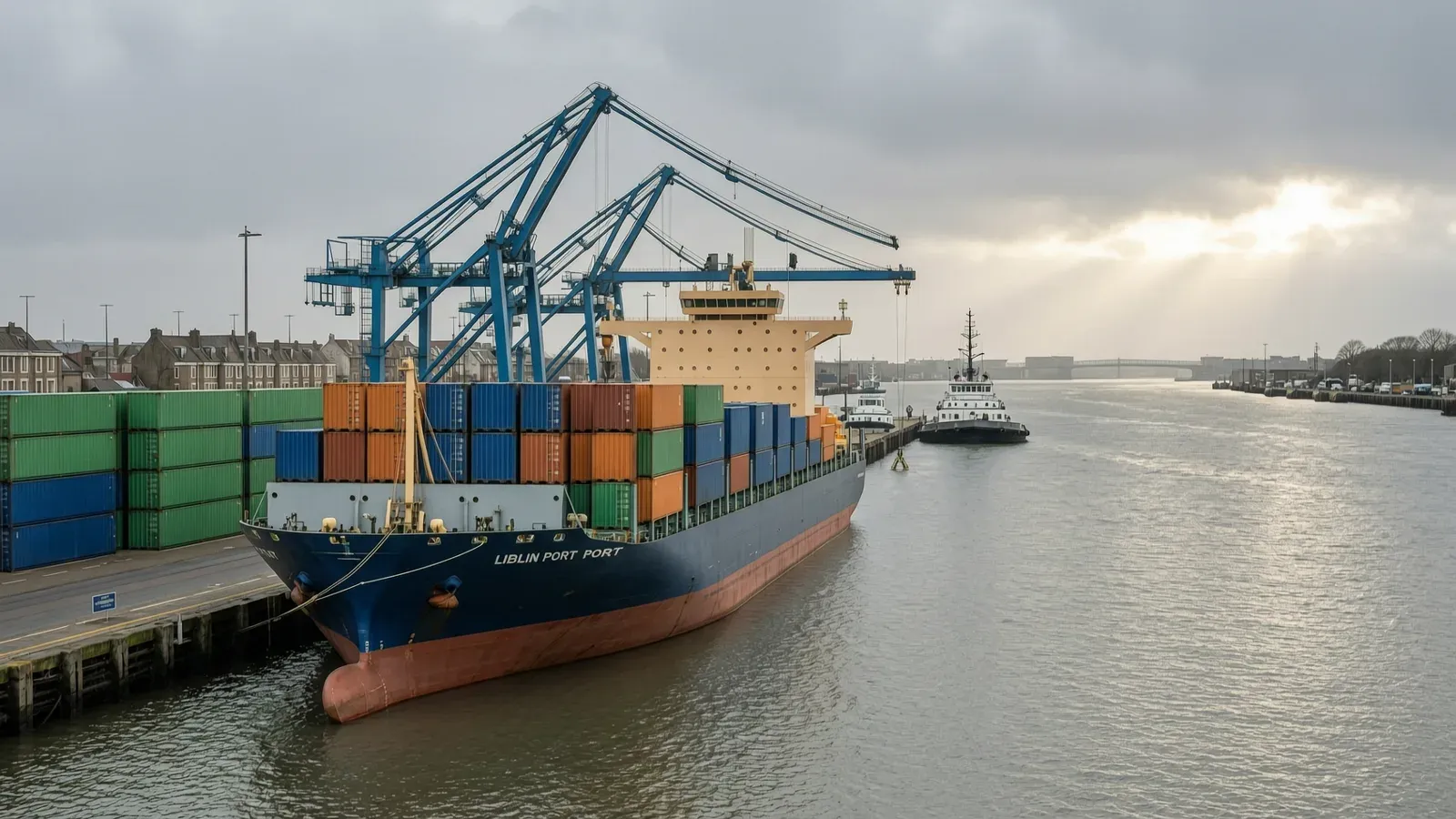
Sea freight from China to Ireland is the default for anything above roughly 15 CBM: furniture, machinery, building materials, vehicle parts, medical device components, textiles and full production runs. Container services leave Shanghai, Ningbo, Shenzhen, Qingdao, Tianjin and Xiamen on Asia–North Europe strings, discharge at Rotterdam, Antwerp, Hamburg, Le Havre or Zeebrugge, and connect to a feeder into Dublin, Cork or Waterford. Ocean transit to the relay port is four to five weeks; the feeder connection adds three to seven days, and that connection is where schedules slip.
The commercial detail most rate sheets hide is that Ireland pays for two sea legs. Your rate sheet shows an Asia–North Europe price and then adds a feeder surcharge, Irish terminal handling and a port charge that is higher per container than Rotterdam or Antwerp because volumes are smaller. Importers who compare a Dublin quote against a Hamburg quote and conclude they are being overcharged have usually missed the second leg, not found a bad forwarder.
When to Choose Sea Freight
- Your shipment exceeds 15 CBM or 2 tonnes and cost per unit matters more than speed
- A five to seven week door-to-door window fits your inventory plan
- You need a full container, a shared LCL slot, reefer capacity or RoRo space for vehicles and machinery
- The goods are non-perishable and tolerate an extra handling point at the relay port
Typical cargo on this lane: furniture and household goods, industrial machinery and spare parts, medical device components, electronics, textiles and footwear, automotive parts, solar equipment and batteries (subject to carrier dangerous goods rules), and project cargo.
Sea Freight vs Air Freight from China to Ireland
| Factor | Sea Freight | Air Freight |
|---|
| Cost per kg | Lowest | Highest |
|---|
| Transit time | 32–42 days | 3–7 days |
|---|
| Minimum sensible load | 15 CBM or 2 tonnes | 50–100 kg |
|---|
| Cargo restrictions | Broadest | Battery, liquid and DG limits |
|---|
| Best for | Volume and heavy goods | Urgent and high-value goods |
|---|
Key Ports and Routes
China origin ports: Shanghai, Ningbo, Shenzhen (Yantian and Shekou), Guangzhou/Nansha, Qingdao, Tianjin and Xiamen.
Irish destination ports: Dublin Port (by far the largest freight gateway, about 36 million tonnes in 2025, with direct quay-to-warehouse transfer into the city and the M50 ring), Cork (Ringaskiddy and Tivoli, for Munster and the south), Rosslare Europort (RoRo and trailer traffic from the continent), Shannon Foynes (bulk, project and heavy lift), Waterford (Belview) and Drogheda by arrangement. Belfast is a UK port in Northern Ireland and is a different customs territory.
Indicative sea freight transit times, China to Ireland
| Origin port | Irish port | Transit time |
|---|
| Shanghai | Dublin | 32–40 days |
|---|
| Ningbo | Dublin | 33–41 days |
|---|
| Shenzhen | Dublin | 34–42 days |
|---|
| Qingdao | Dublin | 35–43 days |
|---|
| Shanghai | Cork | 36–44 days |
|---|
| Shanghai | Rosslare | 34–42 days |
|---|
| Ningbo | Waterford | 36–44 days |
|---|
Add three to seven days for the feeder connection at the relay port, and three to five days when Dublin Port is congested in the pre-Christmas peak. A routing that promises twenty-eight days to Dublin is quoting the ocean leg only.
FCL, LCL and RoRo
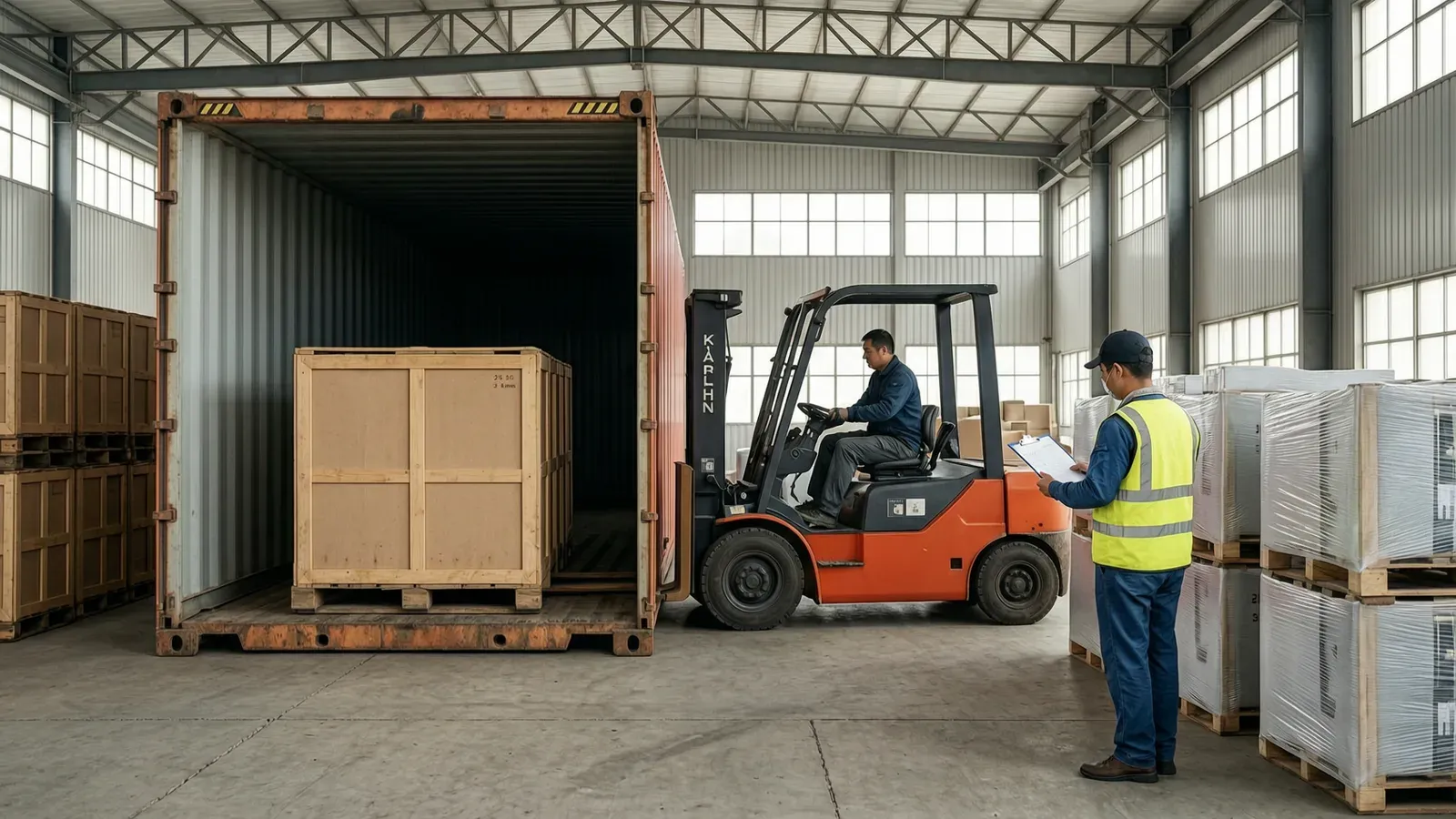
FCL (full container load). A 20ft, 40ft or 40HQ container used exclusively for your cargo. Lowest cost per CBM above roughly 15 CBM and the least handling, which matters more on this lane than on a direct one, because the box stays sealed through the relay port. The standard choice for machinery, furniture sets and repeat orders into Dublin and the east coast.
LCL (less than container load). Your cargo shares a container and is deconsolidated at a Dublin or Cork warehouse. Sensible below 15 CBM, but LCL on this lane can be slower than FCL because it waits for both the ocean and the feeder, and the destination charges (CFS, documentation, delivery order) surprise first-time importers.
RoRo (roll-on/roll-off). For cars, vans, trucks, buses and self-propelled machinery. Ireland imports a significant volume of used and new vehicles from Asia, and RoRo works via Rosslare and Dublin from continental RoRo hubs. Book early: space on the continental legs sells out around model-year launches.
Air Freight From China to Ireland
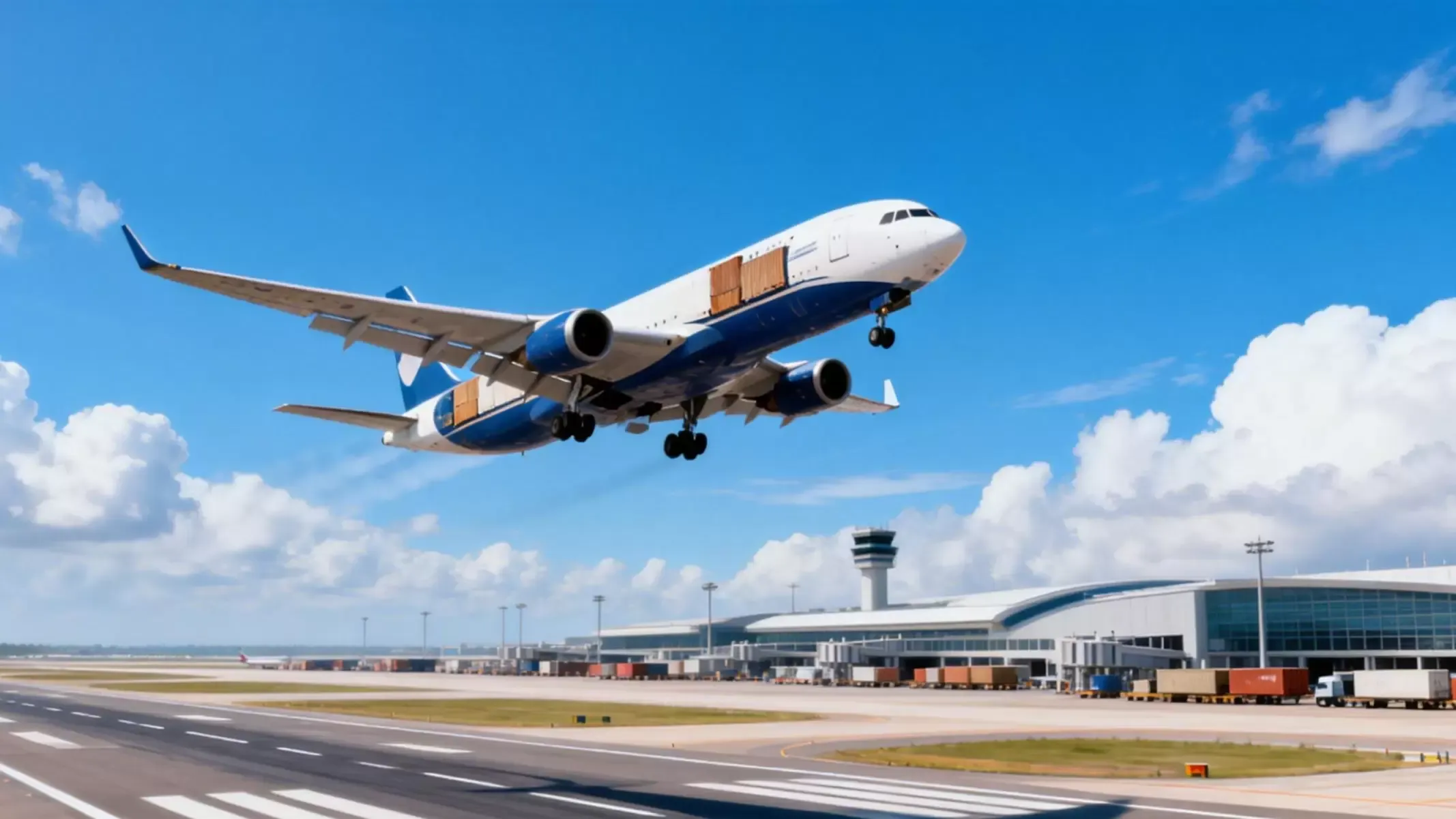
Air freight from China to Ireland is the only sensible option when a shipment is urgent, small or high-value. There is no direct freighter service of any depth from China to Dublin, so cargo travels on one-stop routings: Shanghai, Shenzhen or Hong Kong to a Gulf, Turkish or European hub, then on to Dublin or Shannon. That stop is why door-to-door air transit into Ireland is measured in days rather than hours, and why a Friday cutoff in Shenzhen lands on Tuesday or Wednesday rather than Monday.
Air is the right mode when stockout cost exceeds freight cost: electronics, medical device components, pharma samples, fashion drops, exhibition materials, spare parts for a stopped line, and e-commerce replenishment. It is rarely right for furniture, ceramics or anything above roughly 500 kg that can wait four weeks.
Key Airports and Routes
Chinese airports: Shanghai Pudong (PVG), Guangzhou Baiyun (CAN), Shenzhen Bao’an (SZX), Beijing Capital and Daxing (PEK/PKX), Hong Kong (HKG) and Chengdu Tianfu (TFU).
Irish airports: Dublin (DUB) carries the overwhelming majority of international cargo and has the country’s main bonded warehouse capacity; Shannon (SNN) is the second cargo gateway with US preclearance and freighter handling; Cork (ORK) and Ireland West (NOC) take domestic and ad hoc traffic.
Indicative air freight transit times, China to Ireland
| Route | Transit time | Notes |
|---|
| Shanghai → Dublin | 2–4 days | One stop via a Gulf, Turkish or European hub |
|---|
| Shenzhen → Dublin | 3–5 days | Electronics consolidation |
|---|
| Guangzhou → Dublin | 2–5 days | Belly capacity dependent |
|---|
| Hong Kong → Dublin | 2–5 days | Frequent one-stop options |
|---|
| Shanghai → Shannon | 3–6 days | Via a European hub plus a short leg |
|---|
Transit above is airport to airport. Door to door adds pickup in China, export clearance, import clearance at DUB and trucking — plan 3–7 days end to end, and more if the goods are held for a Revenue query or a product compliance check.
Door to Door Shipping From China to Ireland
Door-to-door shipping from China to Ireland puts the whole chain under one contract: supplier pickup, export declaration in China, main carriage, feeder or landbridge leg, Irish import clearance, duty and VAT settlement, and delivery to your warehouse, store or site. For importers without a customs department, it is usually the difference between a shipment that arrives and one that sits at Dublin Port accruing storage.
What a properly quoted door-to-door service includes:
- Pickup from the supplier, with a check of packing marks and carton counts
- Export clearance in China, plus a certificate of origin where the destination needs one
- Ocean or air main carriage, including the feeder or landbridge connection
- Import declaration filed through Revenue by a customs agent using your EORI
- Duty and VAT settlement, or postponed accounting on your VAT return
- Delivery to the final address, with unloading arranged in advance
Door-to-door process, China to Ireland
| Step | What happens | Owner |
|---|
| Booking | Space, routing and Incoterm confirmed | Efanda |
|---|
| Pickup | Cargo collected and checked at origin | Efanda origin team |
|---|
| Export | Declaration filed in China | Efanda |
|---|
| Main carriage | Ocean or air to the relay port | Carrier |
|---|
| Feeder / landbridge | Onward leg into Dublin or Cork | Efanda partner |
|---|
| Import clearance | AIS declaration, duty and VAT settled | Irish customs agent |
|---|
| Delivery | Trucked to the final address | Efanda partner |
|---|
The detail that decides the design of any DDP shipment into Ireland is the EORI. The declaration must be filed by or on behalf of an EU-established importer of record, and an Irish or EU VAT number is what unlocks postponed accounting. A non-EU seller cannot simply declare its own goods and pay the duty at the port. DDP therefore runs through a registered importer-of-record arrangement — your Irish entity, your customer, or a partner of record that we coordinate — with duty and VAT itemized before the cargo sails.
Shipping Costs From China to Ireland
Shipping costs from China to Ireland are built from five blocks, not four: origin charges, main ocean or air freight, the feeder or landbridge leg, Irish destination charges (terminal handling, documentation, delivery order, storage) and duty plus VAT. Most importer complaints trace back to a quote that silently omitted the third block.
Main freight moves with the market. Rates on the Asia–North Europe strings react to capacity, fuel surcharges and the pre-Christmas peak within weeks, and the feeder surcharge moves separately because it is a different vessel on a different schedule. Treat the ranges below as planning benchmarks, not quotes.
Indicative sea freight cost ranges, China to Ireland, November 2026
| Service | Indicative range | Best for |
|---|
| 20ft FCL | USD 1,900 – 3,400 | 10–28 CBM of dense cargo |
|---|
| 40ft / 40HQ FCL | USD 3,000 – 5,400 | 25–65 CBM, furniture and machinery |
|---|
| LCL | USD 95 – 180 per CBM | 2–15 CBM, test orders |
|---|
| RoRo | Quoted per vehicle | Cars, vans, wheeled machinery |
|---|
Indicative air freight cost ranges, China to Ireland, November 2026
| Shipment size | Indicative range | Typical use |
|---|
| 50–100 kg | USD 4.5 – 8 per kg | Samples, documents, spare parts |
|---|
| 100–300 kg | USD 4 – 7 per kg | Electronics, apparel restock |
|---|
| 500 kg and above | USD 3.5 – 6.5 per kg | Commercial cargo, negotiated |
|---|
All figures are indicative ranges as of November 2026 and exclude duty, VAT and cargo insurance. They move weekly with fuel, capacity and season. The sea bands sit above the continental North Europe lane for the same origin ports, because a Dublin box pays for two ocean legs and Irish port charges — a gap of roughly USD 300 to 500 per container is normal, not a sign of a bad quote.
Shipping Time From China to Ireland
Shipping time from China to Ireland is a range, and the honest version includes the leg most quotes leave out. Ocean transit to the relay port is 28–35 days, the feeder connection adds 3–7 days, and door-to-door delivery adds pickup, export clearance, import clearance and trucking — so plan five to seven weeks by sea and one week by air.
What delays shipments on the China to Ireland lane
| Delay | Typical impact | Where it happens |
|---|
| Missed feeder connection | 3–7 days | Rotterdam, Antwerp or Zeebrugge |
|---|
| Dublin Port congestion | 2–5 days | Pre-Christmas and ferry peaks |
|---|
| GB landbridge border check | 2–6 days | Holyhead, Liverpool or Felixstowe |
|---|
| Revenue query on the declaration | 2–10 days | Customs review at Dublin |
|---|
| Wrong or missing CN code | Reclassification after arrival | Origin documentation in China |
|---|
| Incomplete EORI or importer details | Goods held, storage accrues | Declaration filed without a valid EORI |
|---|
The pattern behind those rows is simple: on this lane nobody loses a shipment because the ocean crossing was slow. They lose it because a feeder was missed by one day, or because the declaration reached Revenue without the EORI and the CN code agreeing with the invoice.
Ireland Customs Clearance, Duties and Documents
Customs clearance is where a well-priced shipment becomes an expensive one. Ireland applies the EU customs code and the EU tariff, so the duty rate is set by the CN code in TARIC, and VAT is charged at the standard rate of 23 percent on the CIF value plus duty.
Duty, VAT and the EU Tariff
There is no free trade agreement between the EU and China, so duty is payable on Chinese-origin goods whatever paperwork accompanies them. That is the single biggest structural difference between this lane and the China–Chile or China–Peru routes: a certificate of origin does not reduce the rate to zero here. What does change the bill is classification, the anti-dumping register, and cashflow.
Duty and VAT on a USD 10,000 FOB shipment, worked example
| Line | Machinery at 2.7 percent | Apparel at 12 percent |
|---|
| CIF value (goods + freight + insurance) | USD 12,100 | USD 12,100 |
|---|
| Duty at the TARIC rate | USD 327 | USD 1,452 |
|---|
| VAT base | USD 12,427 | USD 13,552 |
|---|
| VAT at 23 percent | USD 2,858 | USD 3,117 |
|---|
| Total tax paid | USD 3,185 | USD 4,569 |
|---|
Two practical conclusions follow. First, an extra five percentage points of duty costs more than most importers assume, because it also inflates the VAT base — a classification argument is often worth more than a freight negotiation. Second, businesses registered for VAT and customs can use postponed accounting, declaring import VAT on the VAT return instead of paying it at the port. On the machinery example above, that moves USD 2,858 of cash out of the port and into a return cycle, which for a company shipping monthly is a working-capital decision rather than an accounting detail.
Anti-dumping is the trap on this lane. The EU maintains measures on a long list of Chinese products — electric bicycles have carried definitive duties from around 10 to 70 percent since the original 2019 measures, renewed after an expiry review in 2025, and similar measures cover ceramics, certain steel products, glass fibres and fasteners. A rate sheet built on the base TARIC figure will not show them. Screening the CN code against the anti-dumping register before booking is the difference between a landed cost and a guess.
Documents Required for Irish Customs
The import declaration is filed electronically through Revenue by a customs agent, and the supporting documents must agree with it line by line.
Standard documents for importing into Ireland
| Document | Purpose | Notes |
|---|
| Commercial invoice | Declares value and terms | Must match the CN code and Incoterm |
|---|
| Packing list | Quantity, weight, packaging | Drives inspection and CFS charges |
|---|
| Bill of lading / AWB | Contract of carriage | Original, telex release or sea waybill |
|---|
| EORI number | Importer identification | Required for every declaration |
|---|
| Import declaration | Customs entry (AIS) | Filed by the customs agent |
|---|
| VAT registration | Unlocks postponed accounting | Irish or EU VAT number |
|---|
| Product compliance file | CE marking, WEEE, Repak | Sector-specific obligations |
|---|
| Insurance certificate | Cargo cover evidence | Recommended on every shipment |
|---|
Compliance work does not stop at customs. Electrical and electronic goods need CE marking, WEEE Ireland registration and battery obligations, packaged goods need Repak membership for packaging waste, and toys, medical devices, cosmetics and chemicals carry their own regimes. Prepare these in China — the labelling, the technical file, the authorised representative — because fixing them after arrival means storage charges at Dublin and a product that cannot be sold even though it has cleared.
Relay, Landbridge or Air: Choosing the Routing
Routing is now a real commercial decision on this lane, and the right answer depends on your deadline, your volume and how much documentation you want to manage.
Routing options into Ireland compared
| Factor | Continental relay + feeder | UK landbridge | Air to Dublin |
|---|
| Typical transit | 32–42 days | 28–35 days | 3–7 days |
|---|
| Cost per container | Lowest | Medium | Highest |
|---|
| Transit document | Through B/L, no extra procedure | T1 transit with a guarantee | Air waybill |
|---|
| Extra border | None | GB entry and exit | None |
|---|
| Best for | Volume, FCL, predictable schedules | Urgent LCL, seasonal stock | Stockouts and high value |
|---|
The relay route is the default and the cheapest, and for most importers it is also the most predictable: one bill of lading, one customs declaration at Dublin, no guarantee to post. The landbridge buys two to four days into Dublin and suits urgent LCL and seasonal stock, but it puts a border crossing in the middle of your transit, which means the transit guarantee, the carrier’s GB handling and the risk of a check all land on your shipment. Air is the answer when the stockout costs more than the freight, and it is worth remembering that Shannon is a genuine alternative to Dublin when the Dublin warehouse is congested.
And one caution that catches new importers every month: Northern Ireland is not Ireland for customs purposes. Belfast is a UK port and goods moving there follow the UK declaration and the Windsor Framework arrangements, not an Irish entry. A quote that mixes Dublin and Belfast as interchangeable options is a quote that has not understood the route.
Common Mistakes When Shipping From China to Ireland
Most losses on this lane are avoidable, and they repeat in the same patterns across importers of every size.
Frequent mistakes and their impact
| Mistake | What it causes | Typical cost |
|---|
| Comparing a Dublin quote with a Hamburg quote | Missing feeder and Irish port charges | Extra 15–25 percent on the invoice |
|---|
| Naming a non-EU importer of record | Declaration rejected or delayed | Storage and re-issue costs |
|---|
| Skipping the anti-dumping check | Duty discovered at clearance | Margin erased on e-bikes and ceramics |
|---|
| Wrong CN code | Wrong duty and delays | Reclassification after arrival |
|---|
| No postponed VAT set-up | Cash tied up at the port | Thousands in working capital |
|---|
| Forgetting WEEE or Repak registration | Goods cleared but unsellable | Full cargo value at risk |
|---|
Three habits prevent almost all of it. First, ask for an all-in door-to-door quote broken into origin, ocean, feeder, destination and tax, rather than a headline rate. Second, confirm the CN code, the TARIC rate and the anti-dumping position before the goods ship. Third, set up the EORI, the VAT registration and the compliance registrations weeks before arrival — not when the vessel is at anchor in Dublin Bay.
How to Choose the Right Freight Forwarder
A freight forwarder from China to Ireland should be judged on routing and customs capability, not on the rate. The failures that hurt importers happen at the relay port, in the customs agent’s office and at the product compliance stage, which is exactly where a cheap online booking platform has no people.
What to check:
- EU customs capability. A customs agent relationship with a named contact who can answer a valuation or classification question, not a referral.
- Routing honesty. A forwarder who quotes only the relay will never tell you the landbridge would have saved four days.
- Anti-dumping screening. Who checks the CN code against the measures in force, and what happens if they miss one.
- Document pre-checks. Invoice, packing list, CN code and compliance file reviewed before departure, not at the quay.
- Communication during exceptions. The test of a forwarder is what happens when a feeder is missed or Revenue raises a query.
Why Work With EFANDA Logistics
EFANDA Logistics has handled China-origin freight since 2018 from Shenzhen, and the China–Ireland lane is one of our standing trade routes. We quote sea and air on the same desk, and we quote both routings — relay and landbridge — so the recommendation you get is the one that fits your deadline rather than the one that is easiest to sell.
EFANDA Logistics on the China to Ireland lane
| Service area | What you get |
|---|
| Sea freight China to Ireland | FCL, LCL and RoRo into Dublin, Cork, Rosslare, Waterford and Shannon Foynes |
|---|
| Air freight China to Ireland | Consolidation and one-stop uplifts into DUB and SNN |
|---|
| Irish customs | Customs agent coordination, AIS declarations, EORI and postponed VAT set-up |
|---|
| Duty planning | CN code verification, TARIC rates and anti-dumping screening |
|---|
| Compliance support | CE marking, WEEE Ireland and Repak registration guidance |
|---|
| Account management | One advisor, proactive milestone updates |
|---|
If you are comparing routes, ask us for a side-by-side: the same shipment priced by sea via the relay, by sea over the landbridge and by air, with realistic transit windows and the landed cost including duty and VAT, with and without postponed accounting. That comparison, not a single rate, is what usually decides the right mode — and it is free.