Is your shipment too small for a full container but too large for express courier? LCL shipping from China to Brazil is often the sweet spot for importers moving 1–15 CBM needing ocean freight savings without paying for unused space. Yet Brazil is one of Latin America’s most complex import markets, and many smaller importers either overpay for FCL (Full Container Load) or get surprised by destination charges, customs exams, and documentation errors.
This guide covers how LCL shipping works on the China–Brazil lane, 2026 costs, transit times, ports, cargo prep, Brazilian customs, LCL vs. FCL, and cost-saving tips.
Disclaimer & Expert Review: Ocean freight rates and transit times fluctuate due to fuel adjustments, carrier capacity, seasonal demand, and port congestion. The figures in this guide are indicative for mid-2026, drawn from Efanda’s carrier quote data and hands-on experience coordinating LCL shipments from South China to Brazil; always request a fresh, itemized quote before booking.
What Is LCL Shipping and When Should You Use It for Brazil?
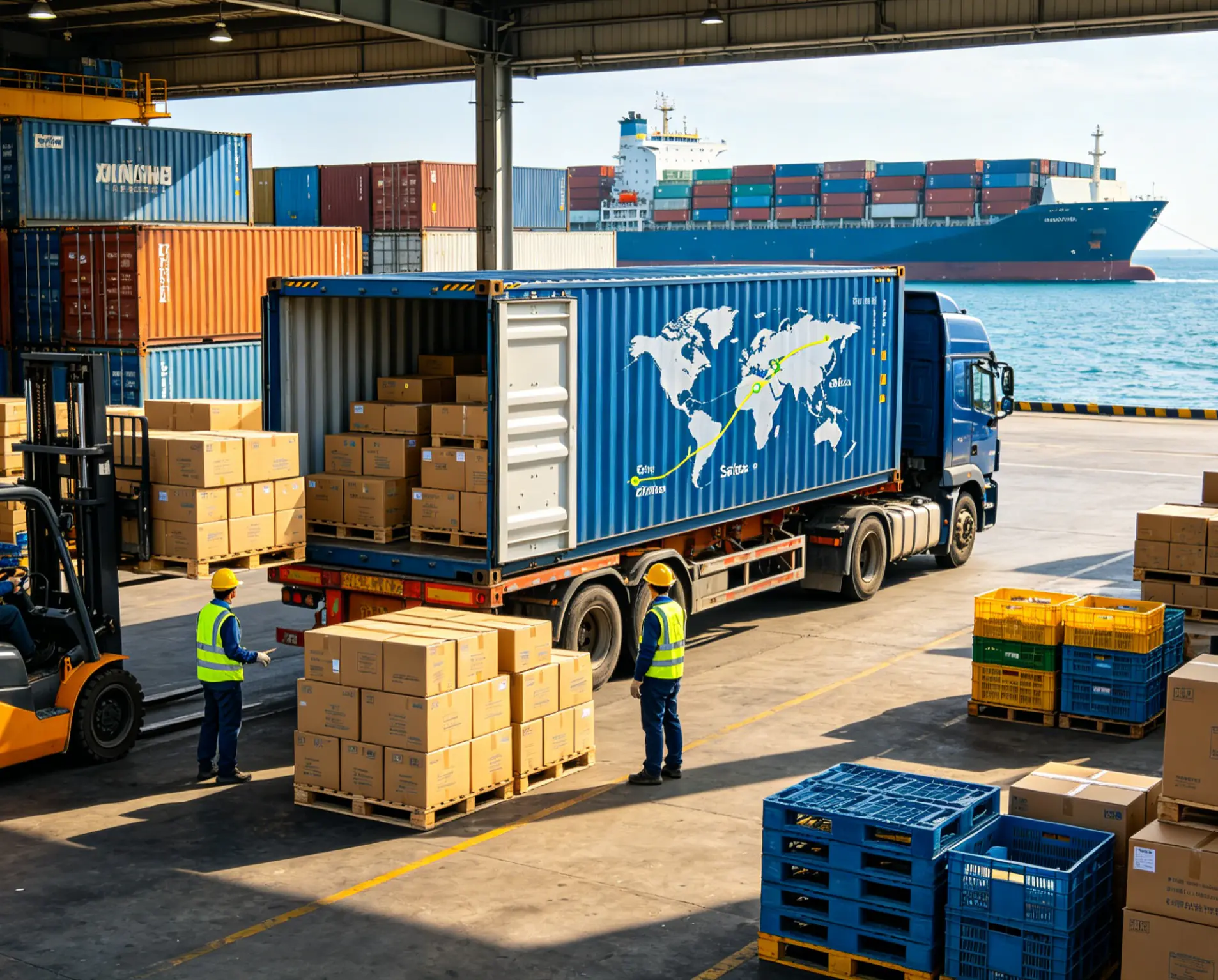
LCL (Less than Container Load) lets multiple shippers share space inside a single container, making it the most cost-effective ocean option for shipments that do not fill a full container. A freight forwarder collects your cargo at a CFS (Container Freight Station), consolidates it with other goods, and ships it under one master Bill of Lading (B/L). At the destination port, the container is moved to another CFS for deconsolidation (also called devanning), where each shipper’s cargo is separated and released.

For the China–Brazil trade lane, LCL is ideal when:
- Your shipment is between 1 and 15 CBM.
- You want to avoid paying for a half-empty 20ft or 40ft container.
- Your cargo is not extremely urgent and can tolerate ocean transit.
- You buy from multiple suppliers and want to consolidate cargo in China before export.
Common LCL cargoes to Brazil include electronics, automotive parts, machinery spares, furniture, lighting, hardware, and consumer goods. LCL is usually not ideal for very dense cargo, hazardous materials, perishables, or time-critical shipments.
How Much Does LCL Shipping from China to Brazil Cost in 2026?
For importers benchmarking shipping container rates from China to Brazil, freight-only LCL rates in mid-2026 typically range from $80 to $220 per CBM, with the final landed cost heavily influenced by origin CFS charges, destination deconsolidation fees, duties, and taxes.
The wide price band exists because LCL quotes are never one-size-fits-all. The following factors all affect your final rate:
- Origin port and CFS: Handling fees in Shanghai, Shenzhen, or Ningbo differ.
- Destination CFS: Santos deconsolidation costs may differ from Paranaguá or Rio.
- Carrier and routing: Direct strings vs. transshipments through Panama, Cartagena, or Kingston.
- Fuel and bunker adjustments: BAF/FAF surcharges move with oil prices.
- Peak season: Rates often rise before Chinese New Year, Carnival, and the June–August peak.
- All-in vs. freight-only: A low ocean rate can be offset by high destination charges.
LCL Cost Components from China to Brazil
The ranges below are compiled from carrier quotes, CFS handling tariffs, and Brazilian customs fee schedules observed by Efanda in mid-2026.
| Cost Component | Typical Range | Notes |
|---|---|---|
| Ocean freight | $80–$220/CBM | Freight-only; subject to carrier and season |
| Origin pickup | $50–$150 depending on distance | From factory to origin CFS |
| Origin CFS handling | $30–$80/CBM | Receiving, loading, consolidation |
| Documentation | $50–$150 | B/L, export customs, certificates |
| Ocean freight surcharges | Variable | BAF, CAF, peak-season surcharges |
| Destination THC/CFS | $80–$200/CBM | Unloading, deconsolidation, sorting |
| Port storage | $8–$15/day after free time | Often 5–7 free days at destination CFS |
| Customs clearance | $100–$300 | Broker fee plus SISCOMEX processing |
| Duties & taxes | 0–35% + IPI + PIS/COFINS + ICMS | Calculated on CIF value; see tax table below |
| AFRMM | ~25% of ocean freight | Brazilian maritime freight tax |
| Siscomex fee | ~$38/shipment | Federal system registration fee |
| Cargo insurance | 0.2–0.5% of cargo value | Optional but recommended |
Pro tip: Always ask for an itemized quote. A freight-only rate of $80/CBM can look cheap until destination CFS and customs charges are added. An experienced freight forwarder will show you the full landed-cost picture upfront.
How Long Does LCL Shipping Take from China to Brazil?
Most LCL shipments from China to Brazil take 35 to 55 days via door-to-door shipping, including origin consolidation, ocean transit, destination deconsolidation, and customs clearance. This is longer than the 30–38 days often quoted for FCL because LCL requires extra handling at both ends. For a route-level comparison across all modes, see our dedicated guide on how long does shipping from China to Brazil take.
Here is how the timeline typically breaks down:
- Origin consolidation at CFS: 3–7 days (waiting for the container to be filled and cut-off).
- Ocean port-to-port: 27–45 days depending on the route and number of transshipments.
- Destination deconsolidation: 2–5 days after vessel arrival.
- Brazilian customs clearance: 3–10 days for green/yellow channel; 2–6 weeks for red-channel inspection.
LCL Transit Times by Port Pair (Mid-2026 Estimates)
| Origin (China) | Destination (Brazil) | Port-to-Port | Door-to-Door Estimate | Best For |
|---|---|---|---|---|
| Shanghai / Ningbo | Santos | 33–46 days | 40–55 days | São Paulo region, high volume |
| Shenzhen / Yantian | Santos | 27–45 days | 35–50 days | Electronics, South China exports |
| Shenzhen / Yantian | Paranaguá | 30–48 days | 38–55 days | Southern Brazil, agro-industrial |
| Guangzhou | Santos | 30–42 days | 38–52 days | Furniture, lighting, consumer goods |
| Qingdao | Rio de Janeiro | 40–48 days | 48–60 days | Industrial machinery, northern China |
Several factors can push these windows wider:
- Transshipment delays: Hubs like Colón, Cartagena, Kingston, or Algeciras can bottleneck during peak season.
- Port congestion: Santos routinely experiences vessel bunching and terminal congestion.
- Seasonal disruptions: Chinese New Year factory closures and Brazil’s Carnival both reduce schedule reliability.
- Customs exams: Brazilian customs uses a red/yellow/green channel system; red-channel inspections are thorough and slow.
Which Ports Should You Use for LCL Shipping from China to Brazil?
The best LCL routing depends on your supplier location in China and your final delivery point in Brazil, with Santos serving as the dominant gateway for São Paulo and the southeast. Santos handles roughly one-third of Brazil’s container traffic and offers the densest network of CFS warehouses, customs brokers, and inland trucking connections.
Major Chinese Origin Ports
| Port | Strengths | Typical Brazil Route |
|---|---|---|
| Shanghai | World’s busiest container port; frequent sailings; competitive rates | Shanghai → Santos / Paranaguá |
| Ningbo | Close to Shanghai; strong LCL consolidation; lower congestion at times | Ningbo → Santos / Paranaguá |
| Shenzhen / Yantian | Electronics manufacturing hub; fast feeder connections via Hong Kong | Shenzhen → Santos / Paranaguá |
| Guangzhou | Strong for furniture, lighting, and consumer goods | Guangzhou → Santos |
| Qingdao / Xiamen / Tianjin | Niche routes for regional suppliers | Qingdao → Rio / Santos |
Major Brazilian Destination Ports
| Port | Region | Strengths |
|---|---|---|
| Santos | São Paulo / Southeast | Largest port; best CFS and inland distribution network |
| Paranaguá | Southern Brazil | Less congestion than Santos; strong for agribusiness and industrial cargo |
| Rio de Janeiro | Southeast | Alternative to Santos for Rio state deliveries |
| Itajaí | Santa Catarina | Electronics, textiles, automotive parts |
| Salvador / Suape | Northeast | Regional distribution to Bahia and Pernambuco |
Why Shenzhen Is a Strategic Origin for Brazil-Bound LCL
For many Brazil importers, Shenzhen offers a clear operational advantage. As the heart of South China’s electronics and manufacturing ecosystem, it generates enormous LCL volume, which means faster consolidation schedules and more competitive per-CBM rates. Feeders from Shenzhen’s Yantian terminal connect smoothly to Hong Kong and major ocean alliances, and the port’s proximity to Guangzhou, Dongguan, and Foshan makes supplier pickup efficient.
At Efanda Logistics, our Shenzhen headquarters puts us close to these origin CFS networks. Since 2018, we have coordinated factory pickup, consolidation, export customs clearance, and documentation under one roof for Brazil-bound LCL shipments, giving us direct visibility into carrier cut-offs and the documentation errors most likely to trigger Brazilian customs exams.
LCL vs FCL from China to Brazil: Which Is Right for You?
Choose LCL when your cargo is under roughly 10–15 CBM or cannot fill a container economically; choose FCL when you have enough volume to justify a full container and need more predictable timing. The FCL vs LCL shipping decision is not just about freight rate per CBM — it also involves handling risk, customs complexity, and scheduling flexibility.
LCL vs FCL Comparison
| Factor | LCL | FCL |
|---|---|---|
| Minimum volume | 1 CBM practical minimum | 20ft (~33 CBM) or 40ft (~67 CBM) |
| Cost per CBM | Higher per CBM, but no empty-space waste | Lower per CBM when container is full |
| Typical transit | 35–55 days door-to-door | 30–45 days door-to-door |
| Scheduling | Flexible; ship when cargo is ready | Fixed container bookings; need enough volume |
| Cargo handling | More touches at CFS; slightly higher damage risk | Sealed at factory; fewer handling points |
| Customs | Deconsolidated before clearance; may face mixed-cargo exams | Cleared as one consignment |
| Best for | 1–15 CBM, multi-supplier consolidation, trial orders | 15+ CBM, regular bulk shipments, fragile/high-value cargo |
Break-Even Point
As a rough rule of thumb, if your cargo reaches 12–15 CBM, you should compare an FCL 20ft container quote against LCL. Once you approach 20 CBM, FCL usually becomes cheaper on a per-CBM basis because you avoid LCL’s origin and destination handling fees. However, if your cargo is light and bulky (low chargeable weight), LCL may remain competitive up to 18–20 CBM.
What Documents and Customs Steps Are Required for Brazil LCL Imports?
Brazilian customs require accurate, consistent documentation through the SISCOMEX electronic system, and even minor discrepancies can trigger red-channel inspections and weeks of delay. Because LCL cargo is deconsolidated at the destination CFS before individual consignments are released, any documentation problem on one shipment can sometimes delay the entire container — making accuracy even more important than with FCL.
Required Documents Checklist
| Document | Purpose | Key Details |
|---|---|---|
| Commercial Invoice | Value declaration for customs | Must match B/L and packing list; Portuguese translation recommended |
| Packing List | Itemized cargo details | Weights, dimensions, quantities, marks & numbers |
| Bill of Lading (B/L) | Contract of carriage and title | House B/L or Sea Waybill depending on terms |
| NCM/HS Code | Brazilian tariff classification | 8-digit NCM must be accurate and consistent |
| Consignee CNPJ | Brazilian tax ID | Mandatory for customs registration |
| RADAR License | Federal Revenue import registration | Required for regular importers |
| Import License (LI) | Regulated products | Required for certain electronics, medical, agri, and chemical goods |
| Certificate of Origin | Preferential duty claims | For MERCOSUR or other trade agreement benefits |
Brazilian Import Tax Structure
| Tax | Typical Rate | Calculation Base |
|---|---|---|
| Import Duty (II) | 0–35%; commonly 10–18% | CIF value |
| IPI (Industrialized Products Tax) | 0–15% | CIF + II |
| PIS/COFINS | ~11.75% combined | CIF + taxes |
| ICMS (State VAT) | 17–25%; ~18% in São Paulo | CIF + all federal taxes |
| AFRMM (Maritime Freight Tax) | ~25% of ocean freight | Ocean freight cost |
| Siscomex Fee | ~$38 per shipment | Per import declaration |
The cumulative effect can push total landed cost to 40–70% above the CIF value for many product categories. This is why accurate product classification and Incoterm negotiation matter so much.
Common Red-Channel Triggers
Based on our experience pre-screening documents for Brazil-bound LCL cargo, the issues below most often trigger red-channel inspections:
- Mismatched weights or quantities between invoice, packing list, and B/L
- Vague product descriptions (e.g., “spare parts” without specifics)
- Incorrect or inconsistent NCM codes
- Missing certifications: INMETRO (electronics/equipment), ANATEL (telecom), MAPA (agriculture), ANVISA (pharmaceuticals/cosmetics)
- Suspected under-invoicing or valuation issues
Working with a freight forwarder that understands the China–Brazil lane can help pre-screen documents before cargo departs, reducing the risk of customs holds.
How Should You Prepare Cargo for LCL Consolidation?
Proper preparation for LCL means packing to protect your goods in a shared container, labeling clearly for the CFS, and understanding how chargeable weight is calculated. In LCL, you are sharing space with other shippers, so poor packaging or unclear labels can cause damage, misdelivery, or extra handling fees.
Understanding Chargeable Weight
LCL carriers charge based on the greater of actual weight or volumetric weight. The standard conversion is:
1 CBM = 1,000 kg chargeable weight
If your cargo measures 2 CBM but weighs only 800 kg, you pay for 2 CBM. If it weighs 2,500 kg but measures only 1.8 CBM, you pay for 2.5 CBM. This is why light, bulky shipments favor LCL, while extremely dense cargo can become expensive.
Packaging Best Practices
- Use double-wall cartons or plywood crates for heavy items.
- Palletize when possible to reduce handling damage and speed CFS processing.
- Avoid overhang; cartons should sit cleanly on the pallet.
- Use moisture barriers and desiccants — ocean containers can experience condensation.
- Secure loose items with straps or shrink wrap to prevent shifting.
Labeling Requirements
- Shipper and consignee name, address, and contact
- Destination port and CFS
- Marks and numbers matching the packing list
- Handling instructions: “Fragile,” “This Way Up,” “Do Not Stack”
- Gross/net weight and dimensions on each unit
Cargo Restrictions and Insurance
From our experience booking LCL space out of Shenzhen and Guangzhou, the cargo types most often restricted or refused are hazardous goods, perishables, liquids without proper packaging, and used personal effects. Always declare your cargo type upfront, including MSDS, certifications, or product datasheets when applicable.
Because LCL cargo is handled more often than FCL, cargo insurance services are strongly recommended. Typical coverage costs 0.2–0.5% of the cargo value and protects against damage, theft, and total loss during consolidation, ocean transit, and deconsolidation.
Can LCL Shipping Support E-commerce and Amazon FBA to Brazil?
Yes, LCL is commonly used by e-commerce sellers and Amazon/Mercado Livre businesses to replenish inventory in São Paulo bonded warehouses or third-party fulfillment centers, though it differs from the Programa Remessa Conforme (PRC) used for small direct parcels.
For B2B e-commerce replenishment, LCL works as follows:
- Goods are consolidated in China and shipped to Santos.
- Cargo is cleared through customs and moved to a bonded warehouse near São Paulo.
- Inventory is distributed to fulfillment centers or local couriers as orders arrive.
This model is different from the PRC program, which applies to small parcels shipped directly to Brazilian consumers. (For a comparison on another high-volume lane, see our guide to LCL shipping from China to USA.) Under PRC, shipments up to $50 face a reduced 20% import duty plus 17% ICMS, while $50–$3,000 parcels face 60% duty minus a $20 discount. PRC requires registration with SECEX, a RADAR license, and pre-payment of taxes. Standard LCL imports are not PRC shipments; they are formal B2B imports subject to the full tax stack above.
Amazon FBA-Specific Considerations
If you plan to use Amazon FBA in Brazil, confirm delivery requirements for fulfillment centers:
- FBA labeling requirements (FNSKU labels, pallet labels)
- Pallet dimensions and weight limits accepted by local Amazon warehouses
- Appointment scheduling for truck deliveries
- Whether your forwarder can deliver DDP to the Amazon dock
5 Actionable Tips to Cut LCL Costs and Avoid Delays
Here are five practical steps our operations team recommends to improve LCL outcomes on the China–Brazil lane:
- Request itemized, all-in quotes with 2–3 week validity. A low ocean rate can hide expensive destination CFS or customs fees. Itemization lets you compare true landed costs.
- Consolidate smaller orders into one LCL shipment. Shipping 3 CBM once is usually cheaper than shipping 1 CBM three times because fixed origin and documentation fees are spread over more volume.
- Choose the right Incoterm. EXW gives your forwarder full control from the factory; FOB shipping is common if your supplier handles local export; DDP shipping includes Brazilian duties. Match the term to your customs comfort level.
- Pre-screen NCM codes and documentation before cargo leaves China. Fixing a wrong NCM after arrival in Santos is expensive and slow.
- Build buffer time around peak seasons. Add 1–2 weeks of flexibility around Chinese New Year, Carnival, and the June–August shipping peak.
Bonus tip: Work with a freight forwarder that has direct carrier contracts and proven experience on the China–Brazil lane. Second-hand rates and inexperienced brokers are common sources of hidden cost and delay.
FAQ
How long does LCL shipping take from China to Brazil?
Most LCL shipments take 35–55 days door-to-door, including origin consolidation, ocean transit, destination deconsolidation, and customs clearance.
How much does LCL shipping from China to Brazil cost per CBM?
Freight-only rates range from $80 to $220 per CBM in mid-2026.
What documents are needed for LCL import into Brazil?
You generally need a commercial invoice, packing list, Bill of Lading, accurate NCM/HS code, consignee CNPJ, and RADAR registration. Regulated products may also require an Import License (LI) and product certifications.
Do I need a customs broker for LCL shipments to Brazil?
Yes. Brazilian customs procedures are complex, and a licensed Brazilian customs broker (despachante aduaneiro) is required to file the import declaration through SISCOMEX.
Can I ship Amazon FBA cargo via LCL to Brazil?
Yes, LCL can deliver to São Paulo-area bonded warehouses or directly to Amazon fulfillment centers, provided you meet FBA labeling, pallet, and appointment requirements.
Conclusion
LCL shipping from China to Brazil is a flexible, cost-effective solution for importers moving 1–15 CBM of cargo — especially when FCL rates surge or your shipment simply doesn’t justify a full container. Success comes down to three things: realistic expectations on timing, accurate documentation for Brazilian customs, and transparent pricing that includes both origin and destination charges.
Brazil’s import environment is demanding, but the right logistics partner can turn complexity into a competitive advantage. At Efanda Logistics, we have managed the full journey from supplier pickup in China to customs clearance and last-mile delivery in Brazil since 2018. Our team combines carrier relationships, CFS coordination experience, and Brazilian customs knowledge to offer competitive transparent pricing, dedicated logistics specialists, and end-to-end visibility for every shipment.