Is RoRo shipping from China to UAE really the simplest way to move cars, trucks, or wheeled machinery into Dubai—without getting surprised by port charges, customs holds, or last‑minute vessel space problems? For many B2B importers, auto dealers, and project buyers, it can be the most efficient option, but only if you understand how RoRo pricing works, how to prepare documents, and what happens after the ship arrives at Jebel Ali.
This 2026 guide breaks down the real decision points: when RoRo is the right choice (and when it isn’t), typical transit time ranges, the cost components you must budget for, the full step‑by‑step workflow from China factory pickup to UAE release, and the most common mistakes that trigger delays or extra fees. For a broader overview of all transport modes, you can also explore our general guide on shipping from China to UAE.
What Is RoRo Shipping From China to UAE, and Who Should Use It?
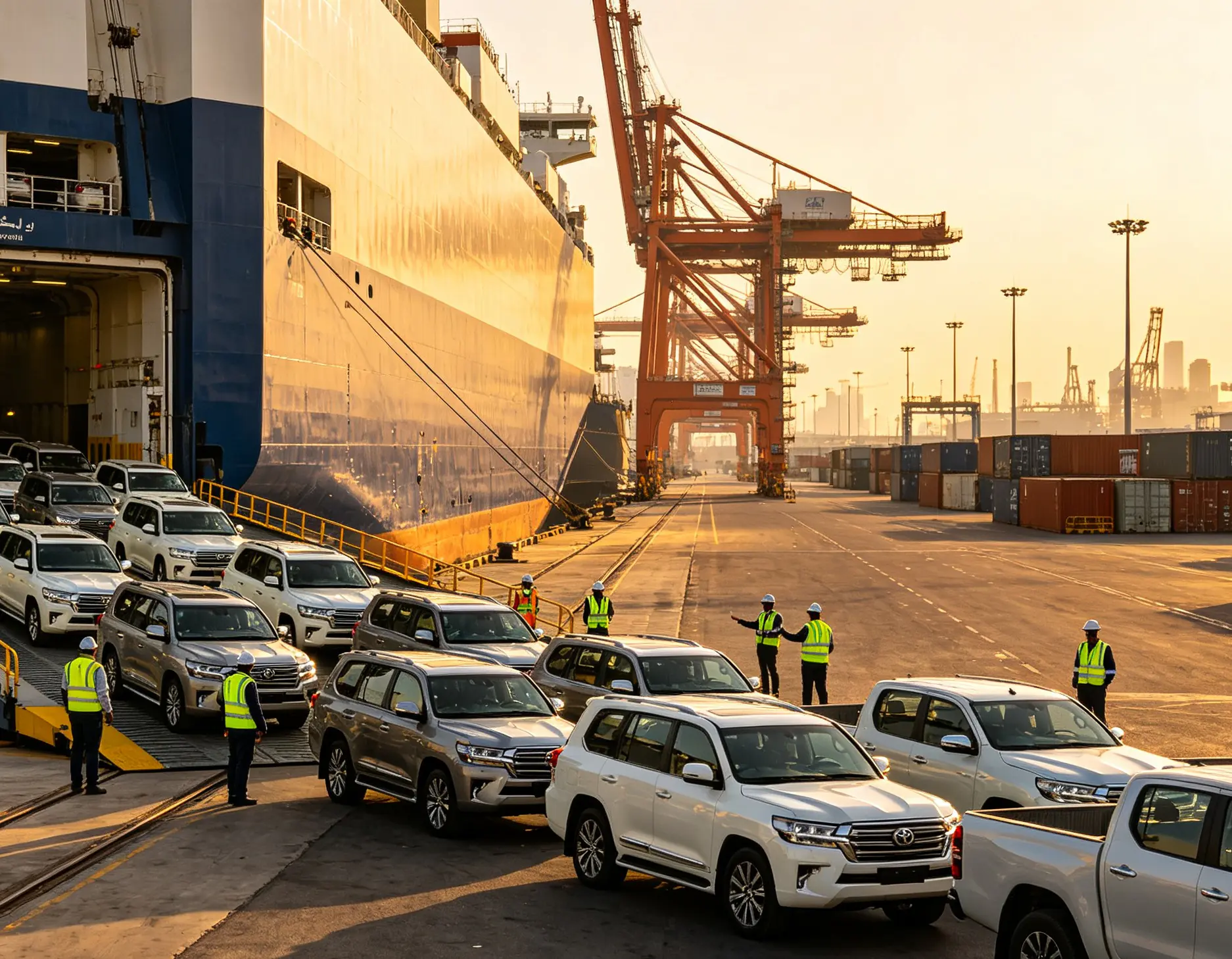
RoRo shipping is a specialized ocean transport method where cargo that can roll is driven or towed onto a vessel via a ramp, then driven off at the destination port. In logistics terms, RoRo (Roll‑on/Roll‑off) is designed for vehicles and wheeled equipment—think passenger cars, SUVs, buses, trucks, trailers, and some types of construction machinery that can be driven, towed, or mounted on rolling platforms.
Best-fit cargo types
- Standard passenger vehicles and commercial fleets (especially when shipping multiple units)
- Buses, trucks, and trailers that don’t fit efficiently in a container
- Wheeled construction equipment (e.g., wheel loaders) or towable machinery
When RoRo is usually not the best choice
- High-value vehicles that require full enclosure and tamper resistance (a sealed container can be safer)
- Cargo that must ship with spare parts or loose items inside the vehicle (RoRo rules are typically strict)
- Non-rolling, non-towable machines (often better handled as LoLo (Lift‑on/Lift‑off) or flat rack cargo)
Key terms you need to understand early
- Bill of Lading (B/L): The ocean transport document and a key release document at destination.
- Customs Clearance: The formal declaration and approval process that allows cargo to enter the UAE legally.
- HS Code: The tariff classification code used to determine duties, VAT, and compliance checks.
- Demurrage & Detention (D&D): Charges that can apply when cargo stays too long in port/terminal or when equipment is held beyond free time.
- Door‑to‑Door: A door to door shipping service model that includes pickup, export handling, ocean freight, destination clearance coordination, and inland delivery.
Best China-to-UAE RoRo Routes, Ports, and Transit Time
For most importers, the most practical UAE gateway for RoRo arrivals is Jebel Ali Port (Dubai), because it is a major logistics hub with strong onward trucking coverage and free zone options. Khalifa Port (Abu Dhabi) can also be relevant depending on your final delivery location, distribution plan, and specific vessel services available at the time you book.
On the China side, your best departure port depends on factory location, RoRo sailing frequency, and terminal capability for your cargo type. Common departure regions include East China (e.g., Shanghai/Ningbo area), North China (e.g., Tianjin), and South China (e.g., Guangzhou/Xiamen area).
Typical transit time ranges (planning guide only)
Transit times for RoRo are schedule‑dependent and can shift due to vessel rotations, port congestion, and security conditions. Use the ranges below for planning, not as guaranteed ETAs. For a comparison with other transport modes, check out how long does shipping from china to uae take.
| Origin area (China) | Common RoRo export gateways (examples) | UAE gateway (typical) | Typical sea transit time range* |
|---|---|---|---|
| East China | Shanghai / Ningbo region | Jebel Ali | 18–28 days |
| North China | Tianjin region | Jebel Ali | 22–32 days |
| South China | Guangzhou / Xiamen region | Jebel Ali | 16–26 days |
*Planning ranges only. Actual ETD/ETA can vary by carrier rotation, intermediate calls, congestion, and weather.
What actually affects your timing in 2026
- Booking lead time: RoRo space can be tight during vehicle export peaks, so booking 2–4 weeks ahead is often safer.
- Port cut-off and gate-in: Missing the cut-off can push you to the next sailing.
- Export clearance speed: Documentation gaps can delay terminal acceptance.
- Port congestion: Yard space constraints can slow roll-on operations.
- Security surcharges and route adjustments: Some periods see higher war risk or additional checks, which can affect scheduling.
RoRo vs Container vs LoLo: Which Shipping Method Is Best for Your Cargo?
In most real-world UAE import scenarios, RoRo is best when your cargo is drivable or towable and you want faster terminal handling, while container shipping is best when you need enclosed protection, stronger security, or the ability to ship accessories with the unit.
Quick decision table
| Factor | RoRo (Roll-on/Roll-off) | Container (FCL) | LoLo / Flat Rack |
|---|---|---|---|
| Best for | Rolling cargo, fleets, standard vehicles | High-value cars, units needing enclosure | Non-rolling or oversized machinery |
| Handling method | Driven/towed via ramp | Lifted by crane in/out of container | Lifted by crane (special handling) |
| Cargo protection | Moderate (terminal exposure risk) | High (sealed metal box) | Lower (often exposed) |
| Can ship loose items inside | Usually not allowed | Often allowed (subject to rules) | Case-by-case |
| Typical risk profile | Scratches during terminal moves | Lower handling damage risk | Higher handling complexity |
| When it can be “more expensive” | Inland trucking from non-RoRo port, storage fees | Higher base freight but predictable | Special equipment and permits add cost |
Scenario guidance you can act on
- Single high-value car: Consider container if security and condition are top priorities.
- Multiple dealer units: RoRo typically wins on cost per unit and terminal efficiency.
- Trucks/buses: RoRo is often the most practical.
- Wheeled machinery: RoRo works well if it can roll/tow; otherwise plan LoLo/flat rack.
How Much Does RoRo Shipping From China to UAE Cost?
RoRo cost is usually driven by the space your unit occupies on the vessel (dimensions), the route, and the season—so it is rarely a single “flat price” you can rely on year-round.
At a high level, your landed cost includes ocean freight plus origin charges, destination port charges, UAE duty and VAT, and local delivery. The most common budgeting mistake is focusing only on the sea freight quote and ignoring destination release costs and storage risk. If you are comparing options and might use FCL, review our exact shipping container rates from china to uae 2026 update.
RoRo cost components (what you should ask for in a quote)
- Ocean freight (space-based pricing tied to dimensions/type)
- Origin terminal handling and documentation
- Export customs handling (China side)
- Destination terminal handling and port fees (UAE side)
- Delivery Order (DO) and release charges
- UAE import duty and VAT (based on classification and declared value)
- Customs broker handling fee (if applicable)
- Inland trucking to Dubai, Abu Dhabi, Sharjah, or a free zone
- Marine insurance (recommended for vehicles and machinery)
Example budget table (illustrative, not a live quote)
Use this as a checklist to ensure your quote is “all-in.” Replace the numbers with your actual quotation items.
| Cost bucket | Passenger vehicle (example) | Wheeled machinery (example) | Notes |
|---|---|---|---|
| Ocean freight (RoRo) | $$ | $$ | Driven by dimensions/space and season |
| Origin charges (China) | $$ | $$ | Terminal handling, documents, export processing |
| Destination terminal charges (UAE) | $$ | $$ | Handling, storage risk if delayed |
| Duty + VAT (UAE) | $$ | $$ | Depends on HS Code, CIF value, and rules |
| Inland delivery | $$ | $$ | Port-to-warehouse or free zone transfer |
| Insurance | $$ | $$ | Often priced as % of cargo value |
| Estimated total landed cost | $$ | $$ | Always confirm what is excluded |
A practical UAE tax note (keep it simple)
Many UAE imports commonly reference a 5% duty framework plus 5% VAT on the relevant taxable base, but what you actually pay depends on the declared value, the HS Code, and whether the cargo is routed into a free zone versus mainland release. Build your budget with a buffer and confirm classification before shipping.
Step-by-Step RoRo Shipping Process: From China Factory to UAE Delivery
The RoRo workflow is straightforward when the documents and responsibilities are clear: you reserve space, gate-in and roll-on at the China port, track the voyage, then clear and release the unit in the UAE.

Step 1: Cargo check and booking (before you move anything)
- Confirm your unit can roll, drive, or be towed.
- Measure length, width, height, and verify weight.
- Share cargo photos and VIN/serial numbers early to avoid terminal rejection.
- Book early if you are shipping in peak vehicle export months.
Step 2: Vehicle preparation and condition control
- Remove loose items and personal belongings.
- Verify VIN/chassis/serial plate is clear and matches paperwork.
- Take photos as evidence (before pickup, at yard, and at gate-in).
- If it is an EV or hybrid shipment, confirm battery documents early and follow carrier rules.
Step 3: China export paperwork and terminal gate-in
- Prepare Commercial Invoice and Packing List (keep descriptions consistent).
- Ensure export declaration readiness and correct consignee data.
- Complete terminal gate-in within the cut-off window to avoid roll-over.
Step 4: Roll-on loading and lashing
- Terminal staff drives/tows the unit via ramp.
- Cargo is secured with wheel chocks and lashing to control movement at sea.
Step 5: Ocean transit and ETA control
- Track the vessel and monitor ETA changes.
- Start UAE clearance prep before arrival to reduce port dwell time and storage risk.
Step 6: UAE arrival, release documents, and customs clearance
- Collect Delivery Order (DO) and confirm it matches the B/L and consignee details.
- File the customs declaration through the UAE system (often referenced as Mirsal 2 in Dubai workflows).
- Pay applicable duty and VAT, handle inspection channel requirements, and obtain release.
Step 7: Pickup and inland delivery
- Arrange trucking to your final warehouse, yard, or free zone location.
- Inspect the unit at release and document condition immediately if issues are found.
Documents, Compliance, and UAE Customs Requirements You Cannot Ignore
For RoRo cargo, clean documentation is often the difference between same-day release and a multi-day customs hold.
Core document checklist (typical RoRo shipments)
- Commercial Invoice: Accurate value, seller/buyer, consistent descriptions.
- Packing List: Unit details, dimensions, weight (if applicable).
- Bill of Lading (B/L): Must match consignee information exactly.
- HS Code: Use the correct classification to avoid reclassification, fines, or delays.
- Certificate of Origin (when applicable): Can be required for certain trade or clearance scenarios.
- VIN/chassis number or machinery serial details: Must match the physical plate.
EV and hybrid shipments: extra compliance signals
If you are moving electric or hybrid vehicles, carriers and authorities may request battery-related documentation. Common terms include:
- UN38.3 test report (battery transport safety testing)
- MSDS (Material Safety Data Sheet) for battery/relevant materials
- UN3171 / Class 9 references under dangerous goods frameworks
Even if your cargo is accepted for RoRo, the wrong or expired document set can slow down approvals and trigger additional checks.
Free zone vs mainland release in the UAE
If your plan involves re-exporting, regional distribution, or holding inventory, routing into a free zone like JAFZA can be operationally useful. If you need the cargo on the mainland market quickly, plan the clearance path and trucking accordingly.
Cargo-Specific Advice: Cars, Trucks, Heavy Machinery, and EVs
The best RoRo setup depends on what you ship, so you should treat cars, commercial vehicles, machinery, and EVs as separate playbooks.
Cars and SUVs
RoRo is typically cost-effective for standard cars and bulk shipments, especially when your delivery plan is built around a RoRo-friendly gateway. For a single high-value unit, container shipping can be worth the premium if you need additional enclosure and security.
Trucks and buses
RoRo often remains the most practical option because containerization is difficult and expensive. Expect pricing sensitivity to height/length and verify any restrictions for modified vehicles.
Heavy machinery (wheeled vs non-wheeled)
For wheeled machinery, RoRo can work well as long as the unit can roll or be safely towed. If the unit cannot roll, does not start, or has an unusual center of gravity, you may need LoLo handling or flat rack solutions instead.
EVs and hybrids
EV shipments can face stricter acceptance rules due to battery risk management. The safest approach is to treat EV documentation as a “pre-clearance” requirement: confirm UN38.3 and MSDS availability early, align on state-of-charge policies, and budget for potential DG-related surcharges.
Fast decision rule of thumb
- If it rolls and ships in batches, RoRo is usually a strong option.
- If it is high-value and you want maximum enclosure, consider a container.
- If it does not roll, plan LoLo/flat rack.
- If it is an EV, plan RoRo only after confirming battery compliance documents.
Common Risks, Hidden Costs, and How to Avoid Delays
Most RoRo problems are preventable when you budget the full landed cost and treat documentation as a controlled process rather than a last-minute task.
The most common delay triggers
- Wrong HS Code or inconsistent invoice/packing list details
- Missing or mismatched consignee information between documents
- Late customs filing (waiting until after arrival)
- Inspection selection without a buffer plan
- Port storage and D&D because the unit was not picked up in time
Hidden costs many importers miss
- DO and document release fees
- Terminal storage once free time is exceeded
- Handling charges for special units (oversize, non-running, DG/EV)
- Inland delivery to non-Dubai locations
- Insurance gaps (relying only on basic carrier liability)
Actionable best practices (use these as your checklist)
- Validate your document set before gate-in: invoice, packing list, B/L draft, and serial/VIN details must match perfectly.
- Build a buffer into your ETA plan: assume inspections can add time and storage risk.
- Photograph condition at three points: before pickup, at gate-in, and at release in the UAE.
- Ask for an itemized “all-in” quote: origin, ocean, destination, taxes, and inland delivery—not only the sea freight line.
- Consider marine insurance: especially for higher-value vehicles and machinery. We highly recommend reviewing our cargo insurance services to protect your assets.
Where a freight forwarder adds real value
If you are coordinating China-side pickup, port booking, export handling, UAE customs clearance coordination, and last-mile trucking with different parties, a single point of control can reduce both cost leakage and operational risk. Efanda Logistics (Shenzhen-based, established in 2018) positions its service around transparent pricing, end-to-end coordination, and a dedicated logistics specialist. As a reliable door to door-shipping agent from china to middle east, we ensure seamless operations, whether you need general logistics or specialized shipping from shenzhen to uae—particularly useful for importers who want predictable execution rather than fragmented handoffs.
FAQ About RoRo Shipping From China to UAE
Is RoRo shipping from China to UAE cheaper than container shipping?
RoRo is often cheaper per unit for standard vehicles and fleets because terminal handling is faster and you avoid container stuffing and crane lifts, but a sealed container can still be more cost-effective for a single high-value unit or when you must ship accessories inside.
How long does RoRo shipping to Jebel Ali usually take?
Transit time depends on the departure port, carrier rotation, intermediate calls, and congestion, but many importers plan within a multi-week window rather than a fixed date. Always confirm the sailing schedule and build buffer time for destination processing.
Can I ship used cars, trucks, or construction equipment by RoRo to the UAE?
In many cases yes, but used units are more likely to face documentation and inspection scrutiny. Make sure VIN/serial details are clear, values and descriptions are consistent, and any required permits are arranged before arrival.
What documents are needed to ship a car from China to UAE?
Most shipments require a Commercial Invoice, Packing List (when applicable), Bill of Lading (B/L), correct HS Code, and accurate VIN/chassis details. Some scenarios also require a Certificate of Origin.
Do I need UN38.3 and MSDS for electric vehicle shipping?
Often yes, or you should be prepared to provide them if requested by the carrier or authorities. EV rules vary by carrier, route, and shipment details, so confirm acceptance requirements before booking.
How are UAE import duty and VAT calculated for RoRo cargo?
Duty and VAT depend on classification and declared value. Many imports reference a 5% duty framework plus VAT calculations, but you should confirm the correct HS Code, the taxable base used, and whether your cargo is released to mainland or moved via a free zone strategy.
What happens if the cargo is delayed at Dubai Customs or selected for inspection?
Inspection and document verification can extend release time and increase storage risk. The best prevention is early filing, correct HS classification, and consistent documents across invoice, packing list, and B/L.
Can Efanda Logistics manage pickup in China, booking, customs coordination, and final delivery in the UAE?
Yes—many importers prefer an end-to-end model where one team coordinates factory pickup, export handling, ocean freight booking, UAE clearance support, and inland delivery, while keeping pricing transparent and communication consistent.