Is your China-to-Iran cargo stuck between slow ocean freight and expensive air freight? China to Iran rail freight offers a practical middle ground: faster than sea, cheaper than air, and increasingly reliable as the China–Central Asia–West Asia corridor matures. In the first nine months of 2025 alone, container-train frequency on this lane surged to 43 trains, with typical transit hovering between 14 and 18 days.
This guide walks you through the route, cost structure, transit time, required documents, Iranian customs, and how to choose a dependable China Iran railway freight forwarder. Whether you are a B2B importer, an Amazon FBA seller, or a brand building a stable restock cycle, you will find actionable answers here.
What Is China to Iran Rail Freight?
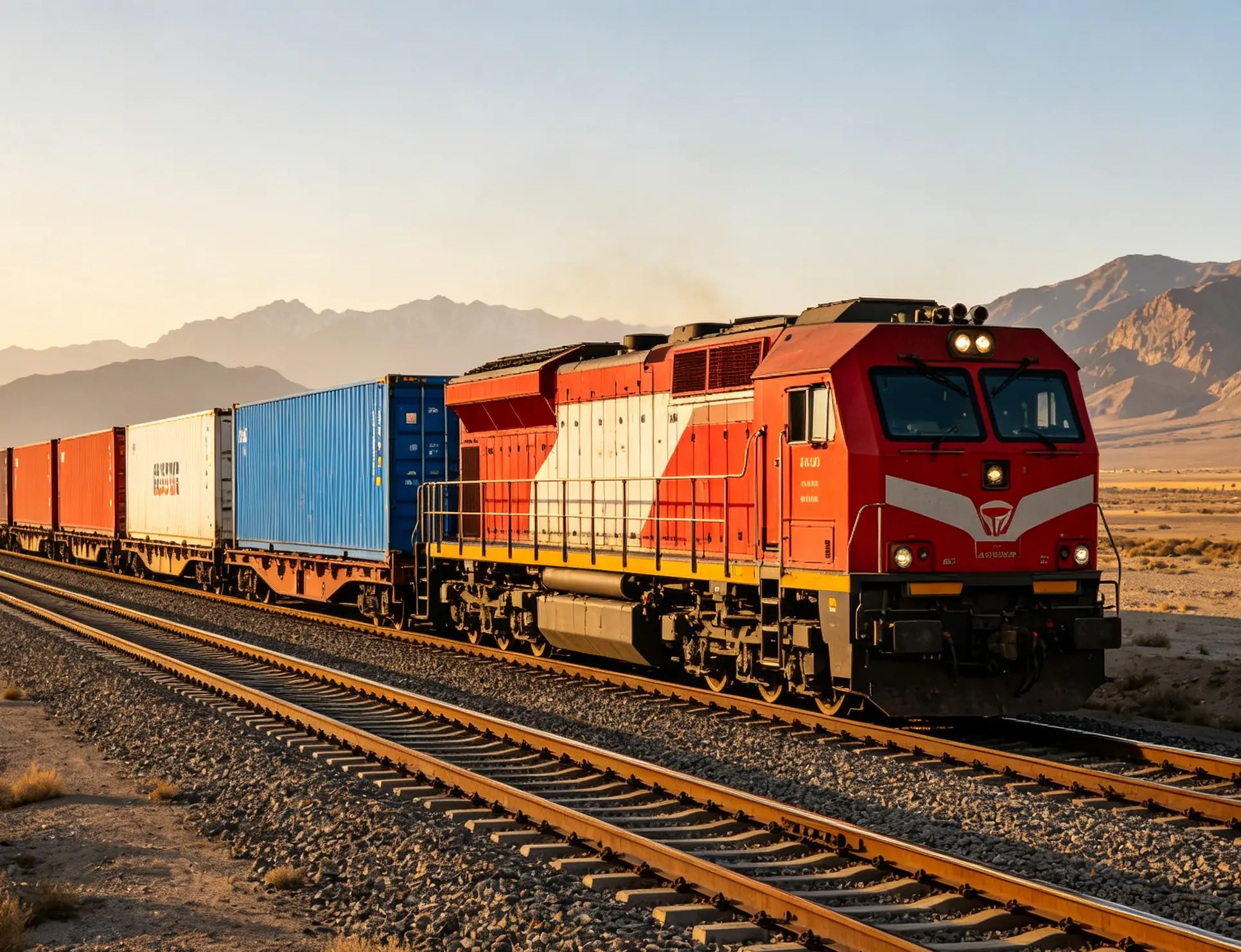
China to Iran rail freight is a containerized overland service that moves cargo from Chinese industrial hubs westward through Central Asia, enters Iran at Sarakhs or Incheh Burun, and continues to Tehran, Mashhad, Isfahan, Bandar Abbas, and other Iranian cities. It operates as part of the Belt and Road Initiative (BRI) and connects to broader corridors such as the Middle Corridor and the International North–South Transport Corridor (INSTC).
Because the journey crosses multiple countries and rail networks, several terms appear constantly in this lane:
- FCL (Full Container Load): One shipper books an entire 20ft or 40ft container.
- LCL (Less than Container Load): Cargo from multiple shippers shares one container.
- TEU / FEU: Twenty-foot Equivalent Unit and Forty-foot Equivalent Unit. One 40ft container equals two TEU.
- Block train: A dedicated train for one customer or a fixed group, often with priority scheduling.
- Gauge change / break-of-gauge: China uses 1,435 mm standard gauge, while Kazakhstan, Turkmenistan, and Iran use 1,520 mm broad gauge. Containers must be reloaded onto different wagons at border hubs.
- CIM/SMGS consignment note: The international rail waybill that governs carriage across Europe/Asia (CIM) and the former Soviet bloc (SMGS).
- Customs bond / T1 transit: A guarantee allowing cargo to cross Kazakhstan and Turkmenistan without paying import duty until final clearance in Iran.
For most shippers, rail freight is not a standalone choice but one option within a multimodal transport strategy that may also include sea freight, air freight, and trucking.
Why Importers Are Choosing Rail Freight from China to Iran
Three forces are pushing more importers toward shipping from China to Iran by rail.
Speed. Sea freight to Bandar Abbas takes 30–45 days. Rail cuts that to 14–18 days terminal-to-terminal, with premium block-train services reaching about 14 days.
Cost balance. Air freight to Tehran runs $4.50–$8.50 per kilogram, which is hard to justify for medium-value goods. Rail sits between sea and air: cheaper than air for most cargo, and often competitive with all-in sea costs for time-sensitive containerized loads.
Reliability. Rail avoids Persian Gulf port congestion, Red Sea uncertainty, and Suez Canal bottlenecks. Once a container is loaded onto a block train, the schedule is usually more predictable than a vessel waiting for a berth.
Cargo that performs well by rail includes electronics, machinery, auto parts, textiles, consumer goods, and construction materials.
Main China to Iran Rail Freight Route and Key Border Nodes
The standard corridor looks like this:
China origin → Khorgos / Alashankou / Altynkol → Kazakhstan → Turkmenistan → Sarakhs / Incheh Burun → Iran → Tehran (Aprin Dry Port / Shahyar Railway Yard) → final destination

Each node has a specific job, and most delays happen at these handoff points rather than on the open track.
| Node | Country / Border | Function | Typical Delay |
|---|---|---|---|
| Khorgos Dry Port | China–Kazakhstan | Consolidation, export customs, first gauge change | 1–2 days |
| Altynkol | Kazakhstan | Kazakh entry, reload to broad-gauge wagons | 0.5–1 day |
| Dostyk | Kazakhstan | Major gauge-change and transshipment hub | 1–2 days |
| Sarakhs | Turkmenistan–Iran | Primary Iran entry; roughly 80% of Iran’s rail transit | 1–2 days |
| Incheh Burun | Turkmenistan–Iran | Alternative Caspian-side entry for project cargo | 1–2 days |
| Aprin Dry Port / Shahyar Yard | Tehran area | Final yard, customs inspection, de-stuffing, last-mile dispatch | 1–2 days |
Several Chinese cities serve as origin hubs:
- Xi’an: A major China–Europe班列 hub with strong electronics, machinery, and auto parts flows.
- Changsha: Weekly block trains to Tehran, often 40HQ-focused, ideal for industrial equipment.
- Yiwu: Strong consolidation network for small commodities, textiles, and e-commerce samples.
- Bayannaoer: Specialized for agricultural exports such as sunflower seeds and oil.
- Chengdu / Zhengzhou: High-value manufacturing and cross-border e-commerce.
In April 2024, the railways of China, Kazakhstan, Turkmenistan, and Iran signed a unified tariff agreement in Beijing. The deal established a single through-rate structure and a benchmark 15-day transit from Khorgos/Altynkol to Tehran. That agreement is a major reason behind the rising train frequency and more stable schedules seen in 2025 and 2026.
A future southern corridor via the Kashgar–Osh railway through Kyrgyzistan could eventually shorten the route. Until that line is operational, however, the Kazakhstan–Turkmenistan–Iran corridor remains the practical option.
China to Iran Rail Freight Transit Time
Standard China to Iran rail freight transit time is 14–18 days terminal-to-terminal. Premium block-train services can reach about 14 days, usually at a 20–30% cost premium.
The journey breaks down as follows:
| Leg | Activity | Estimated Time |
|---|---|---|
| China origin to Khorgos / Alashankou | Haulage + export customs | 2–4 days |
| Khorgos to Kazakhstan broad-gauge entry | Gauge change + border formalities | 1–2 days |
| Kazakhstan + Turkmenistan mainline | Movement under customs bond | 6–8 days |
| Dostyk / Sarakhs gauge changes | Reloading onto new wagons | 2–3 days |
| Iran entry + IRICA clearance | Form T1, inspection, duty assessment | 1–3 days |
| Tehran yard to final destination | Last-mile trucking | 1–2 days |
| Total | 14–18 days |
Destination-specific estimates:
- China to Tehran: 14–16 days
- China to Mashhad: 16–18 days
- China to Bandar Abbas: ~18 days with inland extension
Delays usually come from border congestion at Khorgos or Sarakhs, winter weather in Kazakhstan, the Chinese New Year space crunch, or small document mismatches that trigger inspections.
China to Iran Rail Freight Cost (2026 Estimates)
China to Iran railway freight cost depends on origin city, container type, season, and service terms. The figures below are indicative for 2026 market conditions and fluctuate with fuel, capacity, and border congestion.
FCL Station-to-Station Rates
| Container Type | Estimated Rate (USD) | Best For |
|---|---|---|
| 20ft GP | $3,000 – $3,800 | General cargo, electronics, small machinery |
| 40ft GP / 40HQ | $4,500 – $5,000 | Machinery, textiles, bulk consumer goods |
| Per TEU (Khorgos–Tehran) | $3,500 – $4,500 | Benchmark quoting unit |
LCL Rates
| Service | Estimated Rate | Best For |
|---|---|---|
| LCL per CBM | $150 – $280 | 1–15 CBM, samples, mixed small orders |
LCL adds 2–4 days for consolidation and deconsolidation but is often the best entry point for small businesses testing the corridor.
Typical Add-On Costs
| Cost Item | Estimated Range | Notes |
|---|---|---|
| Gauge change fee | $500 – $800 per container | Applied at Dostyk and Sarakhs |
| China export customs + haulage | $200 – $500 | Depends on inland distance to rail hub |
| Iran import clearance (IRICA) | $300 – $600 | Varies by HS code and cargo value |
| Duties and VAT | 9%–40%+ of CIF | VAT generally ~9% |
| Terminal handling at Aprin / Shahyar | $150 – $350 | Storage, lift, de-stuffing |
| Final-mile trucking in Iran | $200 – $800 | Tehran vs. provincial city |
Rail vs. Sea vs. Air
| Mode | Transit Time | Cost (Approx.) | Best For |
|---|---|---|---|
| Rail via Central Asia | 14–18 days | $3,500 – $4,500 per TEU | Medium-value, time-sensitive, containerized cargo |
| Sea to Bandar Abbas | 25–45 days | $1,050 – $3,200 base rate | Bulk, heavy, non-urgent cargo |
| Air to IKA Tehran | 3–7 days | $4.50 – $8.50/kg | Urgent, high-value, small shipments |
Sea freight may look cheaper at first glance, but the all-in landed cost often rises sharply once terminal handling, customs, duties, and inland trucking are added. For a deeper mode comparison, see our guide on sea freight vs air freight. Rail can be the better total-cost option when inventory carrying cost and stockout risk are factored in.
FCL vs LCL: Which Rail Shipping Option Fits Your Cargo?
Choosing between FCL and LCL rail comes down to volume, handling risk, and cost per unit.
FCL is best when cargo exceeds 15 CBM or is heavy and dense. You get a dedicated container, less handling, and a fixed schedule. Some China–Iran block trains only accept 40HQ containers, so confirm equipment availability before booking.
LCL is best for 1–15 CBM, e-commerce samples, or mixed supplier orders. Cargo is consolidated at hubs such as Shenzhen, Yiwu, or Xi’an.
| Cargo Volume | Recommended Mode | Rationale |
|---|---|---|
| < 1 CBM | Air or courier | Fastest for very small shipments |
| 1–15 CBM | LCL rail | Cost-effective with reasonable speed |
| 15–28 CBM | 20ft FCL rail | Dedicated container, less handling |
| > 28 CBM | 40ft FCL rail | Best per-unit cost |
Step-by-Step: How to Ship from China to Iran by Rail
The rail freight process crosses three regulatory regimes:
- Supplier pickup or CY delivery to the Chinese rail terminal.
- China export customs declaration with GACC, including invoice, packing list, and HS codes.
- Loading onto the block train at Xi’an, Changsha, Yiwu, or another hub.
- Cross-border transit at Khorgos / Altynkol and reload onto Kazakh broad-gauge wagons.
- Transit through Kazakhstan and Turkmenistan under a customs bond.
- Gauge change and handover at Sarakhs / Incheh Burun to Iranian wagons.
- Iran import clearance — IRICA reviews Form T1, validates HS codes, assesses duty and VAT, and may inspect cargo.
- Inland delivery from Tehran’s Aprin or Shahyar yard to the consignee’s door.
A reliable freight forwarder coordinates each handoff so the container does not sit idle at border yards waiting for paperwork or wagon space.
Required Documents for China–Iran Rail Freight
Documentation consistency is critical on this corridor. A mismatch between the invoice value and the cargo manifest is one of the most common triggers for a 2–4 day inspection delay.
China Export Documents
- Commercial invoice — value declaration for export and Iran import duty assessment
- Packing list — weight, dimensions, package count
- Export customs declaration — filed with GACC
- Certificate of Origin (CO) — proves China origin; mandatory for Iran import
- Fumigation certificate — required for wooden packaging
- MSDS / transport鉴定报告 — required for batteries, liquids, powders, chemicals
International Rail Transport Document
- CIM/SMGS consignment note — the rail contract of carriage covering the multi-country corridor
Iran Import / Transit Documents
- IRICA Form T1 — Iran’s transit declaration
- HS code validation — conducted via Iran’s Single Window System
- Iranian importer Commercial ID (Kart-e Bazargani) — required for customs clearance
- Standard Certificate — required for regulated products such as electronics, food, chemicals, and auto parts
Iranian Customs Clearance and Sanctions-Compliant Workflow
Iranian customs clearance is handled by the Islamic Republic of Iran Customs Administration (IRICA). For rail arrivals, clearance usually takes place at Aprin Dry Port, Shahyar Railway Yard, or directly at Sarakhs.
The IRICA rail arrival process follows six steps: container arrives at the Iranian rail yard; IRICA validates Form T1 and the CIM/SMGS consignment note; HS codes are checked against the Iran Single Window System; duty and VAT are assessed based on CIF value; if selected, containers are inspected; once cleared, containers are released for inland delivery.
Sanctions compliance is not optional. Shippers should follow this checklist:
- Use accurate HS codes and consistent descriptions across all documents.
- Declare the true end-user and final destination.
- Avoid re-export misdeclaration or transshipment concealment.
- Maintain full cargo insurance for the entire multimodal journey.
- Work with a forwarder that provides clear, auditable documentation.
Products that frequently need extra certification include electronics, telecom equipment, auto parts, tires, pharmaceuticals, medical devices, food, agricultural products, chemicals, and cosmetics.
Incoterms for China–Iran Rail Freight
The right Incoterm defines who pays for what and who bears risk at each gauge change. If you are unsure which term fits your shipment, our guides on DDP vs DAP Incoterms and FOB vs CIF explain the key differences.
| Incoterm | Seller Responsibility | Buyer Responsibility | Best For |
|---|---|---|---|
| EXW | Makes cargo available at factory | Pickup, export, rail, import, delivery | Experienced buyers with Iran-side control |
| FOB | Delivers to Chinese port or rail terminal | Main carriage, import clearance, delivery | Buyers with a destination broker |
| DAP | Delivered to named Iranian terminal | Import clearance, duties, last-mile | Buyers handling Iran customs |
| DDP | Door-to-door including duties | Minimal involvement | Buyers wanting one partner |
Under DDP, the forwarder handles export customs, rail freight, Iran import clearance, duties, and final delivery. This is often the safest choice for buyers who do not have an in-house Iran logistics team. Under FOB or EXW, the buyer controls more of the chain but must manage Iranian brokers, duties, and last-mile trucking.
How South China Shippers Should Plan China–Iran Rail Freight
If your supplier is in Shenzhen, Dongguan, Guangzhou, or Foshan, you rarely load the container directly onto a train in South China. Instead, cargo is trucked or railed to a western hub such as Xi’an or Changsha.
Feeder pre-carriage from South China to Xi’an typically takes 3–5 days by truck and costs $300–$800 depending on volume. Consolidation at a hub such as Xi’an or Changsha adds 1–3 days but lets you tap fixed block-train departures.
For example, a Shenzhen electronics supplier recently needed replenishment stock in Tehran within three weeks. The cargo was collected in Dongguan, consolidated at Xi’an, moved via the Khorgos–Kazakhstan–Turkmenistan–Sarakhs corridor, cleared through IRICA at Aprin Dry Port, and delivered to a Tehran warehouse under one DDP quote. Total door-to-door time: 18 days.
Choosing the right hub matters. Xi’an is best for electronics, machinery, and auto parts. Changsha suits industrial equipment on weekly 40HQ block trains. Yiwu works well for small commodities and textiles with flexible consolidation.
This origin-side coordination is where a Shenzhen-based freight forwarder adds clear value: shorter feedback loops with South China suppliers, faster pickup response, and direct control over consolidation quality.
Common Risks, Seasonality, and Contingency Planning
No multi-country rail corridor is risk-free. The most common issues and how to mitigate them:
| Risk | Impact | Mitigation |
|---|---|---|
| Border congestion at Khorgos / Altynkol | 1–3 day delay | Book space early; use premium block trains |
| Gauge changes at Dostyk / Sarakhs | 2–4 days built into schedule | Confirm pre-clearance and wagon availability |
| Winter weather in Kazakhstan / Iran | Mainline slowdown | Add 3–5 days buffer November–February |
| Chinese New Year space crunch | Rolled bookings, higher rates | Book 2–3 weeks before CNY |
| Document mismatches | 2–4 day inspection | Reconcile invoice, packing list, and waybill before departure |
| Sarakhs peak congestion | 1–3 day delay | Consider Incheh Burun routing for eligible cargo |
Because the journey crosses multiple countries and gauges, all-risks cargo insurance from Chinese factory to Iranian door is strongly recommended. Read the exclusions carefully, since standard policies may exclude war risks, sanctions-related seizures, or improper packing claims.
How to Choose a Reliable China–Iran Rail Freight Forwarder
Not every forwarder that sells rail freight truly controls the China–Iran corridor. Before booking, evaluate corridor experience, multiple China hubs, FCL and LCL options, CIM/SMGS consignment note control, Iran-side broker network, door-to-door/DDP capability, cargo insurance plus tracking, and transparent all-in quoting.
Ask specific questions before you commit:
- Do you issue the CIM/SMGS consignment note directly or through a partner?
- Which Tehran terminal do you clear at — Aprin Dry Port or Shahyar Yard?
- What is your contingency route if Sarakhs is congested?
- Do you provide door-to-door DDP quotes?
- How do you handle sanctions compliance and document screening?
The answers reveal whether you are dealing with a booking agent or a forwarder that can actually manage the corridor.
Why Efanda Logistics for China–Iran Rail Freight
For China–Iran rail freight, our value is simple: we control the origin leg from South China, coordinate the block-train handoffs across Central Asia, and manage Iran-side clearance through trusted local partners. That means one quote, one point of contact, and one team tracking your container from factory pickup to final delivery. We also serve neighboring corridors as a door-to-door shipping agent from China to the Middle East.
Our pricing is transparent and based on real market conditions. We do not hide gauge-change fees, terminal handling, or last-mile charges. Every shipment is assigned a dedicated logistics specialist who provides milestone updates at Khorgos, Dostyk, Sarakhs, and Tehran.
If you are planning a China–Iran rail shipment, contact us at +86 18929345880 or request a tailored route recommendation. We will review your cargo details, recommend the right hub and service level, and provide an all-in quote with realistic transit time.
FAQ
How long does China to Iran rail freight take?
Standard terminal-to-terminal transit is 14–18 days. Premium block-train services can reach about 14 days.
What is the China Iran train freight route?
The main route is China → Khorgos/Alashankou/Altynkol → Kazakhstan → Turkmenistan → Sarakhs/Incheh Burun → Iran → Tehran (Aprin Dry Port / Shahyar Yard).
How much does rail freight from China to Tehran cost in 2026?
Expect roughly $4,500–$5,000 for a 40ft container station-to-station, plus gauge change, clearance, duties, and final-mile costs.
What documents are needed for shipping from China to Iran by rail?
Commercial invoice, packing list, export customs declaration, certificate of origin, CIM/SMGS consignment note, IRICA Form T1, and product-specific certificates such as MSDS or Iranian Standard Certificate.
What is IRICA Form T1?
Form T1 is Iran’s transit declaration. It controls the entry of bonded cargo into Iran and is required before customs clearance can begin.
Can I ship LCL cargo by rail from China to Iran?
Yes. LCL is available and is usually consolidated at Shenzhen, Yiwu, or Xi’an. It works well for 1–15 CBM shipments.
Is rail freight faster than sea freight to Iran?
Yes. Rail takes 14–18 days, while sea freight to Bandar Abbas typically takes 25–45 days.
What is the best Incoterm for China–Iran rail shipments?
DDP is easiest for buyers who want one partner to handle everything. FOB or EXW works if the buyer has Iran-side logistics control.
Which products need special certification for Iran import?
Electronics, telecom equipment, auto parts, tires, pharmaceuticals, medical devices, food, agricultural products, chemicals, and cosmetics often require extra certification.
How do I track my rail container from China to Iran?
Most forwarders provide digital tracking by container or wagon number, with milestone updates at Khorgos, Dostyk, Sarakhs, and Tehran.
What causes delays on the China–Iran rail corridor?
Common causes include border congestion, gauge changes, winter weather, Chinese New Year space shortages, and document mismatches.
Conclusion
China to Iran rail freight is no longer a niche option. With 14–18 day transit, competitive all-in costs, and growing block-train frequency, it is a practical choice for importers who need faster restock cycles than sea freight can offer without paying air freight rates.
Success depends on accurate documentation, HS code compliance, and a freight forwarder who understands both the Chinese origin and Iranian destination legs. Rates and regulations change, so confirm current market conditions and compliance requirements before booking.
If you need a route-specific China–Iran rail freight quote, contact Efanda Logistics. Our team in Shenzhen will review your cargo and provide a transparent, all-in price with realistic transit time.