Are you worried that one missing document could leave your excavator stuck at a Saudi port for weeks? You’re not alone. Learning how to import and ship an excavator from China to Saudi Arabia means more than booking ocean freight—it means navigating SABER, SASO, HS Code 8429, and the right shipping method for a machine that may weigh 30 tons or more. This guide gives you a clear, step-by-step process, real 2026 cost ranges, and practical tips. At Efanda Logistics, our heavy-machinery team in Shenzhen coordinates excavator exports to Jeddah, Dammam, and King Abdullah Port every month—and the issues we troubleshoot most often are not freight rates, but paperwork and compliance gaps.
Rates and Saudi customs rules change frequently; confirm current requirements with your freight forwarder before booking.
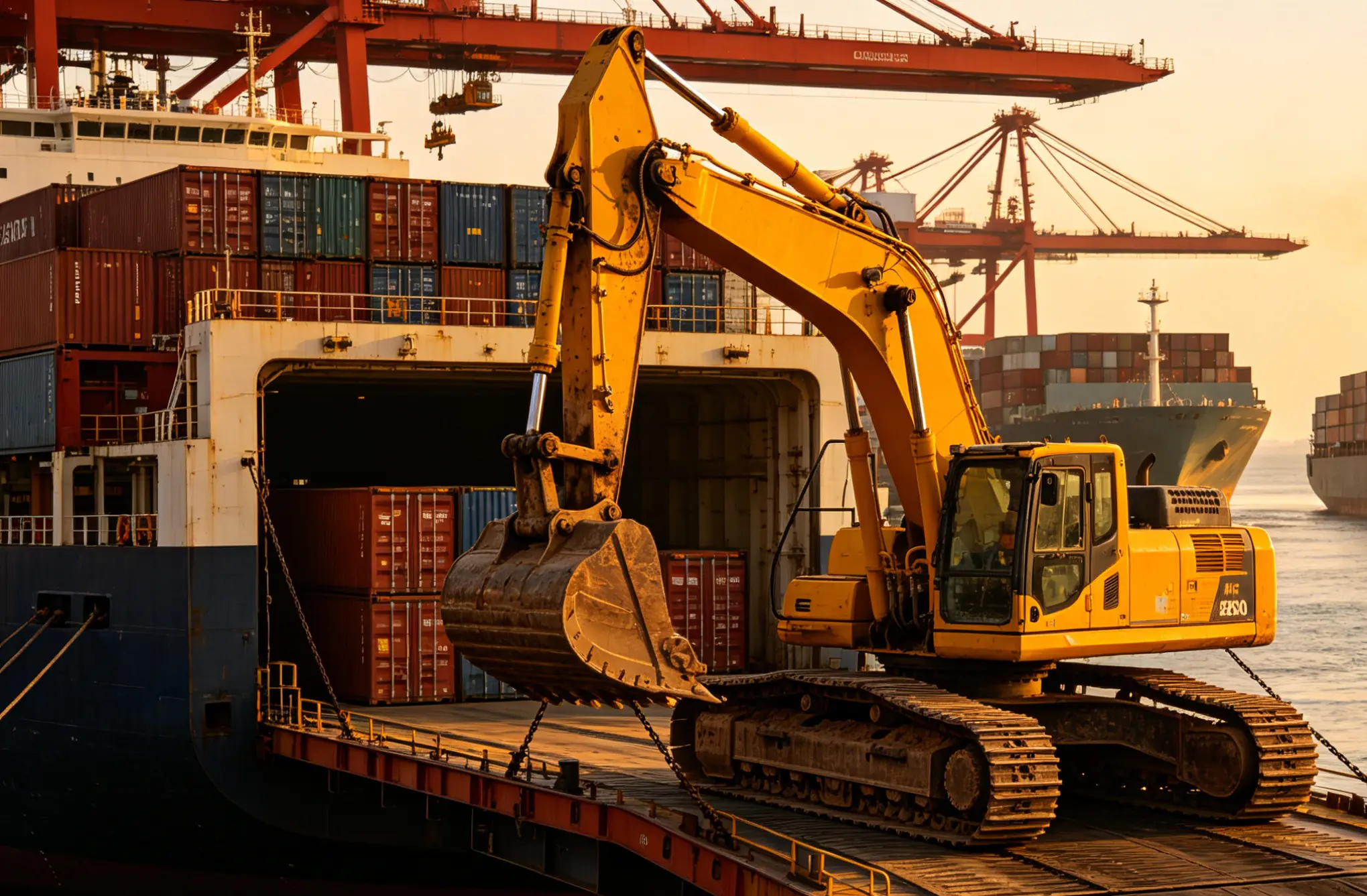
Why Is Saudi Arabia a Major Destination for Chinese Excavators?
Saudi Arabia is one of the fastest-growing markets for construction machinery in the Middle East. Mega-projects under Saudi Vision 2030—including NEOM, the Red Sea Project, Qiddiya, and Diriyah Gate—are driving record demand for excavators, bulldozers, and heavy equipment. At the same time, Chinese manufacturers such as SANY, XCMG, Zoomlion, LiuGong, and Shantui offer competitive pricing, shorter lead times, and increasingly advanced technology. For Saudi contractors, equipment dealers, and project owners, importing from China is often the most cost-effective way to expand a fleet.
China–Saudi trade ties have also strengthened through the Belt and Road Initiative, making sea freight routes between Chinese ports and Jeddah Islamic Port or King Abdul Aziz Port (Dammam) well established. However, the opportunity comes with complexity: Saudi Arabia has strict product-conformity and customs procedures, especially for heavy machinery.
What Types of Excavators Can You Import from China?
You can import mini excavators, crawler excavators, wheel excavators, and large mining excavators from China to Saudi Arabia, with each type falling under different HS code subheadings and compliance rules. Before you choose a shipping method, confirm exactly what you are buying, because the wrong classification on your SABER certificate or customs declaration can trigger delays.
| Excavator Type | Typical Weight | Best Shipping Method | HS Code Reference |
|---|---|---|---|
| Mini excavator | 1–6 tons | 20ft/40ft container (disassembled) or Ro-Ro | 8429.51 / 8429.52 |
| Crawler excavator | 6–50 tons | Ro-Ro, flat rack, or break bulk | 8429.52 |
| Wheel excavator | 8–30 tons | Ro-Ro or flat rack | 8429.52 |
| Large mining excavator | 50+ tons | Break bulk or heavy-lift vessel | 8429.52 |
The most common import is the crawler excavator under HS Code 8429.52. If you are importing a used excavator, Saudi Arabia imposes stricter rules, including age limits and mandatory origin inspection, which we cover later in this guide.origin inspection, which we cover later in this guide.
How to Vet a Chinese Excavator Supplier Before Payment
The best way to avoid customs surprises is to verify your supplier before you sign the purchase order. A low machine price can quickly be erased by hidden defects, missing export licenses, or inconsistent paperwork.
Supplier Verification Checklist
- Confirm the business license and export qualification. Ask for the business license, customs registration code, and any prior export records to Saudi Arabia or the Middle East.
- Request pre-shipment documentation early. The supplier should provide a draft technical data sheet, packing list, and engine emission certificate before loading.
- Verify the machine’s condition if used. Check operating hours, undercarriage wear, hydraulic leaks, and whether the hour meter has been tampered with. A third-party inspection report from SGS, Bureau Veritas, or a similar body is strongly recommended.
- Confirm packaging and loading capability. Ask whether the supplier can handle professional lashing, or whether you need your forwarder to send a loading supervisor.
- Agree on payment terms that protect both sides. For high-value machinery, a common structure is 30% T/T deposit + 70% L/C at sight or payment against copy of B/L. Avoid 100% advance payment unless you have an established relationship.
- Clarify after-sales support. Will the supplier provide English or Arabic manuals? Can they supply a recommended spare-parts list, and do they offer video or on-site commissioning support?
In our experience, the suppliers who cause the fewest problems are the ones who respond quickly to document requests and already understand Saudi SABER requirements. If a supplier says “we will handle everything,” ask exactly which certificates they will provide and in whose name they will be issued.
What Documents Do You Need to Import an Excavator into Saudi Arabia?
You need nine core documents for a smooth Saudi excavator import: commercial invoice, packing list, bill of lading, certificate of origin, technical data sheet, SABER Product Certificate of Conformity, SASO inspection report, power of attorney, and—if the machine is used—a Used Mechanical Equipment Export License from China. Missing or inconsistent documents can trigger inspections, demurrage charges, or even cargo refusal.
| Document | Purpose | Who Provides It |
|---|---|---|
| Commercial Invoice | Declares value, buyer/seller, HS code, Incoterms | Chinese supplier |
| Packing List | Lists weight, dimensions, packaging, serial number | Chinese supplier |
| Bill of Lading (B/L) | Contract of carriage and proof of ownership | Shipping line/forwarder |
| Certificate of Origin (CO) | Confirms country of manufacture | CCPIT or authorized chamber |
| Technical Data Sheet | Engine specs, emissions, weight, dimensions | Chinese supplier |
| SABER Product Certificate of Conformity (PCoC) | Proves conformity with Saudi technical regulations | SASO-accredited body via SABER |
| SASO Certificate / Inspection Report | Pre-shipment inspection for regulated products | SASO-accredited inspection body |
| Power of Attorney | Authorizes broker/forwarder to act on your behalf | Importer |
| Used Mechanical Equipment Export License | Required for used machinery leaving China | Chinese supplier/exporter |
Make sure every document matches the others. A mismatch between the invoice value and the B/L description, or the wrong HS code on the SABER certificate, is enough to stop clearance. In our experience, the most common delay comes from the technical data sheet: if the engine serial number, emission standard, or gross weight on the sheet differs from the packing list by even a small margin, Saudi customs can flag the shipment for inspection.
How Do SABER, SASO, and HERC Affect Excavator Imports?
Saudi Arabia regulates heavy machinery through three overlapping systems: SABER, SASO, and the Heavy Equipment Regulatory Centre (HERC). Understanding how they interact before you buy can save weeks of port detention.
SABER is Saudi Arabia’s online product-conformity platform, managed by SASO and accessible through the SABER portal. Most excavators require registration before shipment. According to SASO guidelines, the process starts with a Product Certificate of Conformity (PCoC) issued by a SASO-accredited body, followed by a Shipment Certificate of Conformity (SCoC) after inspection. Without both SABER approvals, customs can hold or refuse your cargo.
SASO (Saudi Standards, Metrology and Quality Organization) sets the technical regulations. For excavators, this includes safety standards, emissions requirements, and energy-efficiency rules. A SASO-accredited inspector may need to examine the machine before it leaves China.
HERC manages the national heavy-equipment database and operator-licensing framework under Saudi Arabia’s Ministry of Transport and Logistics Services. While HERC registration often happens after arrival, importers should confirm whether their excavator model must be registered before it can be used on Saudi job sites.
If you are importing a used excavator, expect additional scrutiny. Saudi Arabia generally requires used construction equipment to be less than 10 years old, to pass an origin-country inspection, and to meet current emissions and safety standards. Used machines may also face higher customs duties than new ones. In China, the supplier must apply for a Used Mechanical Equipment Export License from the General Administration of Customs (GACC), which can take 2–4 weeks depending on the machine’s condition and documentation. Because these rules change, verify the latest requirements with your freight forwarder or Saudi customs broker before you buy.
What Are the Best Shipping Methods for Excavators from China to Saudi Arabia?
The best shipping method depends on whether the excavator is operational, its dimensions, and whether it can be disassembled. From a practical standpoint, the first question we ask clients is: “Can the machine be driven, and do the brakes work?” That single answer usually determines whether Ro-Ro is viable.
| Shipping Method | Best For | Advantages | Disadvantages |
|---|---|---|---|
| Ro-Ro (Roll-on/Roll-off) | Self-propelled, working excavators | Fast loading/unloading; lower damage risk; cost-effective | Not for dismantled or non-operational machines |
| Flat Rack Container | Oversized crawler/wheel excavators | No dismantling needed; flexible dimensions | Higher cost; exposed to weather; needs strong lashing |
| Break Bulk Shipping | Very large or non-operational units | No size limits; ideal for heavy-lift cargo | Most expensive; longer handling time |
| Standard FCL Container | Mini excavators or disassembled units | Weather protection; lower freight cost | Requires disassembly for most machines; confirm shipping container dimensions before planning |
| Open Top Container | Tall excavators or attachments | Top-loading convenience | Limited availability; higher cost than standard |
For most shipping from China to Saudi Arabia excavator shipments, Ro-Ro is the preferred method if the excavator can be driven onto the vessel. It reduces handling damage and is usually the fastest sea freight from China option from Chinese ports to Jeddah or Dammam. Note that Ro-Ro terminals require a working battery, operable steering, and enough fuel only for loading and unloading; a non-functional unit may be rejected or charged for special lifting. In our experience, a dead battery or hydraulic leak is the most common reason Ro-Ro terminals reject machines out of Shanghai or Tianjin. For oversized or non-operational machines, flat rack or break bulk becomes necessary, so compare routes carefully to find the best way to ship from China to Saudi Arabia for your specific unit.
Special Note on Electric and Battery-Powered Excavators
Electric excavators and machines with lithium-ion batteries are becoming more common from Chinese manufacturers. These units require additional care:
- The battery usually needs an MSDS and UN38.3 test report.
- Depending on battery size and configuration, the shipment may be classified as dangerous goods.
- Ro-Ro carriers often have strict rules about EVs and battery-powered equipment; some may refuse them or require special stowage.
- Saudi voltage standards must be confirmed with the supplier to avoid commissioning problems on site.
If you are considering an electric excavator, tell your forwarder during the first quotation so they can route the shipment correctly.
How Much Does It Cost to Ship an Excavator from China to Saudi Arabia?
For a typical crawler excavator, the total landed cost on top of the machine price usually falls between $8,000 and $15,000, including ocean freight, Saudi customs duty, 15% VAT, clearance fees, insurance, and inland delivery. Ocean freight alone is only one part of the equation, and destination charges can equal or exceed the freight cost.
| Cost Component | Typical Range | Notes |
|---|---|---|
| Ocean freight (Ro-Ro, per unit) | $1,800–$3,500 | Depends on size and route |
| Ocean freight (Flat Rack) | $2,500–$4,500 | Includes special handling and lashing |
| Break Bulk | $3,500–$6,500+ | For very large or non-operational units |
| Origin charges (THC, documentation) | $200–$500 | Port handling and export paperwork |
| Cargo insurance | 1–2% of CIF value | All-risk coverage strongly recommended |
| Saudi customs duty | 4.85%–10%+ | Varies by HS code and new/used status |
| Saudi VAT | 15% | Applied to (customs value + duty) |
| Customs clearance broker | $300–$800 | Varies by complexity |
| Inland delivery | $500–$2,000+ | Depends on distance from port |
| Demurrage/detention (if delayed) | $100–$400/day | Avoid by preparing documents early |
Duty and VAT rates are set by Saudi Customs and can change with regulatory updates. As an example, a $50,000 crawler excavator shipped Ro-Ro to Jeddah might face roughly $2,500–$4,000 in ocean freight, plus $2,500–$5,000 in duties, VAT, clearance, and inland delivery—before any insurance or inspection fees. Always request a detailed quote with a clear validity period, and budget a contingency of 10–15% for rate fluctuations.
How Long Does Shipping Take?
Door-to-door delivery of an excavator from China to Saudi Arabia typically takes 4 to 8 weeks, depending on the port pair, shipping method, customs inspection, and inland trucking permits. Port-to-port transit alone is usually 3 to 5 weeks.
| Route / Method | Transit Time (Port to Port) | Total Door-to-Door Shipping Estimate |
|---|---|---|
| Shanghai → Jeddah (Ro-Ro / FCL) | 22–30 days | 5–7 weeks |
| Shenzhen → Dammam (Ro-Ro / FCL) | 18–28 days | 4–6 weeks |
| Ningbo → Jeddah (Ro-Ro / FCL) | 25–35 days | 5–8 weeks |
| Tianjin → Dammam (Ro-Ro / FCL) | 20–30 days | 5–7 weeks |
| Break Bulk / Flat Rack | +5–10 days | 6–9 weeks |
Peak seasons to avoid include Chinese New Year (January/February), Golden Week (October 1–7), and Ramadan/Eid (dates vary). During these periods, factory closures, port congestion, and reduced customs staffing can add 1–2 weeks.
Typical Timeline: From Order to Saudi Delivery
| Phase | Duration | Key Actions |
|---|---|---|
| Supplier verification & purchase order | 1–2 weeks | License check, payment terms, draft documents |
| SABER PCoC & SASO inspection | 2–4 weeks | Start immediately after PO |
| Booking, loading, and sailing | 1–2 weeks | Lashing, photos, insurance, B/L issuance |
| Sea transit | 3–5 weeks | Track vessel, pre-alert Saudi broker |
| Saudi customs clearance | 3–10 days | Duty, VAT, possible inspection |
| Inland delivery | 2–7 days | Oversize permits, job-site unloading |
Which Incoterms Should You Choose?
FOB (Free On Board) and DDP (Delivered Duty Paid) are the two Incoterms we recommend most often for Saudi-bound excavator imports. The right choice depends on whether you have experience arranging ocean freight and a reliable Saudi customs broker.
| Incoterm | Supplier Responsibility | Your Responsibility | Best For |
|---|---|---|---|
| EXW (Ex Works) | Makes goods available at factory | Everything: inland China transport, export clearance, ocean freight, Saudi clearance | Experienced importers with China operations |
| FOB (Free On Board) | Delivers to port and handles export clearance | Ocean freight, insurance, Saudi import clearance | Most balanced option for experienced buyers |
| CIF (Cost, Insurance, Freight) | Freight and insurance to Saudi port | Saudi clearance, duties, inland delivery | Only if you trust the supplier’s carrier choice; read our FOB vs CIF guide before deciding |
| DDP (Delivered Duty Paid) | Almost everything to your door | Simply receive the cargo | First-time importers or complex Saudi clearance |
For most Saudi-bound excavator importers, FOB offers the best balance of cost control and flexibility. If you are new to Saudi customs or do not have a reliable local broker, DDP shipping can protect you from unexpected destination charges and compliance headaches. A freight forwarder experienced in China–Saudi heavy equipment can quote both options so you can compare total landed cost.
Step-by-Step: How to Import and Ship an Excavator from China to Saudi Arabia
The import process can be broken into five clear phases. Following this sequence helps prevent delays and budget overruns.

Phase 1 — Pre-Purchase
- Verify the supplier’s export license and track record.
- Confirm the excavator specs, year, hours (if used), and serial number.
- Check whether the model meets Saudi emissions and safety standards.
- Decide new vs. used, and confirm Saudi age limits for used equipment.
Phase 2 — Pre-Shipment
- Obtain the SABER PCoC and any required SASO inspection.
- Prepare all documents: invoice, packing list, B/L instructions, CO, technical sheet.
- Book the shipping method (Ro-Ro, flat rack, break bulk, or container).
- Arrange professional loading and lashing; take photos/videos before sealing.
- Purchase all-risk cargo insurance covering at least 110% of invoice value.
Phase 3 — In-Transit
- Track the vessel and receive pre-arrival alerts.
- Send copies of documents to your Saudi customs broker in advance.
- Confirm inland trucking and any special permits for oversized loads.
Phase 4 — Saudi Customs Clearance
- Submit the import declaration electronically.
- Pay customs duty and 15% VAT.
- Respond quickly if customs requests additional documents or inspection.
Phase 5 — Post-Clearance
- Arrange inland delivery from Jeddah, Dammam, or King Abdullah Port.
- Inspect the excavator for transit damage before signing delivery.
- Complete assembly/testing and any required HERC registration.
Common Mistakes and How to Avoid Them
Even experienced importers make errors on the China–Saudi route. Here are the most common ones:
- Wrong HS code. Excavators are not all classified the same way. Use the correct subheading under 8429 and confirm it on the SABER certificate.
- Skipping SABER pre-registration. This cannot be fixed after the vessel arrives. Start the process as soon as the purchase order is confirmed.
- Buying used equipment without China export clearance. Used excavators require a Used Mechanical Equipment Export License from China’s General Administration of Customs.
- Ignoring destination costs. Ocean freight is only part of the budget. VAT, duty, THC, clearance, and inland haulage can equal or exceed the freight cost.
- Weak lashing on flat racks. Poor securing leads to damage and insurance disputes. Use a professional heavy-lift team that follows IMO/ISO lashing standards: chains with tensioners at multiple points, hardwood chocks under the tracks, and welded or bolted stoppers to prevent longitudinal movement during ocean transit.
- Paying 100% upfront to an unverified supplier. Use staged payments or an L/C to protect yourself against non-delivery or misrepresented machine condition.
Top Actionable Tips for a Smooth Excavator Import
- Start SABER and SASO compliance early. Pre-shipment registration is mandatory. Delays here will delay your entire project.
- Hire a pre-shipment inspector for used machines. A third-party inspection report protects you from hidden defects and hour-meter fraud.
- Choose a freight forwarder with China–Saudi heavy-equipment experience. If you are unsure what a forwarder handles, start with what is freight forwarding. OOG cargo requires specialized lashing, route planning, and port relationships.
- Buy all-risk cargo insurance. Cover at least 110% of the CIF value to protect against damage, theft, and total loss.
- Plan around peak seasons. Chinese New Year, Golden Week, and Ramadan cause congestion and higher rates.
- Use DDP if you are new to Saudi customs. It transfers clearance risk to your forwarder and gives you a predictable total cost.
- Document the machine’s condition before loading. Take dated photos and videos of the undercarriage, engine bay, hour meter, and hydraulic lines. This baseline protects you if transit damage or discrepancies appear at destination.
- Confirm spare-parts availability before shipping. Order a recommended spare-parts kit with the machine; sea freight for spare parts is far cheaper than urgent air freight later.
Pre-Shipping Checklist
Before the truck leaves the supplier’s yard, confirm:
- [ ] Engine serial number matches the technical data sheet and packing list
- [ ] Battery is charged and brakes are operational (for Ro-Ro)
- [ ] No visible hydraulic leaks or structural damage
- [ ] SABER PCoC has been issued in the correct HS code
- [ ] Used equipment export license obtained (if applicable)
- [ ] All-risk insurance covers at least 110% of CIF value
- [ ] Professional lashing plan approved by the shipping line
- [ ] Dated photos and videos taken from multiple angles
- [ ] Saudi customs broker has received copies of all documents
FAQ
Can I import a used excavator from China to Saudi Arabia?
Yes, but Saudi Arabia imposes strict rules. Used excavators usually must be less than 10 years old, pass an origin-country inspection, and meet SASO emissions and safety standards. They may also face higher duties than new machines.
What is the HS code for excavators in Saudi Arabia?
Most crawler excavators fall under HS Code 8429.52. Mini excavators may use 8429.51 or 8429.52 depending on design. Always confirm the exact subheading with your customs broker before shipment.
Is SABER mandatory for excavators?
Yes. Construction machinery and heavy equipment generally require registration on the SABER platform and a Product Certificate of Conformity (PCoC) from a SASO-accredited body before shipment.
How much does it cost to ship a 20-ton excavator from China to Saudi Arabia?
For a 20-ton crawler excavator, ocean freight alone typically ranges from $2,000 to $4,000 by Ro-Ro, plus origin charges, insurance, customs duty, 15% VAT, clearance fees, and inland delivery. Total landed cost often reaches $8,000–$15,000 on top of the machine price.
How long does sea freight take from Shanghai to Jeddah?
Port-to-port transit from Shanghai to Jeddah is usually 22–30 days. Door-to-door delivery typically takes 5–7 weeks depending on customs clearance and inland transport.
Should I choose FOB or DDP for shipping an excavator to Saudi Arabia?
Choose FOB if you have experience arranging ocean freight and a reliable Saudi customs broker. Choose DDP if you want a single point of contact and a predictable total cost, especially for your first shipment.
What happens if my excavator fails Saudi customs inspection?
Customs may request additional documents, impose fines, or refuse entry. In severe cases, the machine can be re-exported or confiscated. Prevent this by verifying SABER/SASO requirements and ensuring all paperwork is consistent before shipment.
Do I need a customs broker in Saudi Arabia?
In practice, yes. Saudi customs procedures are complex, and a licensed broker is essential for filing declarations, calculating duties, and coordinating inspections.
What is the best Saudi port for receiving an excavator?
Jeddah Islamic Port is the main gateway for western and central Saudi projects. King Abdul Aziz Port (Dammam) serves the eastern industrial region and oil-field projects. King Abdullah Port is a newer deep-water option for oversized cargo but has fewer sailing choices. Your forwarder can recommend the best discharge port based on your final destination and cargo size.
Conclusion
Importing and shipping an excavator from China to Saudi Arabia is a multi-step process, but it becomes manageable when you break it down: verify your supplier, choose the right shipping method, master SABER, SASO, and HERC requirements, prepare consistent documents, and budget for the full landed cost—not just ocean freight. The most expensive mistake is not the freight rate; it is a customs delay caused by missing paperwork or non-compliance.
If you need an experienced partner to manage the entire journey, Efanda Logistics can help. Since 2018, our Shenzhen-based team has specialized in the China–Saudi Arabia heavy-equipment corridor, providing end-to-end sea freight, customs clearance, cargo insurance, and inland delivery solutions with transparent pricing and a dedicated logistics specialist for every shipment.
Why importers choose Efanda for excavator shipments:
- China-based advantage: Headquartered in Shenzhen, close to major excavator suppliers and export ports.
- Heavy-equipment focus: Monthly shipments of excavators, bulldozers, and mining equipment to Jeddah, Dammam, and King Abdullah Port.
- End-to-end service: Pickup, warehouse consolidation, export clearance, ocean freight, Saudi customs clearance, insurance, and inland delivery.
- Transparent pricing: Itemized quotes with no hidden fees and clear validity periods.
- Personalized support: A dedicated logistics specialist for every shipment.
Get a free, itemized quote for your next excavator shipment from China to Saudi Arabia. If your fleet expansion also includes Africa, our guide on how to import and ship excavators from China to South Africa covers similar compliance steps for that market.