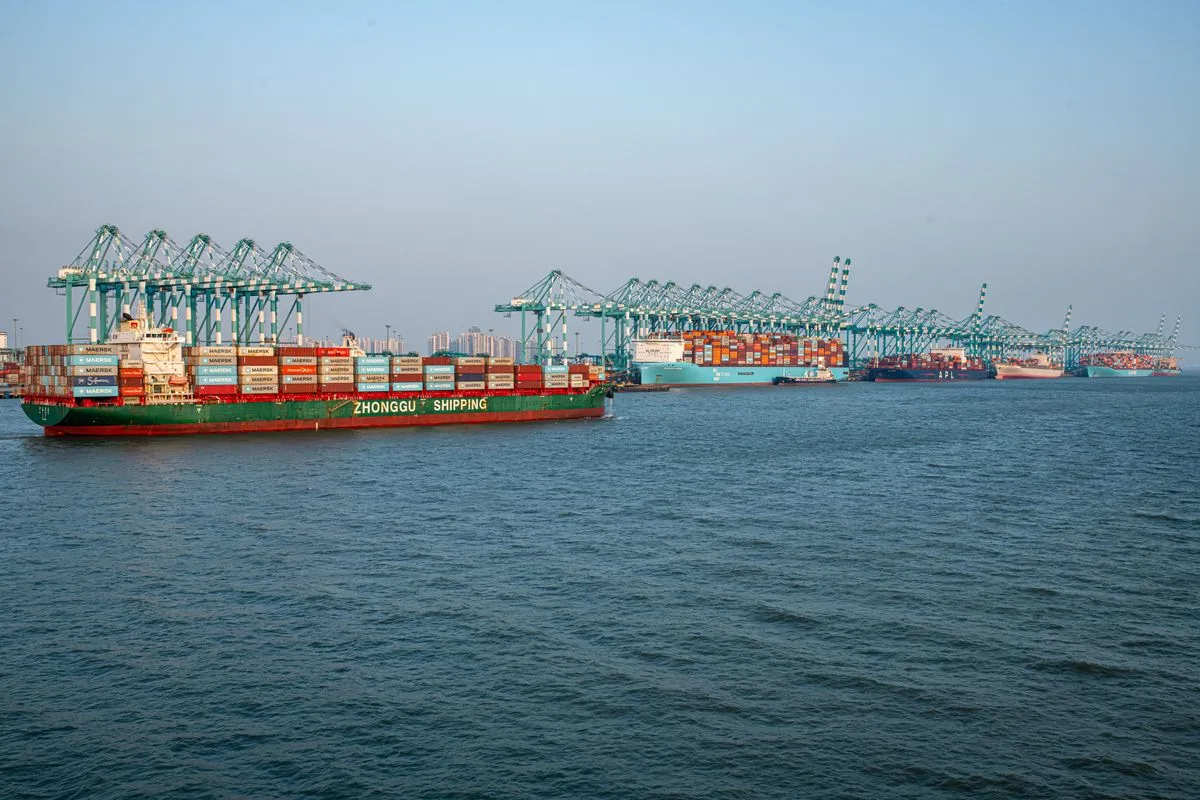
If you export containers from northern China, the odds are high that your cargo passes through Qingdao. With 32.89 million TEU handled in 2025 and over 240 international shipping routes connecting 700 ports in more than 180 countries, Qingdao Port is the dominant container gateway for Shandong, Hebei, Henan, and the broader Yellow River basin. But “shipping through Qingdao” is not one operation — it is three port areas, a dozen terminals, and a customs regime that moves fast when your paperwork is right and stalls when it is not.
This guide covers the operational details that matter to exporters and freight forwarders: which port area handles your cargo, what the transit times look like to major global destinations, how much container shipping costs in 2026, what documents you need for export clearance, and how to handle dangerous goods. Whether you ship FCL (Full Container Load) or LCL (Less than Container Load), understanding the port’s structure before you book will save you delays and demurrage.
1. Qingdao Port at a Glance: Scale and Rankings
Qingdao Port ranked fourth globally in cargo throughput and fifth in container volume in 2025, handling 741 million tons of cargo and 32.89 million TEU. Those numbers grew 4.1 percent and 6.5 percent year on year, respectively. Container throughput crossed 30 million TEU on November 26, 2025 — fifteen days ahead of the same milestone in 2024.
The port operates under Shandong Port Group, which completed a province-wide consolidation of Qingdao, Rizhao, and Yantai ports. That integration has let Qingdao specialize in containers and high-value cargo while Dongjiakou absorbed the expanding bulk commodity traffic. For exporters, the practical result is more vessel calls, denser sailing schedules, and stronger competition among carriers on routes out of Qianwan.
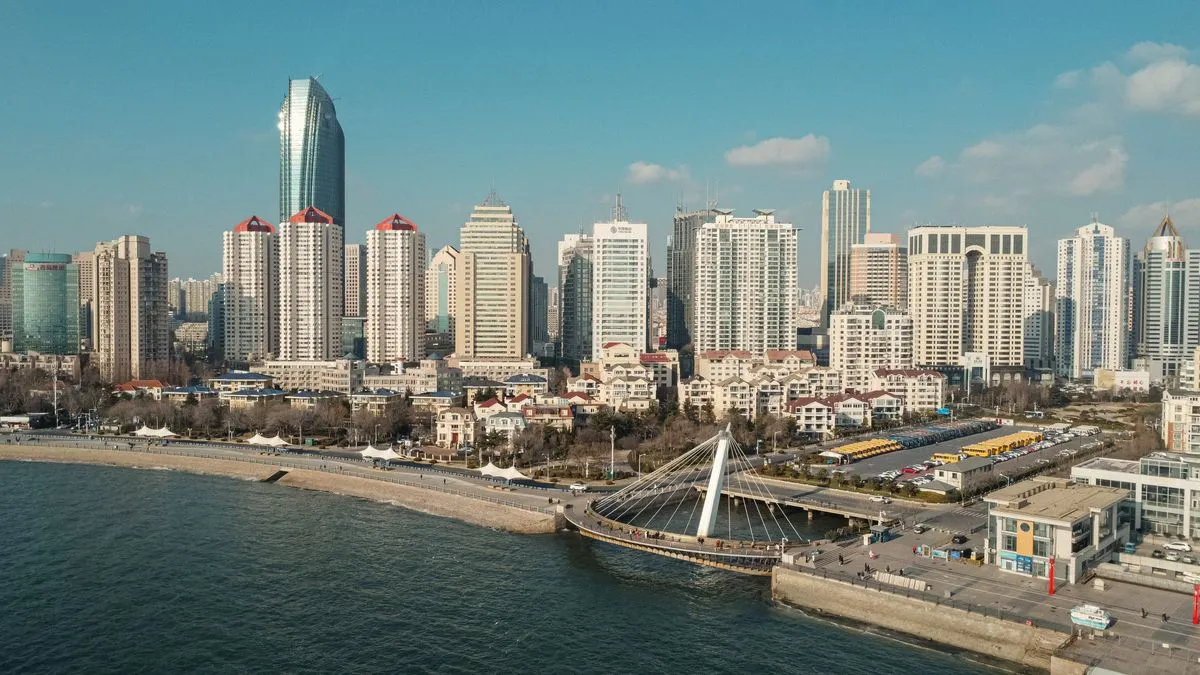
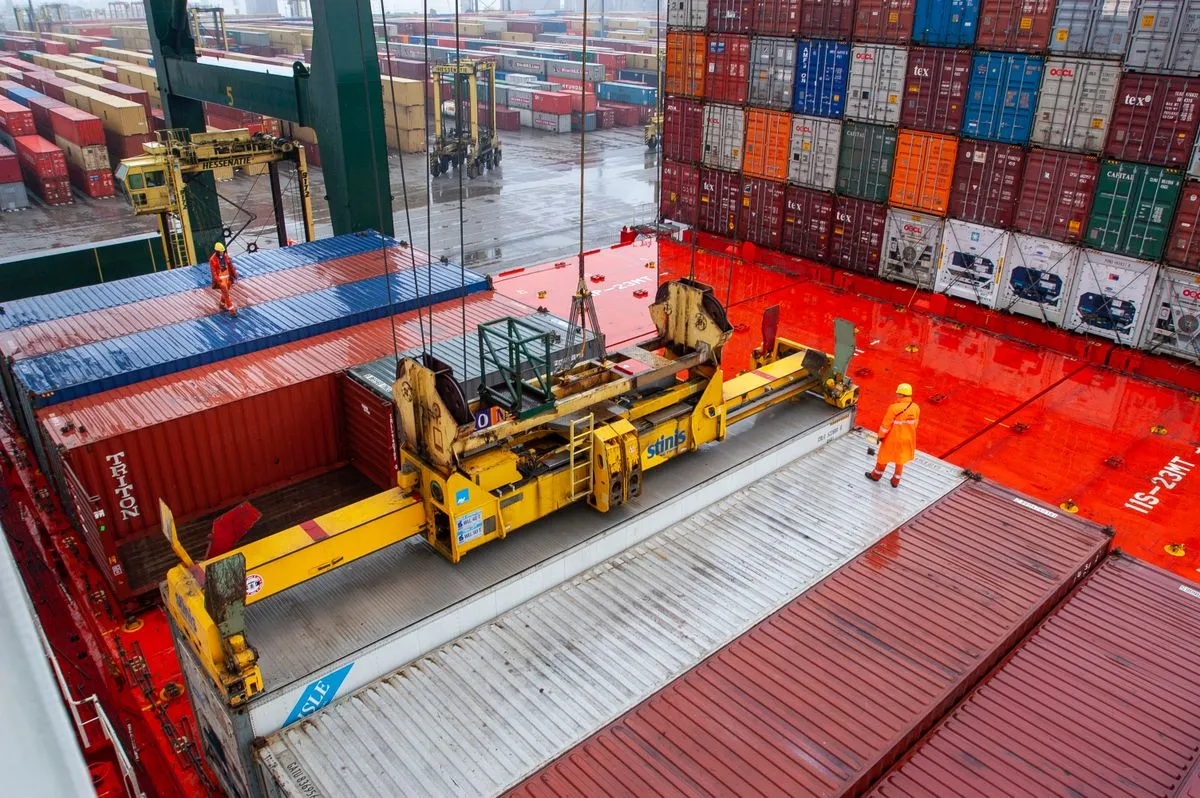
MSC alone moved over 3 million TEU through Qingdao in 2025, setting an annual record for a single carrier at one Chinese port. That kind of volume means multiple weekly departures on most major trade lanes, which gives exporters real flexibility on booking dates.
2. Three Port Areas: Where Does Your Cargo Go?
Qingdao has three core port areas, but for container exporters only one matters most of the time.
Qianwan Port Area: The Container Hub
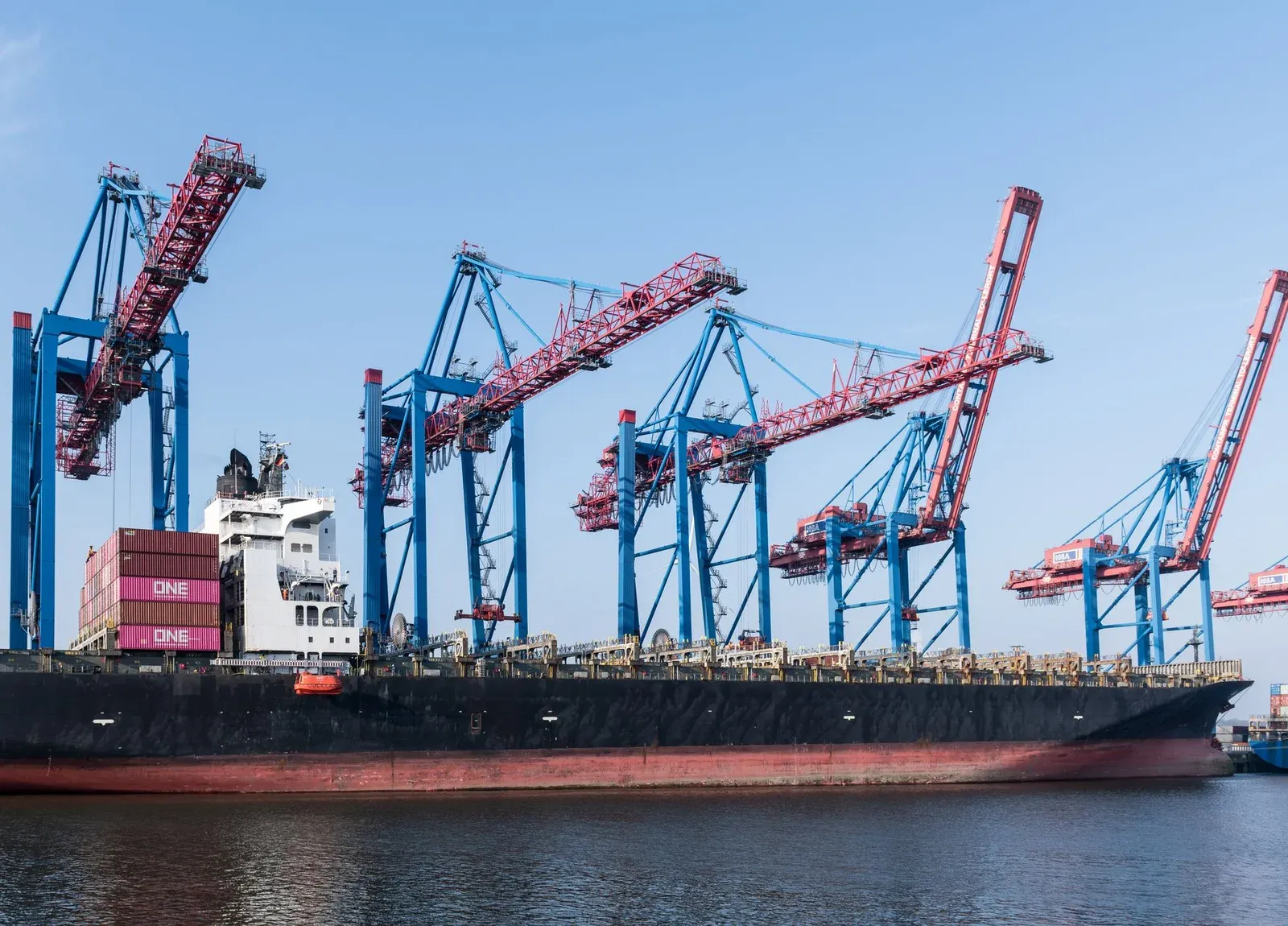
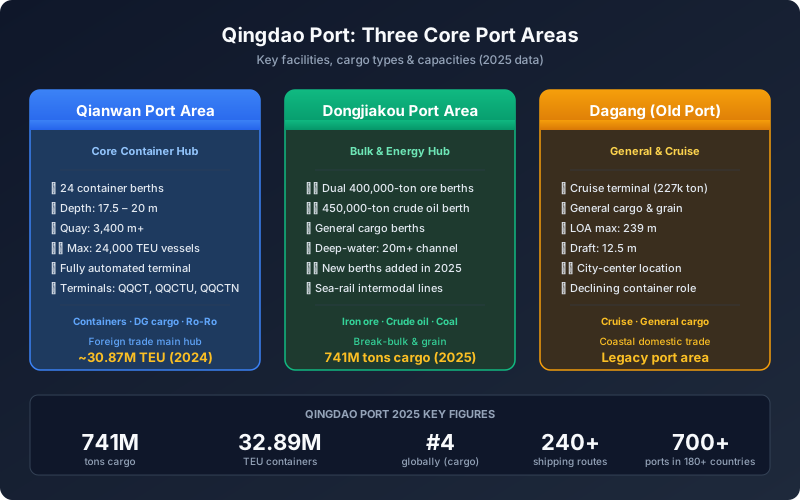
Qianwan (前湾港区), on the west coast of Jiaozhou Bay in Huangdao District, handles virtually all of Qingdao’s foreign-trade container traffic. It has 24 container berths with depths of 17.5 to 20 meters and can berth the world’s largest 24,000 TEU container ships. Three terminal operators share the quay:
- QQCT (Qingdao Qianwan Container Terminal): The south-side berths, jointly operated by Qingdao Port Group, DP World, COSCO SHIPPING Ports, and APM Terminals. Deep-water berths with 3,400 meters of quay.
- QQCTU (Qianwan United Container Terminal): Phase 4 berths with 3,163 meters of quay, built by a multinational consortium including China Merchants Group, DP World, and Maersk. Handles ultra-large container and Ro-Ro vessels.
- QQCTN (Qingdao New Qianwan Container Terminal): The north-side automated terminal. Phase I entered service in May 2017, Phase II in November 2019, and Phase III in December 2023 — China’s first fully domestically produced, fully automated container terminal.
The automated terminal (QQCTN) holds 13 world efficiency records, with a peak of 60.18 container moves per hour using 5G, AI, and hydrogen-powered AGVs. For exporters, the practical point is faster turnaround: vessels load and discharge faster at Qianwan than at most competing Chinese ports, which shortens the window between gate-in and sailing.
Dongjiakou Port Area: Bulk and Energy
Dongjiakou (董家口港区) is the bulk cargo and energy hub. It has dual 400,000-ton ore berths, a 450,000-ton crude oil terminal, and general cargo berths added in 2024–2025. It does not handle mainstream container traffic, but exporters of project cargo, heavy machinery, or oversized equipment may use its general cargo berths.
Dagang (Old Port): Cruise and Legacy
Dagang (大港) is the original city-center port. It now handles cruise ships, some domestic coastal trade, and grain cargo with a maximum vessel LOA of 239 meters and 12.5 meter draft. For international container exports, Dagang is not relevant — your container goes through Qianwan.
| Port Area | Primary Cargo | Container Berths | Max Draft | Relevance to Exporters |
|---|---|---|---|---|
| Qianwan | Containers, DG, Ro-Ro | 24 | 17.5 – 20 m | Main hub for all container exports |
| Dongjiakou | Bulk, crude oil, ore | N/A (general cargo only) | 20 m+ | Project cargo, break-bulk |
| Dagang | Cruise, grain, coastal | N/A | 12.5 m | Not used for container exports |
3. Shipping Routes and Transit Times from Qingdao
Qingdao operates nearly 240 international container routes — the highest route density among northern Chinese ports. In 2025 alone, the port added 17 new international container routes and 11 new routes in the first half of the year, with expansions to Southeast Asia, the Middle East, South America, and Belt and Road regions.
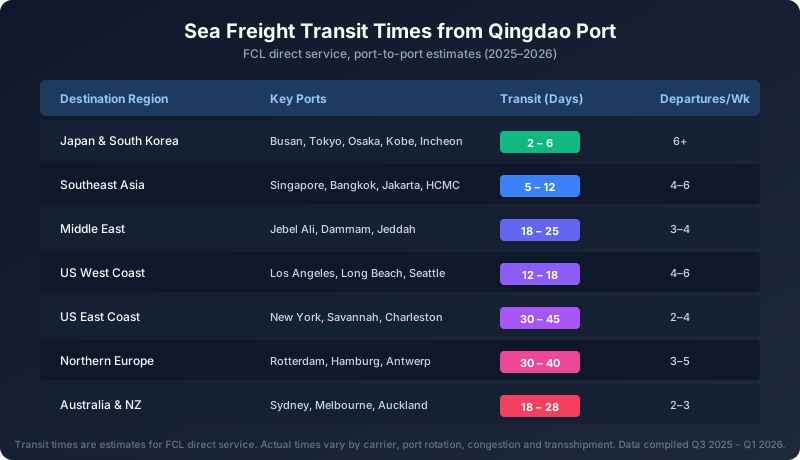
All major global carriers serve Qingdao: Maersk, MSC, COSCO, CMA CGM, Hapag-Lloyd, ONE, Evergreen, ZIM, OOCL, and Yang Ming. Direct sailings reach every major container port worldwide, with the highest frequency on intra-Asia and trans-Pacific routes.
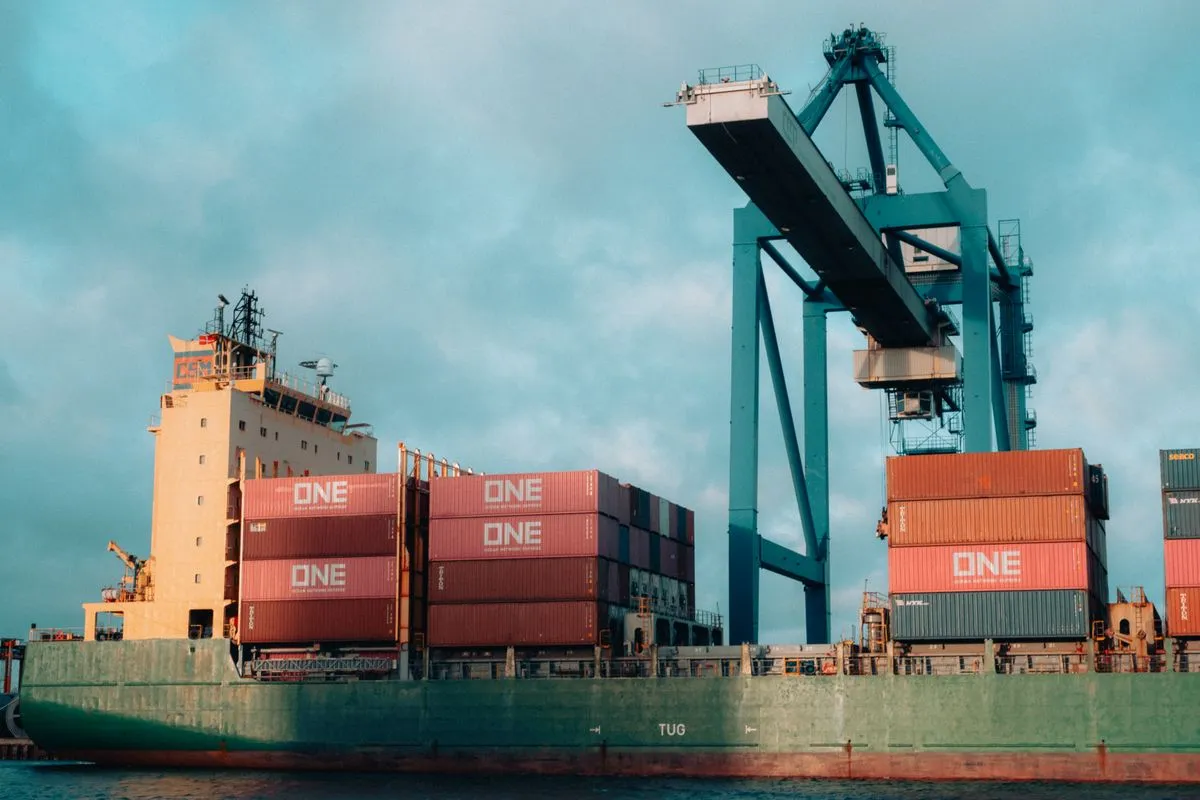
| Destination Region | Key Ports | Transit Time (FCL Direct) | Sailings per Week |
|---|---|---|---|
| Japan & South Korea | Busan, Tokyo, Osaka, Kobe | 2 – 6 days | 6+ |
| Southeast Asia | Singapore, Bangkok, Jakarta, HCMC | 5 – 12 days | 4 – 6 |
| Middle East | Jebel Ali, Dammam, Jeddah | 18 – 25 days | 3 – 4 |
| US West Coast | Los Angeles, Long Beach, Seattle | 12 – 18 days | 4 – 6 |
| US East Coast | New York, Savannah, Charleston | 30 – 45 days | 2 – 4 |
| Northern Europe | Rotterdam, Hamburg, Antwerp | 30 – 40 days | 3 – 5 |
| Mediterranean | Barcelona, Genoa, Piraeus | 25 – 35 days | 2 – 4 |
| Australia & NZ | Sydney, Melbourne, Auckland | 18 – 28 days | 2 – 3 |
| Africa | Dar es Salaam, Mombasa, Lagos | 25 – 40 days | 1 – 2 |
| South America | Santos, Callao, Buenos Aires | 35 – 50 days | 1 – 2 |
Transit times are port-to-port estimates for FCL direct service. LCL shipments add 3–7 days for consolidation at both ends. Actual timing depends on carrier schedules, port rotation, transshipment, and congestion. Our sea freight from china service includes real-time schedule tracking so you can plan around confirmed sailing dates.
4. Container Shipping Costs from Qingdao in 2026
Freight rates fluctuate with season, demand, carrier capacity, and fuel surcharges. The ranges below reflect spot market conditions observed in Q1–Q3 2025 and projected into early 2026. Always request a fresh quote before booking.
| Destination | 20ft Container | 40ft Container | Notes |
|---|---|---|---|
| US West Coast (LA/LB) | USD 1,500 – 3,200 | USD 2,000 – 4,500 | Peak season surcharge Aug–Oct |
| US East Coast (NY) | USD 2,800 – 4,500 | USD 3,500 – 6,000 | Via Panama Canal or Suez |
| Northern Europe (Rotterdam) | USD 1,800 – 3,100 | USD 2,500 – 4,200 | Red Sea diversions add 10–15 days |
| Dubai (Jebel Ali) | USD 1,200 – 2,000 | USD 1,600 – 2,800 | Direct service available |
| Southeast Asia (Singapore) | USD 400 – 800 | USD 600 – 1,200 | Shortest routes, lowest cost |
| Japan/Korea (Busan) | USD 200 – 500 | USD 300 – 700 | Feeder services, very frequent |
| Australia (Sydney) | USD 1,200 – 2,200 | USD 1,800 – 3,200 | Biosecurity inspection on arrival |
On top of the base ocean freight, budget for these common charges:
| Charge | Estimated Cost | When It Applies |
|---|---|---|
| Export customs declaration | USD 50 – 100 / shipment | Every export shipment |
| Terminal Handling Charge (THC) | USD 200 – 350 / container | Origin side (Qingdao) |
| Documentation fee | USD 40 – 75 / shipment | B/L issuance |
| Bunker Adjustment Factor (BAF) | 12–22% of base freight | Fluctuates with oil prices |
| Peak Season Surcharge (PSS) | USD 100 – 300 / container | September – December |
| Container Imbalance Charge (CIC) | USD 50 – 150 / container | When empty repositioning is high |
Rates and surcharges change frequently. Our pricing is transparent with no hidden fees — request a quote from Efanda Logistics for current rates on your specific lane.
5. Export Customs Clearance at Qingdao
Qingdao Customs, under the General Administration of Customs of China (GACC), has reduced export procedures from 14 steps to 10, and compliant low-risk shipments can clear in under 24 hours through the single-window system. Export clearance typically takes 1–3 working days from document submission.
Required Documents
| Document | Purpose | Common Mistake |
|---|---|---|
| Commercial Invoice | Declares goods value and transaction parties | Undervaluation triggers inspection |
| Packing List | Itemized contents, weights, dimensions | Mismatch with actual cargo weight |
| Customs Declaration Form | Official filing with China Customs | Wrong HS Code classification |
| Bill of Lading (B/L) | Transport contract and cargo receipt | Issued before customs release |
| Certificate of Origin | Confirms manufacturing country | Missing for preferential duty claims |
| Export License | Required for controlled goods | Overlooked for dual-use items |
| MSDS | For chemical or hazardous cargo | Outdated (must be within 3 years) |
Three actionable tips for smooth clearance:
- Pre-classify your HS Codes. The most common reason for customs delays at Qingdao is incorrect commodity classification. Have your freight forwarder verify HS codes before the cargo reaches the terminal, not after.
- Submit documents electronically via the China International Trade Single Window. The system lets you file customs declarations, inspection applications, and port logistics documents through one platform. Pre-arrival submission cuts clearance to under 24 hours for compliant shipments.
- Keep your CIQ records for 3 years. If your goods are subject to commodity inspection (food, chemicals, machinery, textiles), the Commodity Inspection and Quarantine certificate is mandatory. Start the CIQ application 4–6 weeks before your planned shipment date.
Need help navigating Chinese export regulations? Our customs clearance team handles documentation, HS code verification, and coordination with Qingdao Customs on your behalf.
6. Dangerous Goods (DG) Handling at Qingdao
Qingdao is one of China’s top ports for dangerous goods container handling, with dedicated DG storage yards at Qianwan and the fastest Maritime Safety Administration (MSA) approval cycle in northern China (1–3 working days).
What Qingdao Accepts and Prohibits
| Category | Status | Examples |
|---|---|---|
| Class 1 (Explosives) | ❌ Prohibited | Fireworks, detonators |
| Class 2 (excl. 2.3 toxic gases) | ✅ Accepted | Aerosols, CO₂, compressed nitrogen |
| Class 3 (Flammable liquids) | ✅ Accepted (restricted Jun–Oct for water-reactive) | Paints, solvents, ethanol |
| Class 4 (Flammable solids) | ✅ Accepted | Sulfur, metal powders |
| Class 5 (Oxidizers) | ✅ Accepted | Hydrogen peroxide, pool chlorine |
| Class 6 (excl. 6.2 infectious) | ✅ Accepted | Pesticides, phenol |
| Class 7 (Radioactive) | ❌ Prohibited | Medical isotopes |
| Class 8 (Corrosives) | ✅ Accepted | Sulfuric acid, caustic soda |
| Class 9 (Miscellaneous) | ✅ Accepted | Lithium batteries (UN3480/3481), EVs |
Important operational notes:
- Class 2.3 toxic gases, Class 6.2 infectious substances, and Class 7 radioactive materials are strictly prohibited from loading, unloading, or storage at the port.
- Class 4.3 (dangerous when wet) and Class 5.2 (organic peroxides) must be directly loaded/discharged between vehicle and ship — no port-area storage.
- Some Class 3 flammable liquids with water-reactive properties face storage restrictions from June 1 to October 31.
Every DG shipment requires: MSDS (dated within 3 years), DG Packaging Certificate, maritime DG declaration filed with MSA at least 3 working days before vessel loading, and carrier DG acceptance letter. Do not commit cargo to a Qingdao booking without confirming DG acceptance with your forwarder first — published policy and operational reality can differ.
7. Sea-Rail Intermodal: Qingdao’s Inland Advantage
Qingdao Port has led all Chinese ports in sea-rail intermodal container volume for 11 consecutive years. In the first two months of 2025, the port handled 512,000 TEU by rail-sea intermodal, up 10.6 percent year on year. The port operates 56 inland ports and 86 rail-sea intermodal train routes, reaching deep into Henan, Shaanxi, Shanxi, and the broader Yellow River basin.
For exporters based in inland cities, sea-rail intermodal works like this: your cargo is loaded into a container at an inland rail terminal, sealed, and moves by rail directly to the Qianwan container yard. Customs clearance can happen at the inland port under the “single declaration, single inspection, single release” model, so the container moves straight from the train to the vessel without re-inspection at Qingdao.
The cost advantage is significant for transport distances over 600 kilometers. Shandong Land Bridge International reported saving over 360,000 RMB in a single year by switching 120+ TEU from road to rail-sea intermodal. The “front port–back station” model also cuts dwell time: goods arriving by rail are loaded or discharged within an average of two hours, with train punctuality above 99 percent.
Key intermodal corridors include:
- Central Asia: Qingdao → Alashankou/Khorgos → Kazakhstan, Kyrgyzstan, Uzbekistan
- China–Europe Railway Express: Qingdao → Manzhouli → Moscow and onward to Europe
- ASEAN route: Qingdao → Pingxiang → Hanoi, Vietnam
If your factory is in Zhengzhou, Xi’an, Jinan, or Taiyuan, ask your forwarder about sea-rail intermodal rates — the combined cost is often lower than trucking to Shanghai or Ningbo, with comparable transit times.
8. Step-by-Step: Exporting a Container from Qingdao
Here is the standard export workflow for a container shipment from Qingdao, from factory to vessel departure:
- Booking confirmation. Your freight forwarder books space with a carrier and receives a booking confirmation with the vessel name, ETD, and container pickup location.
- Container stuffing. Empty container is picked up from the Qianwan depot and delivered to your factory or warehouse. Cargo is loaded, sealed, and weighed. The Verified Gross Mass (VGM) must be submitted before the carrier’s cutoff.
- Export customs declaration. Your customs broker files the declaration through the Single Window system. For low-risk goods, clearance completes within 24 hours. If flagged for inspection, allow 1–2 additional working days.
- Gate-in to terminal. The loaded container enters the Qianwan container yard before the carrier’s CY cutoff (typically 24–48 hours before ETD). The terminal issues a dock receipt.
- DG declaration (if applicable). For dangerous goods, the maritime DG declaration must be filed with MSA at least 3 working days before loading.
- Vessel loading and departure. The container is loaded onto the vessel. The carrier issues the Bill of Lading after departure.
- Document release. Original B/L or Telex Release is sent to the consignee for import clearance at destination.
The entire process from booking to departure typically takes 7–14 days, depending on vessel schedule and customs clearance speed.
9. Why Exporters Choose Qingdao Over Other Chinese Ports
Qingdao’s competitive advantages for container exporters center on three factors:
Route density for northern China cargo. If your goods are manufactured in Shandong, Hebei, Henan, or Beijing-Tianjin, trucking to Qingdao is shorter and cheaper than sending containers south to Shanghai or Ningbo. The port’s 240+ international routes cover every major market, and new routes are added monthly.
DG handling capability. Qingdao accepts IMDG Classes 2–9 (excluding 2.3, 6.2, and 7), has dedicated DG container yards at Qianwan, and processes MSA filings faster than competing ports. For Shandong’s chemical industry — one of China’s largest — this is the default DG export gateway.
Automation and efficiency. The QQCTN automated terminal consistently achieves 30+ moves per hour, compared to the global average of 25–28. Faster vessel turnaround means tighter schedule reliability and fewer roll-overs for your booking.
Our door to door shipping from china service covers the full chain from factory pickup in any northern China city, through Qingdao export clearance, to final delivery at your destination warehouse.
10. Frequently Asked Questions
What is the port code for Qingdao? The international port code is CNTAO (UN/LOCODE: CN TAO). Use this code in all customs declarations, shipping instructions, and carrier bookings to avoid routing errors.
How long does it take to ship from Qingdao to the US? FCL direct service to the US West Coast takes 12–18 days. To the US East Coast, expect 30–45 days depending on whether the vessel transits via the Panama Canal or the Suez Canal. LCL adds 5–10 days for consolidation.
Can I ship lithium batteries through Qingdao? Yes. Lithium batteries fall under IMDG Class 9 (UN3480, UN3481, UN3536) and are accepted at Qianwan. You need a valid MSDS, UN-approved DG packaging certificate, and maritime DG declaration filed with MSA at least 3 working days before loading.
What are Qingdao Port’s operating hours? The container terminals at Qianwan operate 24 hours a day, 7 days a week. Customs clearance operates during business hours on working days, with electronic submissions accepted around the clock through the Single Window system.
Is Qingdao cheaper than Shanghai for container shipping? Ocean freight rates from Qingdao are often USD 100–300 lower per container than Shanghai on the same lane, because carriers compete harder for northern China cargo. However, if your factory is south of the Yangtze, the inland trucking savings to Shanghai usually outweigh the slightly higher ocean rate.
How far in advance should I book a container from Qingdao? For standard FCL on major routes, book 2–3 weeks before your target ETD. During peak season (August–November) or for DG cargo, book 3–4 weeks ahead to secure space and complete MSA filings on time.
Qingdao Port is the workhorse of northern China’s container trade, and understanding its structure — three port areas, a world-class automated terminal at Qianwan, 240+ routes, and a customs regime that rewards preparation — is the first step toward shipping more efficiently. If you are planning a shipment through Qingdao and want a transparent quote with no hidden fees, our team at Efanda Logistics can handle the entire process from factory to destination port. We have been coordinating China exports since 2018, with dedicated logistics specialists for every lane.
Written by the EFANDA Logistics team — a Shenzhen-based freight forwarder established in 2018, moving cargo from China to ports worldwide with end-to-end pickup, consolidation, customs and door delivery.About us