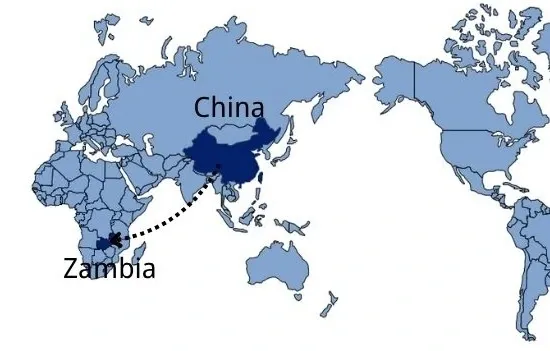
Shipping from China to Zambia is not one route. It is an ocean leg to a port in another country, followed by a thousand kilometres of road, one or two borders, a weighbridge and a customs declaration. Importers who compare only the ocean freight rate are choosing the cheapest 40 percent of the journey — and paying for the rest in delays at Nakonde or demurrage at Dar es Salaam.
This guide is written from the operating side of the corridor: which of the four ports actually works for your cargo and deadline, how the overland leg and transit bonds function, what ZRA charges in duty and 16 percent VAT, where the days are lost, and how mining, solar and construction importers should plan heavy and out-of-gauge cargo. Zambia’s import profile is dominated by mining equipment, diesel and solar generation, construction materials and FMCG, and each of those behaves differently on the road.
Why Shipping to Zambia Starts With a Corridor Decision
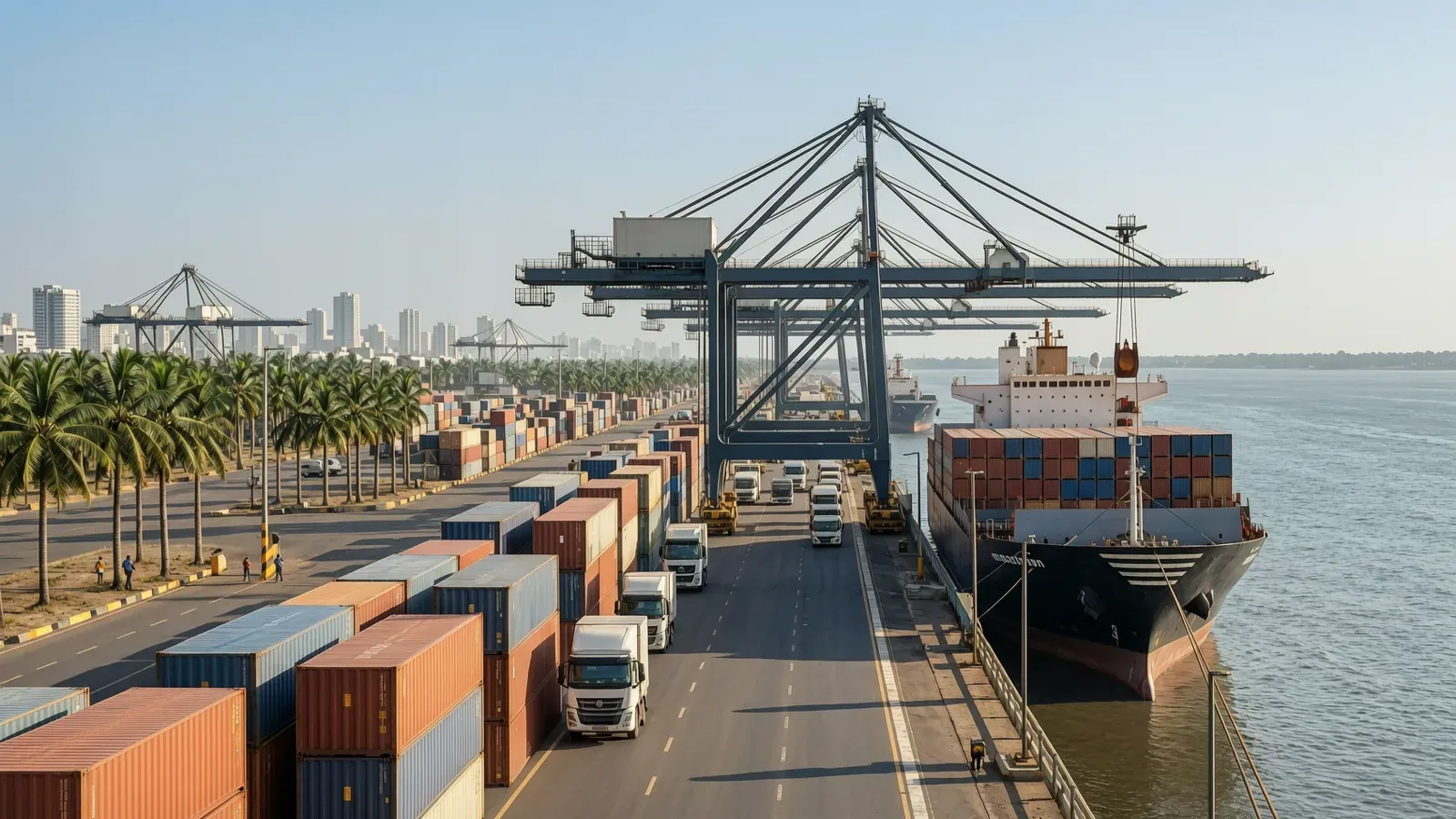
Because Zambia has no coastline, the port decision is the shipment decision. Four corridors serve the country, each with a different ocean transit, a different road distance and a different border. The right answer depends on where your cargo must end up and how much float your delivery date has.
The Four Corridors
Dar es Salaam (Tanzania). The shortest land leg to Lusaka at roughly 1,800 kilometres on the Great North Road through Nakonde. Ocean schedules are frequent and rates are competitive, but Dar is congested, and the Nakonde border queues when volumes spike.
Durban (South Africa). The deepest port on the continent with the most reliable sailing schedules. The road leg runs roughly 2,200 kilometres via Beitbridge and Chirundu, so more trucking days but typically more predictable handling.
Beira (Mozambique). The natural port for the Copperbelt and eastern Zambia, with a shorter inland run via Tete or Mutare. Capacity is smaller and schedules are thinner, so it works best for regular volumes.
Walvis Bay (Namibia). The longest ocean leg but the least congested port, entering Zambia via Katima Mulilo or Kazungula. A good fit for Livingstone, the south and west, and for cargo that cannot afford port delays.
The four corridors into Zambia
| Corridor | Port | Border entry | Inland distance | Ocean transit |
|---|
| North | Dar es Salaam | Nakonde | ~1,800 km | 25–33 days |
|---|
| South | Durban | Beitbridge and Chirundu | ~2,200 km | 28–36 days |
|---|
| East | Beira | Tete or Mutare | ~1,500 km | 30–38 days |
|---|
| West | Walvis Bay | Katima Mulilo or Kazungula | ~1,900 km | 30–40 days |
|---|
Sea Freight From China to Zambia
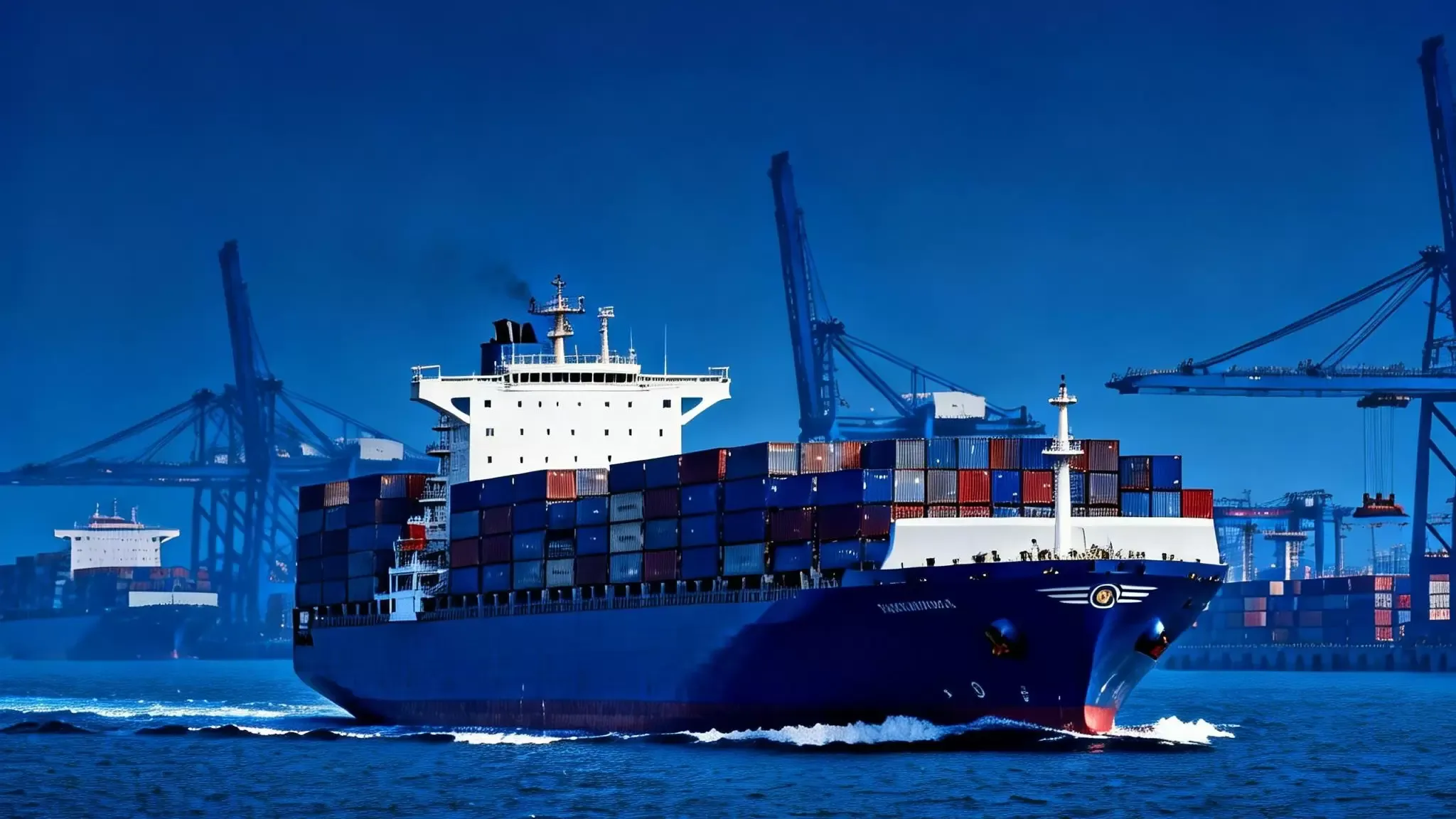
Sea freight carries almost everything above 15 CBM into Zambia, from containerised machinery to bagged materials and full production runs. Services leave Shanghai, Ningbo, Shenzhen, Qingdao and Xiamen and connect to the four ports, with the inland leg priced as a separate but usually bundled component.
Two cost traps dominate this lane. The first is demurrage at the discharge port: containers waiting for a corridor booking or a transit bond accrue storage that can exceed the ocean freight. The second is weight: Zambian roads and the corridors enforce axle-load limits, and an overloaded 20ft container is stopped at the weighbridge and repacked, not waved through.
When to Choose Sea Freight
- Your shipment exceeds 15 CBM or 2 tonnes and cost per unit matters more than speed
- A six to eight week door-to-door window fits your inventory or project plan
- You need a full container, a shared LCL slot, or RoRo capacity for vehicles
- The goods are non-perishable and can tolerate two handling points and one border
Typical cargo on this lane: mining machinery and spares, generators and transformers, solar modules, inverters and batteries, construction materials and steel, agricultural inputs, vehicles, and consumer goods for Lusaka wholesalers.
Chinese origin ports serving the Zambia corridors
| Origin port | Best corridor | Why |
|---|
| Shanghai | Dar es Salaam or Beira | Frequent sailings, strong container availability |
|---|
| Ningbo | Dar es Salaam | High-volume container capacity |
|---|
| Shenzhen | Beira or Durban | South China exports, flexible routings |
|---|
| Qingdao | Durban | North China gateway, deep-sea services |
|---|
| Xiamen | Dar es Salaam | Frequent east Africa connections |
|---|
Indicative ocean transit times to the corridor ports
| Port | Transit from China | Notes |
|---|
| Dar es Salaam | 25–33 days | Congestion risk in peak months |
|---|
| Durban | 28–36 days | Most reliable schedule |
|---|
| Beira | 30–38 days | Thinner capacity |
|---|
| Walvis Bay | 30–40 days | Least congested, longest ocean leg |
|---|
FCL, LCL and RoRo
FCL (full container load). A 20ft, 40ft or 40HQ container used exclusively for your cargo. Lowest cost per CBM above roughly 15 CBM, and the only sensible option for machinery, project cargo and anything with a fixed delivery window.
LCL (less than container load). Your cargo shares a container to the port and is then consolidated onto a Zambia-bound truck. Sensible below 15 CBM, but expect a longer door-to-door window because your cargo waits for a full truck before the overland leg starts.
RoRo (roll-on/roll-off). For cars, vans, trucks, buses and self-propelled machinery, discharged at Durban or Dar es Salaam and driven or carried onward. Check the carbon emission surtax and vehicle age rules before booking.
The Overland Leg: Trucking, Borders and Bonds
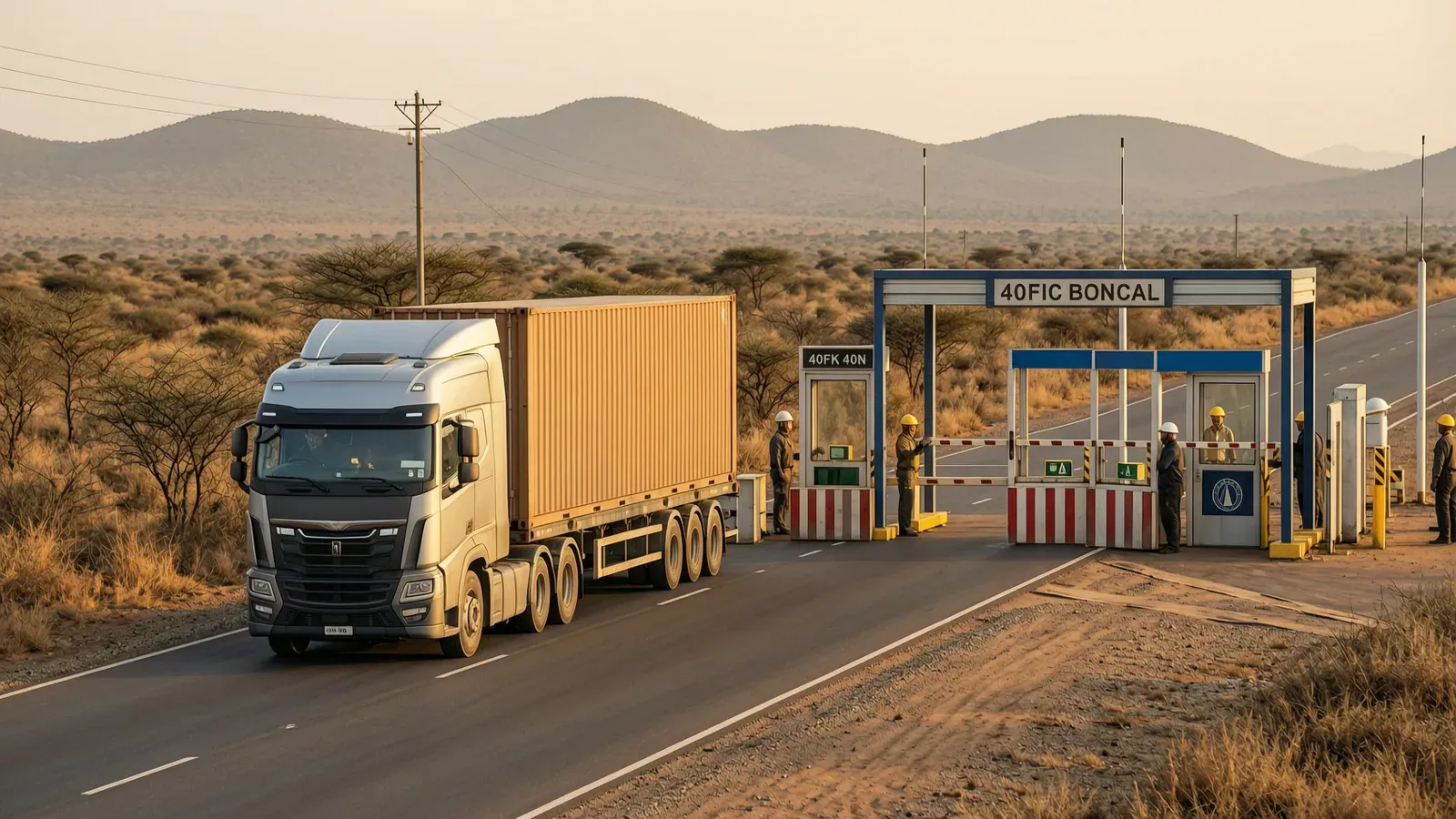
The port-to-door truck is where Zambian shipping is won or lost. Cargo moves under a transit bond through the neighbouring country, is presented at the border, and is then cleared into Zambia at an inland office such as Lusaka or Ndola — or at the border itself, depending on the regime and the agent.
Border Posts That Decide Your Schedule
Main border posts and what to expect
| Border | Corridor | Typical delay | Notes |
|---|
| Nakonde | Dar es Salaam | 1–4 days | Highest volume, queues in peak season |
|---|
| Chirundu | Durban | 1–3 days | Zimbabwe to Zambia, northbound heavy traffic |
|---|
| Kasumbalesa | Copperbelt | 1–3 days | Zambia to DR Congo, mining traffic |
|---|
| Kazungula | Walvis Bay | 1–2 days | Botswana crossing, new bridge |
|---|
| Mutare | Beira | 1–3 days | Zimbabwe transit |
|---|
Three practical rules keep the overland leg on schedule. Book the truck before the vessel berths, not after, so the container is collected inside free time. Make sure the transit bond covers the full corridor and is lodged before arrival. And confirm axle loads at loading in China — repacking at a weighbridge costs more than the extra pallet position ever saved.
Rail to Zambia: TAZARA and the Southern Line
Rail exists on this lane but it is a capacity supplement, not a plan. TAZARA links Dar es Salaam to Kapiri Mposhi, and the southern network links Zambia to Zimbabwe and South Africa via Livingstone. Both handle containers and bulk, both are slower than road, and both are subject to locomotive and wagon availability.
Rail options into Zambia
| Route | Typical transit | Best for |
|---|
| Dar es Salaam → Kapiri Mposhi (TAZARA) | 10–20 days | Bulk and containers when wagons are available |
|---|
| Durban → Lusaka via Zimbabwe | 12–20 days | Bulk commodities, cross-border rail |
|---|
| Beira → Harare → Lusaka | 14–22 days | Bulk and project cargo |
|---|
Use rail when your cargo is heavy, non-urgent and large enough to fill wagons, and treat any promised transit as indicative. For a container that must arrive by a date, road remains the only dependable option.
Air Freight From China to Zambia
Air freight from China to Zambia is the fastest route and the right choice for spare parts, urgent equipment, samples and high-value electronics. Lusaka Kenneth Kaunda International (LUN) is the main cargo gateway, with one-stop connections through Addis Ababa, Nairobi, Dubai, Doha or Johannesburg; Ndola (NLA) serves the Copperbelt.
Key Airports and Routes
Chinese airports: Shanghai Pudong (PVG), Guangzhou Baiyun (CAN), Shenzhen Bao’an (SZX), Beijing Capital (PEK), Hong Kong (HKG) and Chengdu Tianfu (TFU).
Zambian airports: Lusaka Kenneth Kaunda (LUN) for national and project cargo, Ndola Simon Mwansa Kapwepwe (NLA) for the Copperbelt, and Livingstone (LVI) for the south.
Indicative air freight transit times to Zambia
| Route | Transit time | Notes |
|---|
| Shanghai → Lusaka | 3–5 days | One stop via Gulf or East Africa |
|---|
| Guangzhou → Lusaka | 3–6 days | Belly capacity dependent |
|---|
| Shenzhen → Lusaka | 4–6 days | Electronics consolidation |
|---|
| Shanghai → Ndola | 4–7 days | Via LUN plus domestic leg |
|---|
Transit above is airport to airport. Door to door adds pickup, export clearance, ZRA clearance and inland delivery — plan 4–8 days end to end.
Door to Door From China to Zambia
Door-to-door shipping from China to Zambia puts the whole corridor under one contract: supplier pickup, export declaration, ocean or air carriage, transit bond, ZRA clearance, duty and VAT settlement, and delivery to your site.
What a properly quoted door-to-door service includes:
- Pickup from the supplier, with a check of packing marks and carton counts
- Export clearance and any certificate of origin or exemption claim
- Ocean or air main carriage to the corridor port
- Transit bond and border formalities in the transit country
- ZRA entry, duty and VAT settlement by a licensed clearing agent
- Delivery to the final address, with offloading arranged in advance
Door-to-door process, China to Zambia
| Step | What happens | Owner |
|---|
| Booking | Corridor, mode and Incoterm confirmed | Efanda |
|---|
| Pickup | Cargo collected and checked at origin | Efanda origin team |
|---|
| Export | Declaration and documents filed in China | Efanda |
|---|
| Ocean carriage | China to the corridor port | Carrier |
|---|
| Transit | Bonded truck across the border | Efanda partner |
|---|
| Clearance | ZRA entry, duty and VAT paid | Zambian agent |
|---|
| Delivery | Goods offloaded at the final address | Efanda partner |
|---|
One Zambian detail decides the whole design: the importer of record needs a TPIN and the declaration must be lodged by a licensed clearing agent in the ZRA system. A Chinese seller cannot simply declare its own goods at the border. DDP therefore runs through a registered importer-of-record arrangement — your Zambian entity, your buyer, or a partner of record that we coordinate — with duty and VAT itemized before the container is loaded.
Shipping Costs From China to Zambia
Shipping costs from China to Zambia are built from five blocks: origin charges, ocean freight, corridor port charges, overland transit and border costs, and finally duty plus VAT. Most importer complaints trace back to a quote that covered only the first three.
Ocean freight moves with the market, but on this lane the inland leg is the bigger variable. Fuel prices, border congestion and truck availability change the overland rate faster than carriers change the ocean rate, so re-quote the whole corridor rather than assuming last quarter’s delivered cost.
Indicative sea plus overland cost ranges to Lusaka, November 2026
| Service | Indicative range | Best for |
|---|
| 20ft FCL to Lusaka | USD 4,200 – 7,500 | 10–28 CBM of dense cargo |
|---|
| 40ft / 40HQ to Lusaka | USD 6,500 – 10,500 | 25–65 CBM, machinery and project cargo |
|---|
| LCL | USD 180 – 320 per CBM | 2–15 CBM, test orders |
|---|
| RoRo | Quoted per vehicle | Cars, vans, wheeled machinery |
|---|
Indicative air freight cost ranges to Lusaka, November 2026
| Shipment size | Indicative range | Typical use |
|---|
| 50–100 kg | USD 7 – 10 per kg | Samples, documents, spare parts |
|---|
| 100–300 kg | USD 6 – 9 per kg | Electronics, urgent spares |
|---|
| 500 kg and above | USD 5 – 8 per kg | Commercial cargo, negotiated |
|---|
All figures are indicative ranges as of November 2026 and exclude duty, VAT and cargo insurance. Corridor choice moves the delivered number materially — the cheapest ocean rate and the cheapest delivered cost are frequently not the same quote.
Shipping Time From China to Zambia
Shipping time from China to Zambia is a sum of parts, and the parts fail independently. Ocean transit is 25–40 days depending on the port, the overland leg is five to twelve days, and clearance can be one day or one week. Plan 35–50 days door to door by sea and 4–8 days by air.
What delays shipments on the China to Zambia corridor
| Delay | Typical impact | Where it happens |
|---|
| Port congestion | 3–10 days | Dar es Salaam in peak season |
|---|
| Container demurrage | 2–8 days | Discharge port before trucking |
|---|
| Border queues | 1–4 days | Nakonde, Chirundu, Kasumbalesa |
|---|
| Weighbridge overload | 1–3 days | Corridor weighbridges |
|---|
| Incomplete transit bond | Cargo held | Border or inland office |
|---|
| Missing TPIN or certificate | Cargo held | ZRA declaration stage |
|---|
Zambia Customs: ZRA, Duty and VAT
Customs work on this lane is done by the Zambia Revenue Authority, through licensed clearing agents filing in the electronic single-window system. Duty is assessed on the CIF value, and 16 percent VAT is charged on the customs value plus duty.
Duty Bands, VAT and TPIN
Zambian duty mostly falls into three bands: 0–5 percent for capital equipment and raw materials, 15 percent for intermediate goods, and 25 percent for finished consumer goods. Machinery for mining, agriculture, aquaculture and solar energy is commonly duty-free, which is why the same shipment value can produce very different tax bills depending on classification.
Duty and VAT on a USD 20,000 CIF shipment into Zambia
| Line | Mining or solar machinery | Finished consumer goods |
|---|
| CIF value | USD 20,000 | USD 20,000 |
|---|
| Duty rate | 0 percent | 25 percent |
|---|
| Duty paid | USD 0 | USD 5,000 |
|---|
| Value for VAT | USD 20,000 | USD 25,000 |
|---|
| VAT at 16 percent | USD 3,200 | USD 4,000 |
|---|
| Total tax at import | USD 3,200 | USD 9,000 |
|---|
Two further charges matter. Motor vehicles attract a carbon emission surtax on top of duty and VAT. And the classification itself is the biggest controllable variable on the file: a machinery line coded as a finished good instead of capital equipment can turn a 0 percent assessment into 25 percent, so verification before booking is worth more than any freight negotiation.
Documents Required for Zambian Clearance
Standard documents for importing into Zambia
| Document | Purpose | Notes |
|---|
| Commercial invoice | Declares value and terms | Must match HS code and Incoterm |
|---|
| Packing list | Quantity, weight, packaging | Drives inspection and truck loading |
|---|
| Bill of lading / AWB | Contract of carriage | Original, telex release or sea waybill |
|---|
| Transit bond / T1 | Covers the corridor movement | Lodged before arrival |
|---|
| Importer TPIN | Identifies the importer | Required before declaration |
|---|
| Certificate of origin | Supports exemption or preference | Issued in China before departure |
|---|
| Product certificates | Compliance for regulated goods | Depends on the goods |
|---|
| Insurance certificate | Cargo cover evidence | Recommended on every shipment |
|---|
Mining, Solar and Project Cargo Into Zambia
Zambia’s import mix is unusual in how much of it is heavy, long and time-critical. Mining houses order crushers, mill liners, spare motors and transformers; the solar programme brings in modules, inverters, mounting structures and batteries; construction brings steel, roofing and plant. These shipments fail on dimensions and documentation, not on freight rates.
What project cargo needs before it sails: verified weights and lifting points, a road survey for the abnormal load, corridor permits for each country crossed, axle-load compliance, and a crane booking at site. A transformer that needs an escort and a low-bed is a different shipment from one that fits in a 40ft container, and the difference is discovered at the port if nobody checked at quotation.
Solar and battery cargo carries its own rules: lithium batteries are dangerous goods and need carrier approval, correct UN numbers and compliant packing, and modules need crating that survives an overland corridor rather than a terminal-to-terminal move.
Common Mistakes When Shipping From China to Zambia
Most losses on this corridor are avoidable, and they repeat in the same patterns.
Frequent mistakes and their impact
| Mistake | What it causes | Typical cost |
|---|
| Comparing ocean freight only | Ignores transit, border and port costs | 20–40 percent of the landed cost |
|---|
| Booking the truck after berthing | Demurrage at the port | Daily storage charges |
|---|
| Wrong HS code | Higher duty band | Up to 25 percent instead of 0 percent |
|---|
| Overloaded container | Weighbridge stop and repack | Days of delay plus repacking |
|---|
| No transit bond before arrival | Cargo held at the border | Storage and penalties |
|---|
| No cargo insurance | Unrecoverable damage | Full cargo value at risk |
|---|
Three habits prevent almost all of it. First, quote the whole corridor delivered to your door, broken into ocean, port, transit and tax. Second, verify the HS code and the duty band before the goods leave China. Third, book the truck and the transit bond before the vessel berths, so the container leaves the port inside free time.
How to Choose the Right Freight Forwarder
A freight forwarder from China to Zambia should be judged on corridor capability, not on the ocean rate. The failures that hurt importers happen at the discharge port, on the weighbridge and at the border — not on the bill of lading.
What to check:
- Corridor experience. Proof of regular moves on at least two of the four corridors, and a reason for recommending one over the other.
- Transit bond handling. Who lodges the bond, how many days of cover, and what happens if the truck is delayed.
- Zambian clearance capability. A licensed agent, a named contact, and a duty-band opinion you can act on before booking.
- Project cargo competence. Permits, road surveys and lifting plans for out-of-gauge items.
- Communication during exceptions. The test is what happens when the vessel is rolled or the border closes.
Why Work With EFANDA Logistics
EFANDA Logistics has handled China-origin freight since 2018 from Shenzhen, and the China–Southern Africa corridor is one of our standing trade routes. We quote all four corridors on the same desk, so the recommendation you get is the one that fits your deadline and your budget rather than the one we happen to sell.
EFANDA Logistics on the China to Zambia corridor
| Service area | What you get |
|---|
| Sea freight China to Zambia | FCL, LCL and RoRo via Dar es Salaam, Durban, Beira and Walvis Bay |
|---|
| Overland transit | Bonded trucking, border formalities and weighbridge compliance |
|---|
| Air freight | Consolidation and one-stop uplifts into LUN and NLA |
|---|
| Zambian customs | ZRA declaration, duty-band checks, TPIN and VAT settlement |
|---|
| Project cargo | Flat racks, low beds, permits and road surveys for heavy lifts |
|---|
| Account management | One advisor, proactive milestone updates |
|---|
If you are comparing corridors, ask us for a side-by-side: the same shipment priced via Dar es Salaam, Durban, Beira and Walvis Bay, with realistic door-to-door windows and the landed cost including duty and VAT. That comparison, not a single ocean rate, is what actually decides the right corridor — and it is free.