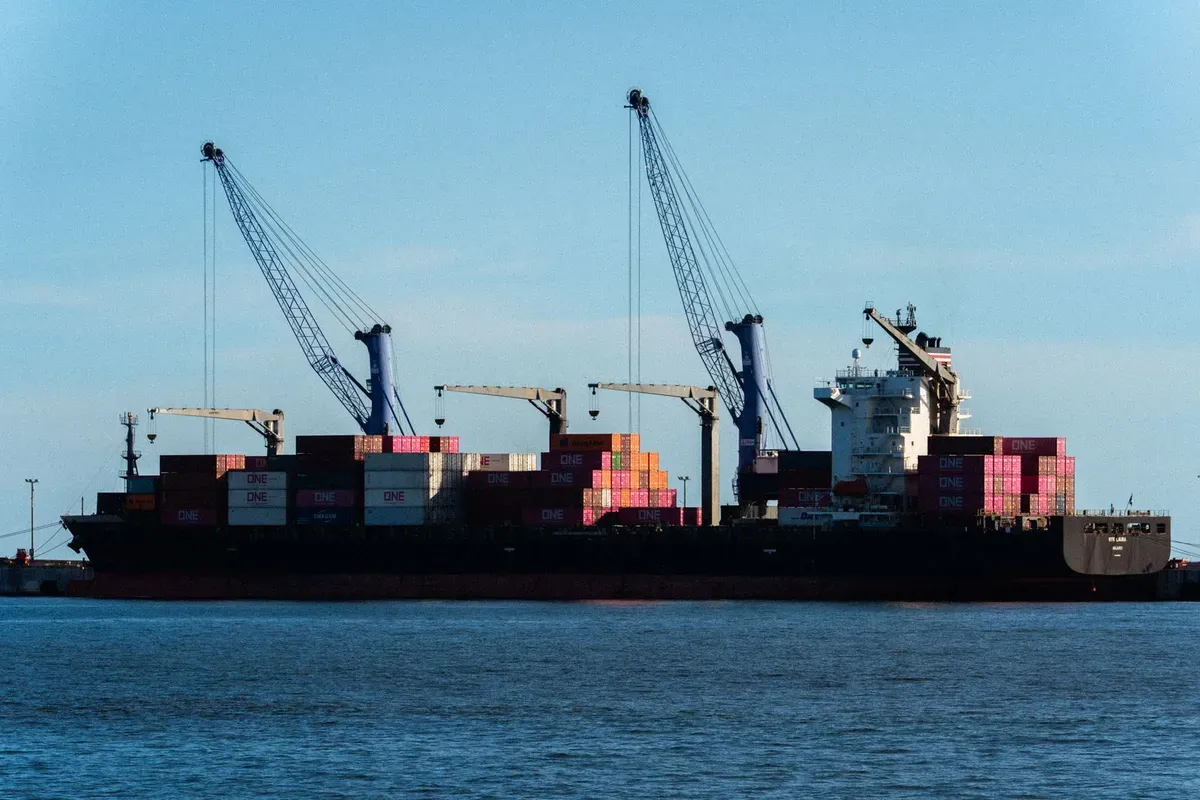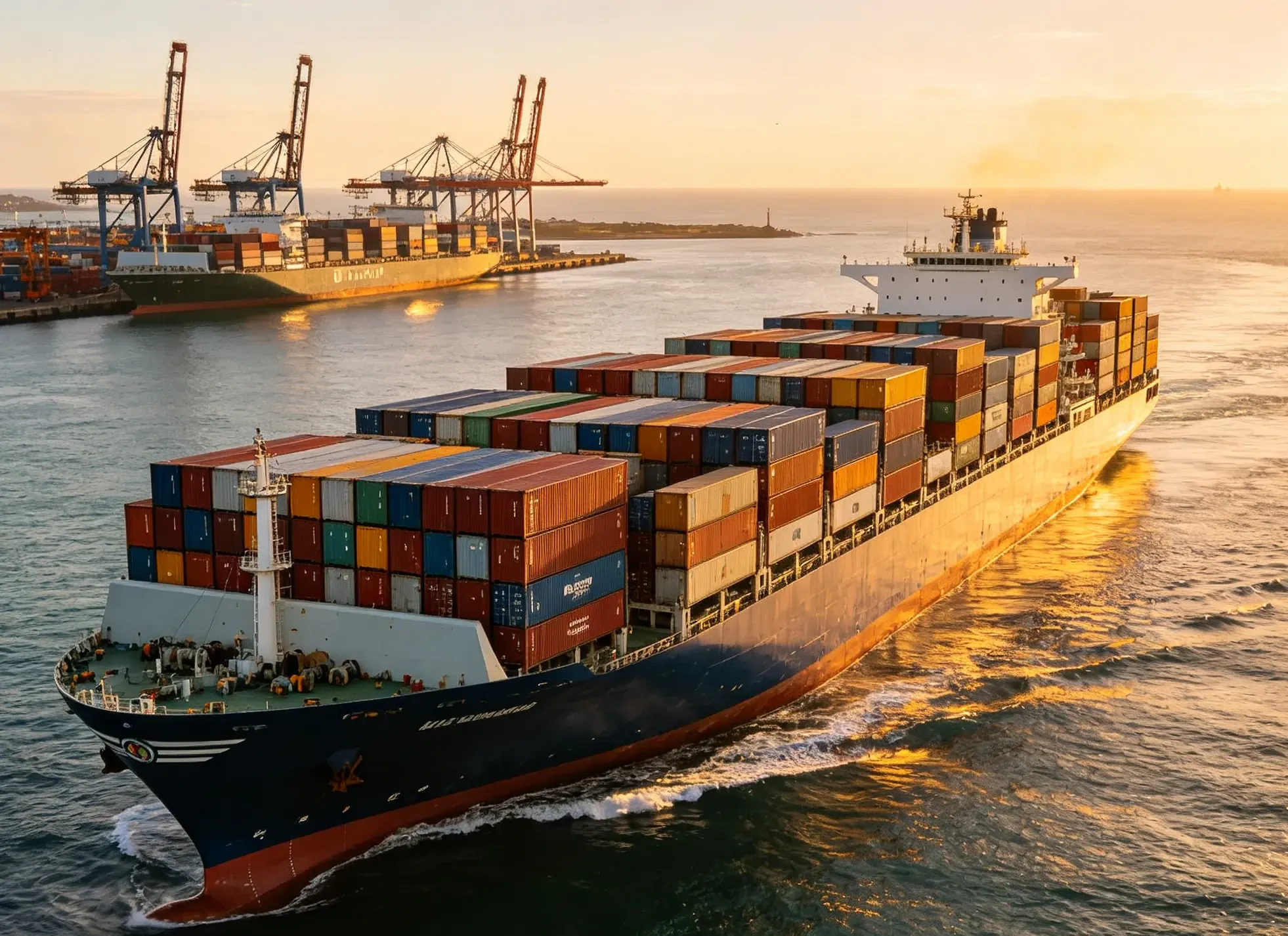
Why do three forwarders quote the same Chinese sedan into Durban at USD 1,000, USD 2,400 and USD 4,000? Shipping cars from China to South Africa is a mainstream corridor, and quotes diverge because each forwarder describes a different mode, scope and clearing assumption. A running car goes on a RoRo vessel at roughly USD 1,000 – 1,188 per unit into Durban, or into a 40HQ at USD 2,950 – 3,300 per box holding 2 – 3 cars, with transit of 22 – 30 days to Durban and 28 – 35 days to Cape Town. The dangerous question is not how the car travels but whether it is allowed in at all.
South Africa restricts used-vehicle imports through ITAC permits, requires NRCS approval for every vehicle placed on the road, and registers right-hand drive cars only. A shipment arriving without those papers gets no second chance — it sits at the terminal while demurrage, detention and storage accrue daily. This guide works through eligibility first, then mode, rates and tax. For wider corridor context see our shipping from China to South Africa overview.
Rate disclaimer: All figures reflect market conditions as of October 2026 and are indicative only. Freight on this corridor reprices with demand, capacity, fuel and equipment, and China-side export rules, ITAC categories, NRCS fees and SARS valuation practice change without notice. Most quotes hold for only 2 – 3 weeks. Confirm duty, ad valorem excise and VAT against SARS on the actual entry date.
Can You Legally Import That Car? New vs. Used Is the First Decision
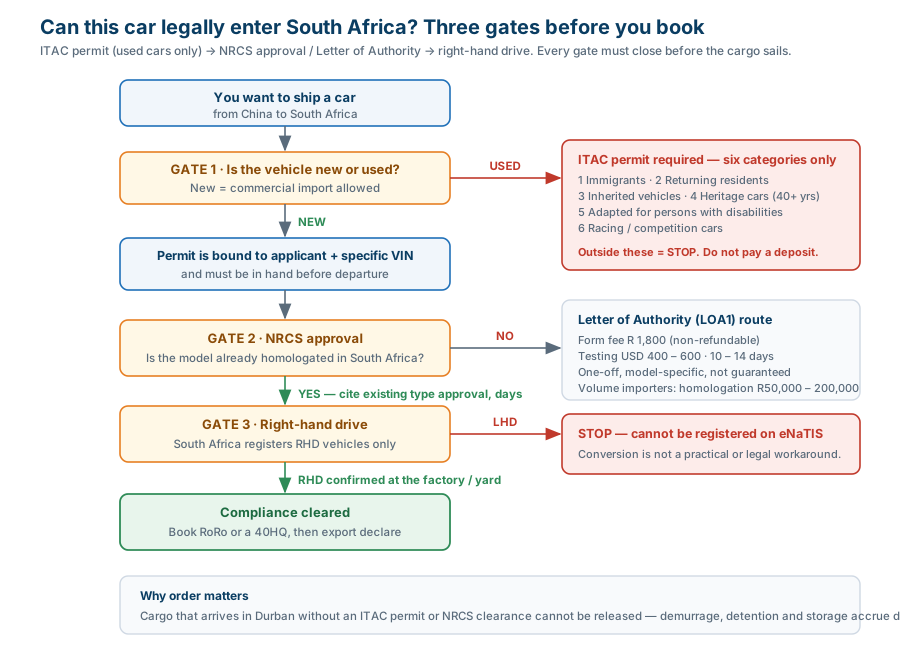
New vehicles can be imported commercially; ordinary used passenger cars generally cannot, unless the import falls into one of six ITAC exception categories. That distinction decides whether the rest of this article applies to you.
South Africa protects a domestic assembly industry including Toyota, Ford, Isuzu, Volkswagen and BMW plants, so the International Trade Administration Commission (ITAC) controls used-vehicle imports through a permit system rather than a tariff wall. The categories are personal — they let people move their own cars, not open a commercial supply line.
| ITAC category | Who it covers | Practical condition |
|---|---|---|
| Immigrants | Persons immigrating to South Africa | Vehicle owned and used abroad before immigration; proof of status required |
| Returning residents | South Africans returning after a period abroad | Ownership and use abroad for a qualifying period |
| Inherited vehicles | Beneficiaries of a deceased estate | Estate documentation, vehicle tied to the inheritance |
| Heritage / veteran cars | Collectors | Generally 40 years or older, imported as a collector vehicle |
| Vehicles adapted for persons with disabilities | The person the adaptation serves | Adaptation evidence; vehicle tied to that user |
| Racing and competition cars | Motorsport use | Not for general road use as a daily passenger car |
Two rules catch out most first-time importers. The permit is bound to a specific applicant and vehicle identification number, so it cannot be transferred. And it must be obtained before the vehicle ships — ITAC issues no retrospective permits. Buses, trucks and taxis face their own restrictions and mostly cannot be imported used at all.
Our industry insight:
Much English-language content claims South Africa has “no vehicle age limit”. That mistakes the ITAC exception categories for a general rule. There is no age threshold because the restriction is not about age — it is about whether you qualify for a permit at all. Importers who act on the age-limit version discover the problem in Durban, after paying for the car, the freight and the insurance.
Chery, GWM, Haval, BYD, BAIC, JAC, Geely, Omoda, Jaecoo and MG all have official dealer networks here. For a single unit, buying locally often beats importing once freight, 25% duty, ad valorem excise, VAT, testing and registration are added — and the local car carries a warranty a grey import does not. Self-importing pays off for fleet orders and for specifications not offered locally.
Where your vehicle does qualify, a registered clearing agent handles arrival. Our customs clearance service pre-checks documents against the physical cargo before departure, which is where most South African vehicle delays are created.
NRCS Approval, the Letter of Authority and the Right-Hand Drive Rule
Every imported vehicle must hold National Regulator for Compulsory Specifications (NRCS) approval before registration, and the cost depends on whether that exact model has already been homologated in South Africa.
| Compliance route | Cost | Lead time | When it applies |
|---|---|---|---|
| Cite an existing type approval | Near zero | A few days | Model already homologated for South Africa (BYD, GWM, Haval, Geely, Chery, Omoda, Jaecoo, MG and others) |
| Letter of Authority (LOA1) | Form fee R 1,800 (non-refundable) plus testing at USD 400 – 600 | 10 – 14 days for testing, longer if queries arise | Single units or small batches of a model with no South African approval |
| Full model homologation | R50,000 – 200,000 | 2 – 4 months | Importers planning sustained volume of one model |
The LOA is the route that surprises people. It is a one-off concession for a specific vehicle, not a certification of the model, and NRCS states plainly that approval is not guaranteed. The R 1,800 form fee is payable whether or not the application succeeds. If NRCS requests additional testing, the 10 – 14 day window restarts in practice — which is why the “standard” timeline below is 70 – 100 days rather than 40 – 55.
One naming confusion: SABS writes standards, while NRCS administers compulsory specifications and issues Letters of Authority. Documents telling you to “get SABS approval” name the wrong body.
The third gate is mechanical and absolute. South Africa registers right-hand drive vehicles only, and a left-hand drive car cannot be entered on the eNaTIS national traffic register. Conversion is not a workaround — it is expensive, invalidates the manufacturer’s type approval, and will not produce a registrable vehicle in a sensible timeframe. Not every Chinese model is built right-hand drive, so confirm against the production line and the actual VIN before a deposit is paid.
RoRo vs. Container vs. LCL: How to Ship a Car from China to South Africa
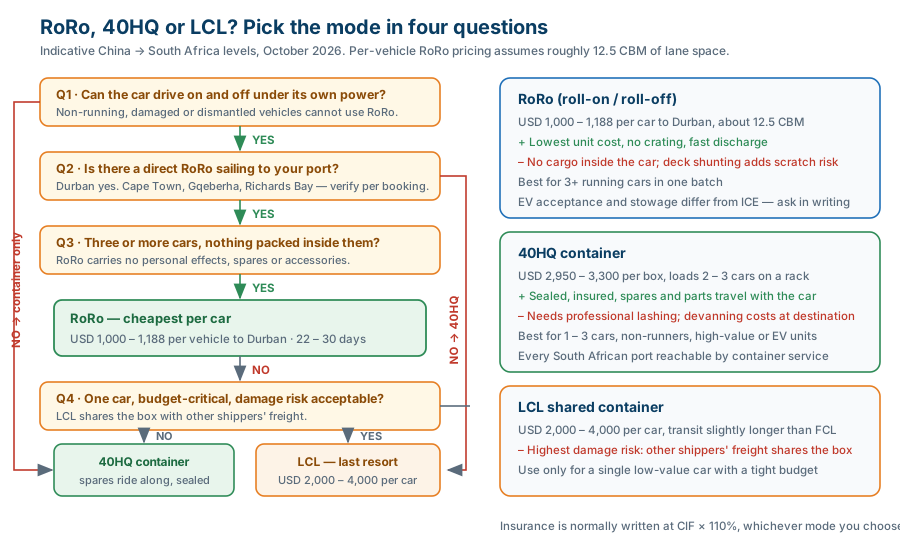
A car that can drive on and off under its own power is cheapest on RoRo; one or two units, non-runners, or a shipment carrying spare parts goes in a 40HQ; LCL is a budget-driven last resort.
| Factor | RoRo | 40HQ container | LCL |
|---|---|---|---|
| Indicative price | USD 1,000 – 1,188 per car into Durban, priced around 12.5 CBM of lane space | USD 2,950 – 3,300 per box, loading 2 – 3 cars | USD 2,000 – 4,000 per car |
| Transit | 22 – 30 days | 22 – 30 days | Slightly longer than FCL |
| Damage risk | Moderate — repeated shunting and deck handling | Low — sealed box, professional lashing | High — shares the box with other shippers’ freight |
| Goods inside the car | Not permitted | Permitted, within weight and lashing limits | Restricted |
| Vehicle must run | Yes, mandatory | No | No |
| Port availability | Verify per booking | Available at all major ports | Available at all major ports |
| Best batch size | 3 or more units together | 1 – 3 units | 1 unit |
The port-availability row is the assumption that most often fails. Durban has a dedicated car terminal under Transnet and is the natural entry point. Cape Town, Gqeberha and Richards Bay handle containerised cargo routinely, but a direct RoRo sailing from China into those ports cannot be assumed — confirm it with the carrier for your booking window, because the answer changes seasonally.
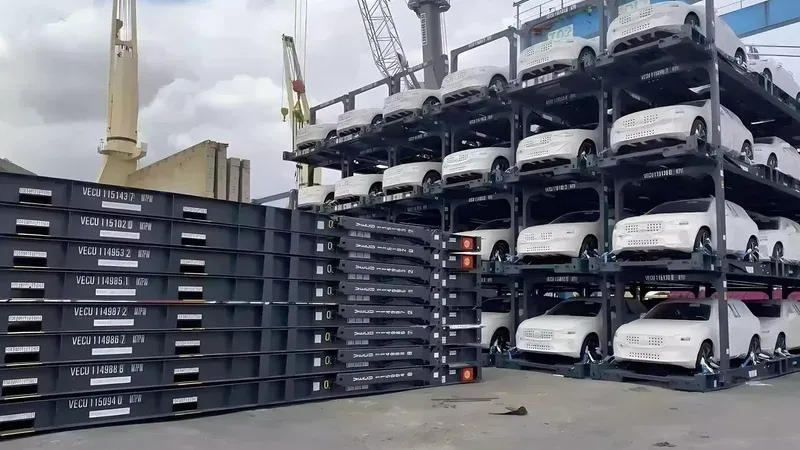
Container loading is a craft. Cars are secured on a steel rack or stacked, all four wheels lashed, the battery disconnected, the steering wheel locked, the handbrake set and the vehicle left in gear, with fuel drawn down to a quarter tank or less. For electric vehicles the state of charge is set to the carrier’s permitted band. Every step is photographed, because those photographs are the evidence base for any claim.
A container also carries the commercial reality of this trade: spare parts, tyres, body kits and service equipment travel in the same box, which RoRo will not accept. For wider options see sea freight from China.
Shipping Costs and Transit Times by Destination Port (October 2026)
From South China to Durban a 40HQ currently runs about USD 2,950 – 3,300 on a 22 – 30 day direct transit; Cape Town adds three to seven days and a few hundred dollars.
| Destination port | RoRo per car | 40HQ per box | Direct transit | Inland leg |
|---|---|---|---|---|
| Durban | USD 1,000 – 1,188 | USD 2,950 – 3,300 | 22 – 30 days | Durban to Johannesburg USD 400 – 700 per car |
| Cape Town | Verify per booking | USD 3,400 – 4,150 | 28 – 35 days | Local delivery, Western Cape |
| Gqeberha (Port Elizabeth) | Verify per booking | On request | 30 – 38 days | Eastern Cape automotive belt |
| Richards Bay | Verify per booking | On request | 28 – 36 days | Onward to Mpumalanga and Gauteng |
Origin port moves the number as much as destination. Shenzhen (Yantian and Shekou), Guangzhou-Nansha, Shanghai, Ningbo, Qingdao and Xiamen all have Southern Africa coverage, but sailing density is highest out of South China, so a Nansha or Yantian booking finds space faster and prices sharper than one out of Qingdao. As a snapshot from 14 October 2026, a transshipment service from Nansha to Cape Town with a 25-day transit was offered at USD 3,920 for a 20GP and USD 5,420 for a 40GP — above the direct band, because transshipment buys flexibility with money and risk.
These rates are not stable. Durban-bound pricing rose roughly 12% month on month in mid-September 2026, and 40GP/40HQ benchmarks have sat between USD 3,400 and USD 4,150 through the quarter. Four surcharge families explain most movement: PSS for peak season, BAF for fuel, THC for terminal handling, ISPS for security. Three habits contain them: book 2 – 4 weeks ahead, since RoRo lane space is allocated well before container slots; negotiate a monthly rate if you ship more than three cars; and avoid both peaks — Chinese New Year at origin and South African year-end restocking.
The Real Landed Cost: Customs Duty, Ad Valorem Excise, ATV and VAT
Landed tax is not “25% plus 15%”. It is 25% customs duty, a sliding-scale ad valorem excise capped at 30% for imports, and 15% VAT charged on the Added Tax Value rather than the invoice — together roughly 45% to 66% of customs value.
Import duty. Passenger cars under HS 8703 and goods vehicles under HS 8704 generally attract 25%. SADC preferential rates do not apply, because China is not a member state.
Ad valorem excise duty. This is the tax most published guides get wrong, often by asserting a flat zero. It slides with the vehicle’s retail price:
Rate = ((0.00003 × A) − 0.75)%
A    = retail selling price excluding VAT and excluding the ad valorem duty itself,
       less 20% for imported vehicles
Cap = 30% for imported vehicles, 25% for locally manufactured vehicles| Retail price excluding VAT | A (price less 20%) | Calculated rate | Indicative ad valorem duty |
|---|---|---|---|
| R300,000 | R240,000 | 6.45% | R15,480 |
| R600,000 | R480,000 | 13.65% | R65,520 |
| R1,200,000 | R960,000 | 28.05% | R269,280 |
The −0.75 term is why cheap cars attract almost nothing while expensive cars climb fast. The 30% import cap starts to bind once A passes about R1,025,000, a retail price near R1,281,250. Importers of premium Chinese SUVs above that point pay a flat 30%; importers of entry-level electric cars may pay close to zero and conclude, incorrectly, that the tax does not exist.
VAT on the Added Tax Value. Import VAT is 15%, but the base is the ATV: customs value plus an uplift of 10% plus any duties payable that are not refunded. Duty and ad valorem excise therefore both sit inside the VAT base, and guides computing VAT as 15% of CIF plus duty understate the bill by the uplift.
| Published tax estimate | Assumptions behind it | Why it differs |
|---|---|---|
| 43 – 44% before VAT credit, 25 – 28% cash | Ad valorem treated as 0%, VAT fully recoverable | Understates excise on anything but the cheapest cars |
| 43 – 50% | Includes ad valorem and environmental levy, silent on VAT recovery | Does not state the importer’s VAT registration status |
| 45 – 55% | Includes ad valorem, VAT base includes freight | Omits the 10% uplift in the ATV |
| 45 – 66% | Full sliding-scale ad valorem, non-exempt import | The conservative, complete calculation |
Two worked examples, both new vehicles, both illustrative rather than quotations.
| Cost component | Entry-level electric SUV (RRP R300,000) | Mid-price petrol SUV (RRP R600,000) |
|---|---|---|
| Customs value (CIF, freight and insurance included) | R180,000 | R360,000 |
| Import duty at 25% | R45,000 | R90,000 |
| Ad valorem excise | R15,480 (6.45% on R240,000) | R65,520 (13.65% on R480,000) |
| Added Tax Value (customs value + 10% + duties) | R258,480 | R551,520 |
| VAT at 15% on ATV | R38,772 | R82,728 |
| Port charges, clearing, roadworthy, inland delivery | R18,000 | R18,000 |
| Total landed cost | R297,252 | R616,248 |
| Tax as a share of customs value | 55.1% | 66.2% |
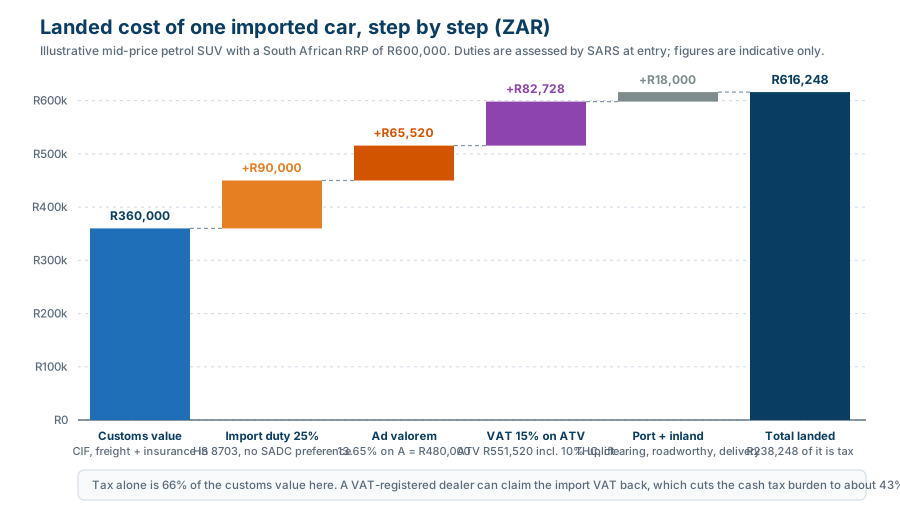
The final variable is who you are. A VAT-registered dealer can generally claim the import VAT back, cutting the cash tax burden in both examples to about 43%. A private individual cannot, and pays the full amount — a gap larger than any freight saving on this corridor. SARS sets the customs value, the ad valorem rate and the ATV on the actual entry, and the ZAR rate that day moves the whole calculation.
China-Side Export: Documents, Loading, Lashing and Insurance
The China side has six steps, and a defect in any one becomes an inspection, a delay and a penalty in Durban. Sellers rarely document this part, which is why it generates most avoidable cost.
- Export qualification and vehicle export licence, including the used-vehicle export pilot where applicable: VIN deregistration in China and pre-export inspection.
- Inspection and preparation — condition photographed, fault codes cleared, fluids checked, fuel drawn down, state of charge set for electric vehicles.
- Export declaration and tax rebate. The Yellow Export Customs Declaration Copy supports the VAT rebate claim; losing it costs real money.
- Inland transport from factory or yard to the port of loading, timed against the booking.
- Loading and lashing — rack installation, four-wheel lashing, battery disconnect, steering lock, seal applied and photographed.
- Bill of lading issuance, with the commercial invoice, packing list, certificate of origin and export certificate.
| Document | Purpose | Common failure |
|---|---|---|
| Bill of Lading (B/L) | Title and carriage contract | Consignee name mismatched against the ITAC permit holder |
| Commercial invoice | Basis of customs valuation | Price inconsistent with the declared model or specification |
| Packing list | Container contents | VINs omitted or mis-keyed |
| Certificate of origin | Origin evidence | Not matching the export declaration |
| Export certificate / deregistration proof | Legal export of the vehicle | Missing for used units |
| Interpol clearance certificate | Stolen-vehicle check | Requested late, delays release |
| ITAC import permit | Used-vehicle eligibility | Obtained after sailing — not fixable retrospectively |
| NRCS LOA or type-approval reference | Roadworthiness approval | Model reference does not match the VIN |
Insurance is where claims are won or lost. Cover is normally written at CIF × 110%. Choose between All Risks and Free of Particular Average deliberately: All Risks is what a vehicle importer wants, and under RoRo the scratch, scuff and dent exclusions need reading line by line. Before the door closes, capture the VIN plate in close-up, a 360-degree walk-around, the odometer, every existing defect marked and dated, and the seal number; at destination, request a joint survey with the carrier’s representative before the vehicle leaves the terminal. Our cargo insurance services team will tell you which clauses actually apply to vehicles, and door to door shipping keeps the chain under one operator.
End-to-End Timeline: 40 Days or 120 Days?
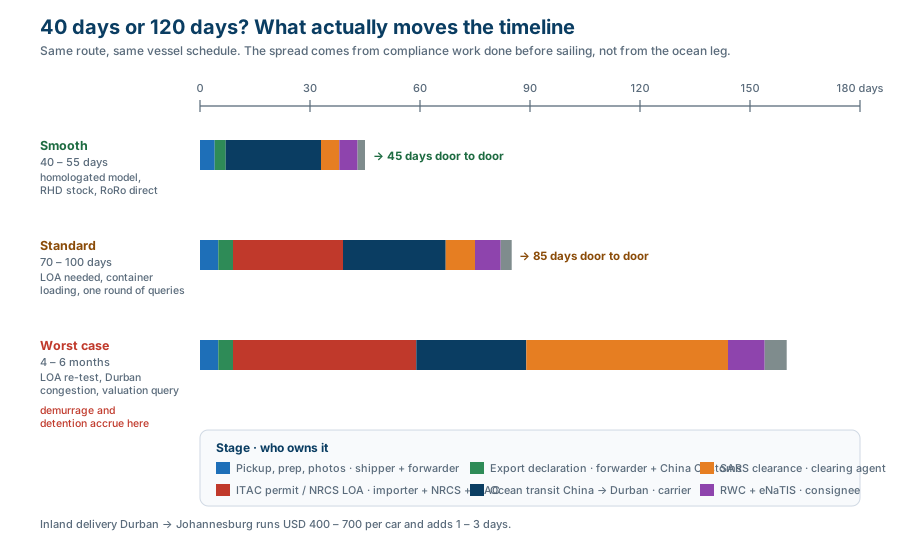
A homologated model on a direct RoRo sailing takes about 40 – 55 days door to door; a model needing a Letter of Authority can take four to six months. The difference is created almost entirely before the vessel sails.
| Scenario | Total time | What triggers it |
|---|---|---|
| Smooth | 40 – 55 days | Homologated model, RHD stock available, direct RoRo into Durban, complete documents |
| Standard | 70 – 100 days | LOA required (10 – 14 days testing plus issuance), container loading, one round of queries |
| Worst case | 4 – 6 months | LOA re-test or supplementary documents, Durban congestion, SARS inspection and valuation dispute, peak-season rollover |
On arrival the sequence is fixed: pre-declaration through eSARS, VIN verification, payment of duty, ad valorem excise and VAT, release, then devanning. The vehicle then needs a Roadworthy Certificate (RWC) before registration on eNaTIS, and registration must precede legal road use.
Two local factors inflate the arrival side. Durban has carried sustained congestion and truck-queue problems that Transnet has publicly acknowledged, so berth and yard delays are a normal planning assumption. Demurrage and detention accrue per day once free time expires, which is why the clearing agent should be engaged before the vessel berths. The inland leg from Durban to Johannesburg or Pretoria costs USD 400 – 700 per car and adds one to three days.
Shipping Chinese EVs to South Africa: Battery and Dangerous Goods Rules
An electric vehicle’s traction battery makes the car a dangerous goods shipment under UN3480 and UN3481, requiring a formal declaration and a state of charge inside the carrier’s permitted band — commonly 20% – 50%.
Classification and declaration. UN3480 covers lithium-ion batteries shipped alone; UN3481 covers batteries packed with or contained in equipment, where a complete electric vehicle sits. The carrier needs a Dangerous Goods Declaration and the battery safety data sheet, and the booking must state chemistry, capacity, state of charge and UN number. Booking an EV as general cargo is the fastest way to have it rolled off at the last minute.
State of charge. Lines limit charge level because a highly charged battery carries more thermal-runaway energy. Deliver a car at 90% and you face refusal, re-booking or a dangerous goods surcharge. Set the charge during preparation in China, not at the port.
Mode considerations. RoRo acceptance of electric vehicles varies by carrier and vessel class, with different stowage positions and fire-response requirements — get the acceptance in writing. In a container, expect requests for battery state evidence and a thermal incident plan.
Charging standards. Chinese domestic cars use GB/T connectors while South Africa follows CCS2. Confirm the connector and onboard charger before shipping, and declare portable charging equipment separately.
Tax treatment. Electric vehicles are not automatically assessed on a different tariff line; the ad valorem excise depends on retail price, not drivetrain. Confirm any relief in writing with SARS or your clearing agent.
The demand side has a local quirk. Years of load-shedding pushed many South African households toward solar and home battery storage, and that group overlaps heavily with EV buyers — so the claim that “South Africa’s power problems kill the EV market” runs backwards at the retail end. It relaxes no battery compliance rule on the voyage. For the underlying logistics see our guide to how to import and ship lithium batteries from China.
Five Actionable Steps Before You Book (And How Efanda Handles It)
Confirm the car can enter the country before discussing how it travels. These five checks before any deposit prevent almost every irreversible loss on this corridor.
- Check the model’s South African approval status first. A homologated model from BYD, GWM, Geely, Chery-Omoda, Jaecoo or MG skips the LOA entirely, saving the R 1,800 fee, USD 400 – 600 testing and up to 2 – 4 months. Get that confirmation in writing.
- For a used car, confirm ITAC eligibility before paying anything. The permit is bound to you and to that VIN, and must exist before departure. A car arriving without one is a total loss, not a delay.
- Verify right-hand drive against the VIN, not the brochure. Left-hand drive cars cannot be registered on eNaTIS and conversion is not a realistic remedy.
- Use CIF rather than DDP to isolate valuation risk. SARS sets the ad valorem rate and the ATV, so a DDP quote must carry a risk premium. CIF with your own clearing agent keeps the assessment auditable.
- Photograph everything before the door closes, and verify RoRo availability per booking. VIN plate, 360-degree imagery, odometer, seal number — then confirm the sailing exists for your port and window.
Efanda Logistics has handled China export freight since 2018 from our Shenzhen headquarters, with working relationships across Yantian, Shekou and Nansha. On this lane we cover factory and yard pickup, vehicle preparation and photographic evidence, export declaration and rebate documentation, RoRo or container booking, ocean freight, coordination with your South African clearing agent, and inland delivery to Gauteng, the Western Cape or the Eastern Cape — one transparent quote with no hidden fees, and a dedicated logistics consultant who reviews the ITAC, NRCS and right-hand drive questions before you commit money. For cargo beyond vehicles, see our shipping from China to South Africa page.
Rates and rules move, so ask for a dated quote built on your exact model, VIN, specification and delivery address. Send the vehicle details and intended entry port, and we will tell you whether the car can legally enter, which mode fits, and what it costs to have it on the road.
FAQ: Shipping Cars from China to South Africa
Can I import a used car from China to South Africa?
Only within one of six ITAC categories: immigrants, returning residents, inherited vehicles, heritage cars generally 40 years or older, vehicles adapted for persons with disabilities, and racing cars. Commercial used-car imports are not permitted, the licence is bound to one applicant and VIN, and it must exist before the vehicle ships.
How much does it cost to ship a car from China to South Africa?
RoRo runs about USD 1,000 – 1,188 per car into Durban; a 40HQ holding 2 – 3 cars runs USD 2,950 – 3,300. On top of freight expect 25% duty, ad valorem excise of up to 30% and 15% VAT on the Added Tax Value — roughly 45% to 66% of customs value.
What is the cheapest way to ship a car from China to South Africa?
RoRo, provided the car runs under its own power and a direct sailing into your port exists for your window. Durban is the reliable gateway; Cape Town, Gqeberha and Richards Bay must be confirmed each time.
How long does it take to ship a car from China to South Africa?
Ocean transit is 22 – 30 days to Durban and 28 – 35 days to Cape Town. Door to door, plan 40 – 55 days for a homologated model and 70 – 100 days if a Letter of Authority is required.
What is the import duty and VAT on cars from China to South Africa?
Duty is generally 25% under HS 8703 for passenger cars and HS 8704 for goods vehicles, with no SADC preference for Chinese origin. VAT is 15% on the Added Tax Value: customs value plus a 10% uplift plus duties not refunded.
What is the ad valorem excise duty formula for imported cars?
Rate = ((0.00003 × A) − 0.75)%, where A is the retail price excluding VAT and excluding the excise itself, less 20% for imports. The cap is 30%, binding near a retail price of R1,281,250.
Do I need an NRCS Letter of Authority?
Only if your exact model has no existing South African type approval. LOA1 carries a non-refundable R 1,800 form fee, testing costs USD 400 – 600 over 10 – 14 days, and approval is vehicle-specific and not guaranteed.
Can I ship a left-hand drive car to South Africa?
No. South Africa registers right-hand drive vehicles only, a left-hand drive car cannot be entered on eNaTIS, and conversion is neither practical nor timely.
What documents do I need to import a car into South Africa?
Bill of Lading, commercial invoice, packing list, certificate of origin, export certificate or deregistration proof, Interpol clearance certificate, the ITAC permit for used vehicles, and the NRCS Letter of Authority or existing type-approval reference. Every VIN and value must match the physical vehicle.
Can I ship an electric vehicle from China to South Africa?
Yes, but the traction battery makes it a dangerous goods shipment under UN3480 or UN3481. You need a Dangerous Goods Declaration, the battery safety data sheet and a state of charge inside the carrier’s band, commonly 20% – 50%.
Which South African port should I use, Durban or Cape Town?
Durban for most vehicle imports: a dedicated car terminal, 22 – 30 day transit and the best RoRo availability. Cape Town suits Western Cape buyers, adding three to seven days at USD 3,400 – 4,150 per box.
How do I get the car from Durban to Johannesburg?
By carrier truck at roughly USD 400 – 700 per vehicle, adding one to three days. The car still needs a Roadworthy Certificate and eNaTIS registration before legal road use, so schedule the inland leg after release.

Written by the EFANDA Logistics team — a Shenzhen-based freight forwarder established in 2018, moving cargo from China to ports worldwide with end-to-end pickup, consolidation, customs and door delivery.About us