Is rail freight from China to Europe the missing middle ground between slow sea freight from China and expensive air freight? For many importers, the answer is yes. Sea freight can take 30–45 days, while air freight from China often erodes margins on mid-value goods. Rail freight lands in the sweet spot: faster than the sea, cheaper than the air, and increasingly reliable for containerized cargo moving between Chinese manufacturing hubs and European markets.
This guide walks you through how rail freight works, what it costs, which routes to choose, and how to avoid the compliance and corridor risks that catch inexperienced shippers off guard. Whether you are moving automotive parts, electronics, or Amazon FBA inventory, the sections below will help you make a confident, cost-effective decision.
What Is Rail Freight from China to Europe?
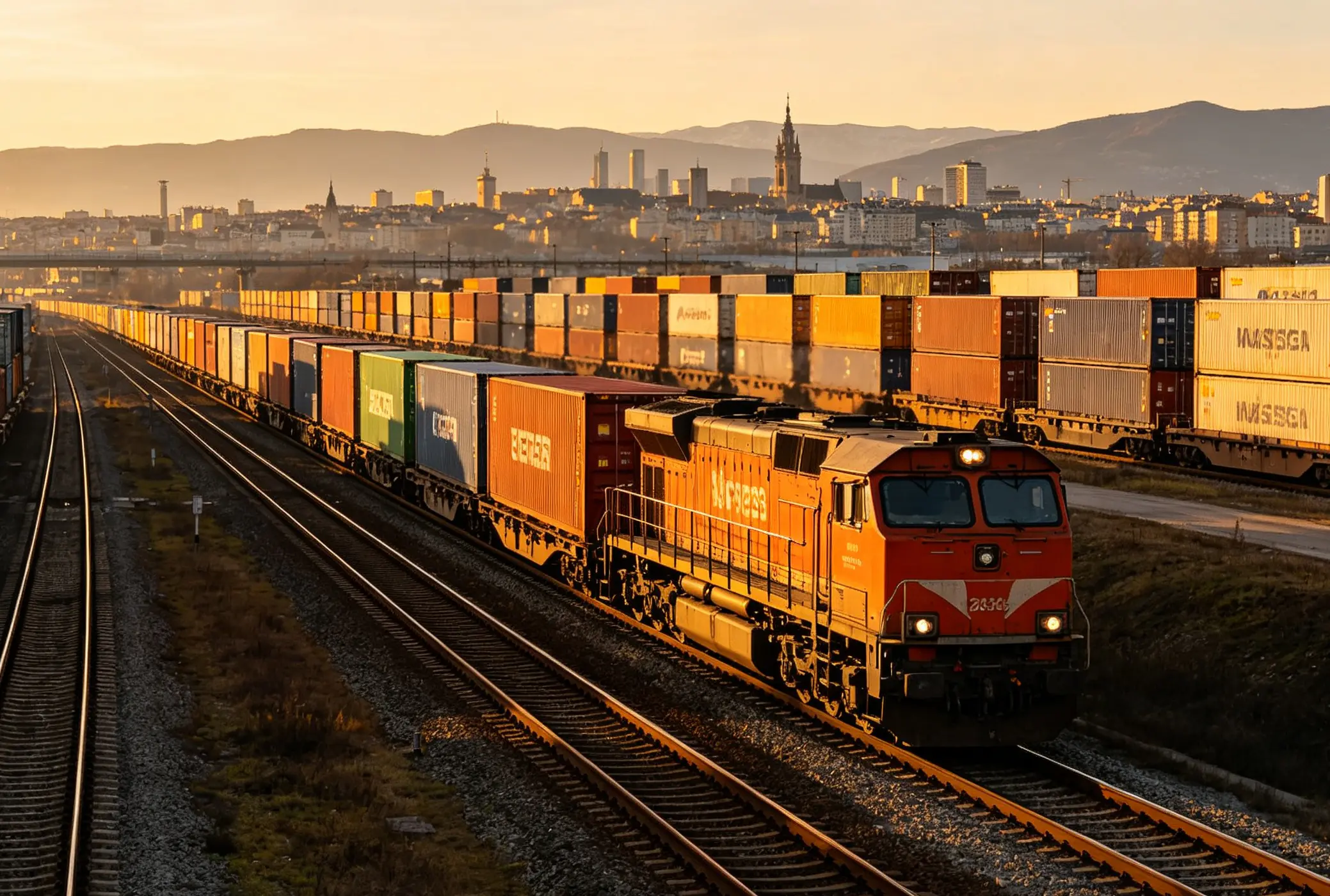
Rail freight from China to Europe is a land-based shipping method that moves containerized or consolidated cargo by freight train across the Eurasian continent. The backbone of this service is the China-Europe Railway Express (CR Express), a network of block trains and scheduled services that connect inland Chinese cities with European rail terminals through the New Eurasian Land Bridge.
The service operates on a multimodal basis: a single shipment may involve Chinese domestic rail, cross-border rail through Kazakhstan, transhipment to the Russian or Central Asian broad-gauge network, and final delivery on European standard-gauge lines. This makes the rail waybill—rather than a traditional ocean Bill of Lading—the controlling transport document for most legs.
Unlike sea freight, which depends on port congestion and vessel schedules, rail operates on fixed corridors with regular departures. Unlike air freight, it moves entire containers or consolidated box loads at a fraction of the per-kilogram cost. Trains typically carry standard 20-foot and 40-foot containers, refrigerated units for temperature-controlled cargo, and flat racks for oversized machinery. If you are unsure which unit fits your cargo, review our guide to shipping container dimensions. Because the route crosses multiple countries with different rail gauges, containers are transhipped at key border hubs such as Dostyk, Alashankou, Khorgos, and Brest.
Our Industry Insight: From our Shenzhen operations, we see rail freight work best for shippers who treat it as a scheduled inventory pipeline rather than an emergency express service. In one recent case, a consumer electronics client shifted a regular Shenzhen-to-Warsaw lane from sea to rail and cut inventory-in-transit by roughly 18 days, freeing enough working capital to justify the slightly higher freight cost within two rotations. If your lead-time planning can absorb two to three weeks of transit, rail often delivers the lowest total landed cost per unit for mid-value consumer and industrial goods.
The corridor’s scale also underlines its maturity. According to China’s National Development and Reform Commission, China-Europe freight trains have maintained full-capacity operations for 46 consecutive months as of June 2026, and the network has surpassed 130,000 cumulative trips since the unified CR Express brand launched in 2016. Scheduled services on the Xi’an–Duisburg lane now run in as little as 11 days, down from roughly 15 days a few years ago.
Rail Freight from China to Europe Transit Time and Routes
Door-to-door rail freight from China to Europe usually takes 14–22 days, depending on the origin city, destination terminal, corridor choice, and current border conditions.

Major Chinese departure hubs include Xi’an, Chengdu, Chongqing, Zhengzhou, Wuhan, Yiwu, Xiamen, and Suzhou. On the European side, the most active arrival terminals are Duisburg, Hamburg, Warsaw, Małaszewicze, Lyon, Madrid, London, Tilburg, and Budapest. For country-specific routing and landed costs, compare our guides to shipping from China to Germany, shipping from China to France, and shipping from China to Poland.
Industry reports reflect this concentration. The six major China-Europe rail ports handled roughly 13,000 trains and about 1.3 million TEUs in the first seven months of 2026, with year-on-year growth in the low teens, while Alashankou and Manzhouli alone accounted for roughly 60% of total volume, according to industry estimates.
| Origin → Destination | Typical Transit Time | Corridor Used |
|---|---|---|
| Xi’an → Warsaw, Poland | ~14 days | Northern |
| Chongqing → Duisburg, Germany | ~16 days | Northern |
| Zhengzhou → Hamburg, Germany | ~15–17 days | Northern |
| Wuhan → Lyon, France | ~16–18 days | Northern |
| Yiwu → Madrid, Spain | ~19–21 days | Northern |
| Chengdu → Duisburg, Germany | ~15–18 days | Northern |
| Xi’an → Budapest, Hungary | ~18–20 days | Middle / Southern |
These figures are baseline estimates for normal market conditions in 2026. Actual transit can stretch during peak season, terminal congestion at Małaszewicze, or additional customs inspections. Always request a forwarder-specific ETA rather than relying on generic route averages.
Rail Freight from China to Europe Cost and Pricing
All-inclusive door to door shipping rates for rail freight from China to Europe typically range from $1.80–$4.50 per kilogram for DDP LCL shipments, or roughly $5,500–$8,000 per 40-foot container for FCL moves. Rates fluctuate with fuel surcharges, corridor capacity, peak-season demand, and the Incoterms you choose. We provide quotes based on real-time slot availability, not static menus, so the range below is a benchmark rather than a guaranteed price.
A transparent rail freight quote should break down the following cost elements:
- Origin trucking from factory to the Chinese rail terminal
- Terminal handling and stuffing charges
- Main rail leg across the corridor
- Border transhipment and gauge-change fees
- Customs transit documentation
- Destination terminal handling and unloading
- Duties, VAT, and import taxes (if shipping under DDP)
- Cargo insurance services and optional add-ons (repacking, labeling, warehousing)
| Cost Factor | What It Covers | Typical Impact on Quote |
|---|---|---|
| Origin haulage | Factory pickup to rail terminal | $100–$500 depending on distance |
| Terminal handling | Loading, container seal, documentation | Included or $150–$400 |
| Rail freight rate | Main leg by block train | Largest variable; corridor-dependent |
| Customs transit | T1 / ECTS / CIS transit documents | $50–$200 per bill |
| Destination charges | Unloading, deconsolidation, THC | $200–$600 |
| Duties & taxes (DDP) | EU/UK VAT and customs duties | Cargo value × HS code rate |
Important: Rail freight rates are market-dependent. The ranges above reflect general conditions observed in 2026. Always ask your forwarder for an itemized quote valid for your specific cargo, route, and shipping window.
FCL vs. LCL Rail Freight from China to Europe
Choose FCL rail freight from China to Europe when your cargo justifies a full container. Choose LCL rail freight when you are shipping smaller volumes that benefit from consolidation. For a detailed side-by-side comparison, see our guide on fcl vs lcl shipping.
FCL advantages include faster terminal handling, lower per-unit cost, fewer touches, and better security because the container is sealed at origin and opened only at destination. It is ideal for volumes above roughly 15 CBM or for high-value cargo where segregation matters.
LCL rail freight works well for shipments between 1 and 15 CBM. You share container space with other shippers, which reduces the minimum commitment. However, consolidation and deconsolidation add time at both ends, so LCL is usually a few days slower than FCL on the same route.
| Shipment Type | Best Volume | Transit Time | Cost Structure | Best For |
|---|---|---|---|---|
| FCL Rail | >15 CBM or >10 tonnes | Faster by 2–4 days | Per container | Bulk inventory, high-value goods, Amazon replenishment |
| LCL Rail | 1–15 CBM | Slightly longer | Per CBM or per kg | SMEs, e-commerce, sample orders, mixed suppliers |
If you source from multiple suppliers in the same region, ask your forwarder about consolidation service at a Shenzhen or Yiwu warehouse. This lets you combine LCL cargo into one FCL rail container, improving both cost and security.
Northern Corridor vs. Middle Corridor: Which Route Should You Choose?
The Northern Corridor is the fastest and most cost-effective route for general cargo, but it carries higher geopolitical exposure. The Middle Corridor is slower and more expensive, but it bypasses Russia and Belarus, making it attractive for compliance-sensitive cargo.
Northern Corridor path: China → Kazakhstan → Russia → Belarus → Poland/EU.
Middle Corridor path: China → Kazakhstan → Caspian Sea ferry → Azerbaijan → Georgia → Turkey → Southeastern Europe.
| Factor | Northern Corridor | Middle Corridor |
|---|---|---|
| Transit time | ~14–18 days | ~20–28 days |
| Cost | Lower | Higher |
| Capacity | High | Limited by Caspian ferry slots |
| Risk profile | Geopolitical/sanctions exposure | More stable for dual-use goods |
| Best for | General cargo, tight deadlines | Electronics, machinery, sanctioned-sensitive goods |
Our Industry Insight: Since late 2024, Russian customs have intensified inspections on dual-use goods transiting the Northern Corridor. We have seen electronics shipments held for 7–12 days at the Belarus–Poland border because the HS description did not clearly distinguish consumer-grade from industrial-grade units. If you ship electronics, machinery, or any goods with potential dual-use classification, pre-screening HS codes and considering the Middle Corridor can prevent weeks of unexpected delay.
Use this decision framework:
- Choose Northern Corridor for standard consumer goods, tight deadlines, and cost-sensitive shipments that do not fall under dual-use or sanctions-sensitive categories.
- Choose Middle Corridor when cargo classification, sanctions exposure, or supply-chain resilience matters more than saving a few days.
- Choose Southern Corridor for destinations in Turkey or Southeastern Europe where overland routing through Central Asia and the Caucasus is competitive.
Rail Freight from China to Europe Customs Clearance and Incoterms
Customs clearance for rail freight from China to Europe requires accurate HS codes, a commercial invoice, a packing list, and the correct rail transport document. Unlike sea freight, which uses a Bill of Lading (B/L) as a document of title, rail freight typically moves under a CIM/SMGS rail waybill. The CIM regime covers Western Europe under the COTIF convention, while SMGS governs the former CIS and Central Asian states. At borders such as Brest or Dostyk, the waybill is often reissued or converted so the cargo can continue under the applicable legal regime.
Key documents and terms to understand:
- CIM/SMGS rail waybill: The international rail transport document used across Europe and the CIS. Unlike a negotiable Bill of Lading, it is usually a non-negotiable consignment note, so cargo release is controlled by the named consignee and the forwarder’s instructions rather than by possession of the original document.
- T1 document: EU customs transit document that lets cargo move under customs control before final clearance.
- ECTS: European Community Transit System, the framework for moving goods under customs supervision across EU borders.
- EORI number: Required for businesses importing into the EU.
- Commercial invoice & packing list: Standard trade documents used for customs valuation.
Incoterms matter because rail is not ocean. FOB and CIF are sea-specific and do not fit land-based moves cleanly. Learn more about FOB in what is fob shipping. For rail, the most practical terms are:
- EXW: Buyer arranges everything from the supplier’s door.
- DAP: Seller delivers to a named destination, but buyer clears customs and pays duties.
- DDP: Seller handles duties, taxes, and final delivery—popular for e-commerce and FBA. For a full comparison, read our guide on ddp vs dap incoterms.
- CIP: Seller pays freight and insurance to the destination terminal.
Compliance Red Flags: Dual-use goods, lithium batteries, wooden packaging without IPPC marks, and restricted chemicals are common causes of customs holds. Pre-screen these with your freight forwarder before the container reaches the border.
What Can You Ship by Rail from China to Europe?
Rail freight from China to Europe is ideal for electronics, automotive parts, machinery, textiles, furniture, home goods, and e-commerce inventory that is time-sensitive but not urgent enough to justify air freight.
The best rail cargo is palletized or containerized, moderately valuable, and able to withstand the 14–22 day transit window. Refrigerated containers support temperature-controlled goods, while flat racks and open-top containers can handle oversized machinery.
Cargo categories commonly moved by rail:
- Consumer electronics and accessories
- Automotive components and EV parts
- Industrial machinery and spare parts
- Textiles, apparel, and footwear
- Furniture and home décor
- Toys, sporting goods, and seasonal inventory
Oversized cargo can move in flat racks or open-top containers, while perishables require reefer containers with an unbroken temperature record from origin to destination.
Restricted or prohibited items typically include dangerous goods without proper classification, flammable materials, weapons and dual-use items without licenses, counterfeit products, and certain perishables without veterinary/phytosanitary permits. Always confirm cargo acceptability before booking.
Rail Freight for Amazon FBA and E-Commerce Shipments
Rail freight from China to Europe is increasingly popular for Amazon FBA replenishment because it cuts two to three weeks off ocean transit while costing significantly less than air freight.
FBA-specific requirements include correct carton and pallet labeling, FBA shipment IDs, EU-compliant pallet dimensions, and scheduled delivery appointments at Amazon fulfillment centers. Many sellers use LCL rail freight to consolidate smaller batches from multiple suppliers, then deconsolidate at a European warehouse close to their target FBA region.
| Factor | Rail for FBA | Sea for FBA | Air for FBA |
|---|---|---|---|
| Transit time | ~16–22 days | ~35–45 days | ~5–8 days |
| Cost per kg | Moderate | Lowest | Highest |
| Best use case | Replenishment, non-urgent inventory | Bulk, low-urgency stock | Urgent restock, high-value items |
Actionable tips for e-commerce sellers:
- Book rail space 3–4 weeks ahead of peak season, especially before Q4.
- Confirm deconsolidation warehouse proximity to your target Amazon fulfillment center.
- Pre-label cartons in China to avoid relabeling fees in Europe.
How to Choose a Reliable Rail Freight Forwarder from China
The best freight forwarder for rail freight from China to Europe combines corridor expertise, transparent pricing, and end-to-end control. Because rail spans multiple countries and legal regimes, experience matters more than a low headline rate.
Use this checklist when evaluating forwarders. If you are new to working with brokers, see what is freight forwarding to understand how a forwarder can simplify multi-country rail moves.
- Do they offer both Northern Corridor and Middle Corridor options?
- Can they handle origin pickup, consolidation, and export customs in China?
- Do they provide destination customs clearance and last-mile delivery?
- Is tracking available, and do they proactively manage exceptions?
- Are quotes itemized, with no hidden terminal handling or customs fees?
- Do they understand Amazon FBA, e-commerce, and cargo insurance requirements?
A forwarder based near China’s major manufacturing and rail hub—such as Shenzhen—can coordinate faster pickups, better consolidation, and quicker problem resolution when exceptions arise.
Efanda Logistics, founded in 2018 and headquartered in Shenzhen, provides end-to-end rail freight from China to Europe solutions including FCL, LCL, customs clearance, warehousing, and door-to-door DDP delivery. Our team offers transparent, itemized quotes with no hidden terminal or customs fees, and a dedicated logistics specialist tracks each shipment from origin pickup to final delivery. You can reach us at +86 18929345880 or request a tailored rail freight quote based on your cargo, route, and delivery requirements.
FAQ: Rail Freight from China to Europe
How long does rail freight from China to Europe take?
Door-to-door transit typically ranges from 14 to 22 days, depending on the corridor, origin city, destination terminal, and current border conditions.
How much does rail freight from China to Europe cost per kg?
All-inclusive DDP rates commonly range from $1.80 to $4.50 per kg for LCL shipments, but prices vary with fuel, capacity, season, and cargo type.
Is rail freight faster than sea freight from China to Europe?
Yes. Rail is usually 40–50% faster than sea freight, with typical rail transit of 14–22 days compared with 30–45 days by ocean.
What is the difference between FCL and LCL rail freight?
FCL means you book an entire container. LCL means your cargo shares container space with other shippers. FCL is faster and more secure; LCL is more flexible for smaller volumes.
What documents are needed for rail freight from China to Europe?
Common documents include the commercial invoice, packing list, CIM/SMGS rail waybill or multimodal B/L, T1/ECTS transit documents, certificate of origin, and EORI registration.
Which is better: Northern Corridor or Middle Corridor?
The Northern Corridor is faster and cheaper but carries geopolitical and sanctions risk. The Middle Corridor is slower and more expensive but more resilient for sensitive cargo.
Can I ship Amazon FBA goods by rail from China to Europe?
Yes. Rail is a popular choice for FBA replenishment when you need faster-than-sea transit at lower cost than air freight.
What are the main Incoterms used for China-Europe rail freight?
The most practical terms are EXW, DAP, DDP, and CIP. FOB and CIF are sea-specific and do not apply cleanly to rail.
Are there any goods that cannot be shipped by rail to Europe?
Yes. Dangerous goods without proper classification, flammables, weapons/dual-use items without licenses, counterfeit goods, and certain perishables are usually restricted.
How do I track my rail freight shipment from China?
Your forwarder should provide a tracking reference linked to the rail waybill or container number. Updates are typically available at major border crossings and terminals.
Why should I use a freight forwarder instead of booking rail directly?
A freight forwarder manages documentation, customs, consolidation, corridor selection, and last-mile delivery across multiple countries—saving time and reducing compliance risk.
How far in advance should I book rail freight space?
For normal periods, 2–3 weeks ahead is usually enough. During peak season, especially Q4, book 3–4 weeks in advance to secure equipment and slots.
Conclusion
Rail freight from China to Europe offers a practical balance of speed, cost, and reliability for importers who do not need air-freight urgency but cannot afford the long lead times of ocean shipping. Success depends on choosing the right corridor, understanding the cost structure, and working with a freight forwarder who can manage customs, documentation, and exceptions across the entire route.
Rates and transit times are subject to market conditions and corridor-specific factors, so always confirm details for each shipment. Rail is not universally cheaper than sea, nor universally faster than the fastest ocean services, but for palletized mid-value cargo with a 2–3 week lead-time tolerance, it is often the most capital-efficient option.
If you need a transparent, end-to-end rail freight solution, Efanda Logistics is ready to help. Request a quote and let our Shenzhen-based team design a China-Europe rail plan tailored to your cargo. You can also call us at +86 18929345880 to speak with a dedicated logistics specialist.