What happens when your container of e-bikes arrives in Los Angeles with a dead battery certificate, a missing safety file, or a duty bill you never priced in? For too many first-time importers, how to import and ship e-bikes from China to USA is a question answered only after something has already gone wrong: a $380 wholesale bike that quietly becomes a $590 landed unit, or a carrier that refuses the booking because the lithium battery paperwork is three months out of date.
None of this is inevitable. E-bikes are heavy, battery-powered, and tariff-heavy — but they are also one of the best-documented cargo types on the China–USA lane. In this guide, you will get the current 2026 tariff stack (it changed twice this year), the exact certifications U.S. customs and retailers expect, container loading math, and a realistic landed-cost breakdown — so you can quote your customers with confidence instead of crossing your fingers.
Why Are E-Bike Imports from China Surging in 2026?
Three forces are pulling U.S. demand toward Chinese factories at the same time. First, tariff relief: after the Supreme Court struck down the IEEPA fentanyl and reciprocal tariffs in February 2026, the total duty burden on Chinese e-bikes fell from the 2025 peak back to the Section 301 layers — a meaningful drop in landed cost that reopened price points American brands had abandoned. Second, the European Union’s 17.2% countervailing duty on Chinese e-bikes (in force since January 2025) pushed a lot of factory capacity away from Europe and toward the U.S. market, improving selection and lead times for American buyers. Third, the product itself keeps winning: e-bikes remain the fastest-growing bicycle category in the U.S., driven by delivery fleets, commuting, and recreational riders.
The catch is that none of the complexity disappeared with the IEEPA tariffs. The battery still makes every shipment Class 9 dangerous goods, U.S. safety enforcement keeps tightening, and the remaining tariff stack still adds a double-digit percentage to every invoice. The importers winning on this lane are the ones who treat compliance as part of sourcing — not as an afterthought for the forwarder.
Is Your Product a Bicycle or a Motor Vehicle?
Your e-bike ships and clears U.S. customs as a consumer product regulated by the CPSC — not as a vehicle — only if it stays inside the federal “low-speed electric bicycle” definition: functional pedals, a motor of no more than 750 W, and assist that cuts out at 20 mph (throttle) or 28 mph (pedal-assist only). This is the industry three-class system (Class 1: pedal-assist to 20 mph; Class 2: throttle to 20 mph; Class 3: pedal-assist to 28 mph), and virtually every mass-market China-made e-bike is built to fit inside it.
Cross the line — a 30 mph e-moped without pedals, or a machine with turn signals and road lighting — and the product falls under NHTSA motor vehicle safety standards. That is a different world: FMVSS compliance, VIN assignment, and a homologation process that essentially excludes direct container imports for retail sale. If your supplier’s spec sheet shows “peak power” numbers above 750 W, clarify whether that is peak or continuous rating before you wire a deposit.
Actionable Tip #1: Lock the spec sheet to the U.S. definition before production — motor continuous rating, speed limiter setting, and pedal function. Retrofitting compliance onto a built container is either impossible or ruinously expensive.
How Many E-Bikes Fit in a Container?
A standard semi-assembled e-bike carton (front wheel, handlebar, and pedals removed) measures roughly 155 × 30 × 82 cm — about 0.38 CBM and 32 kg gross — and that volume, not weight, decides how many units you get. A 40HQ holds roughly 140 to 160 units; a 20GP holds 60 to 70; even the smallest viable ocean box leaves most of its 26-tonne payload unused, because 150 bikes weigh only about 5 tonnes.

| Container | Usable Volume | Payload | E-Bike Capacity | Gross Cargo Weight |
|---|---|---|---|---|
| 20ft GP | ≈ 25 CBM | ≈ 28 t | 60 – 70 units | ≈ 2.0 t |
| 40ft GP | ≈ 55 CBM | ≈ 26 t | 105 – 120 units | ≈ 3.8 t |
| 40ft HQ | ≈ 58 CBM | ≈ 26 t | 140 – 160 units | ≈ 5.0 t |
| LCL (per CBM) | 1 CBM | — | 2 – 3 units per CBM | — |
The practical break-even: below roughly 60 units, a full container rarely pays off and you should compare LCL shipping from China to USA rates; above 100 units, FCL shipping from China to USA almost always wins per unit. Fully assembled bikes cut these counts by a third or more — which is why almost every factory exports semi-assembled.
Why Is Your E-Bike a Class 9 Dangerous Good?
An e-bike battery is a 250–750 Wh lithium-ion pack, far above the 100 Wh threshold of “ordinary” electronics — so every e-bike ships as Class 9 dangerous goods. Booked with the battery installed in the frame, the cargo moves under UN3481 (lithium-ion batteries contained in equipment, packing instruction PI967); forwarders can also treat complete e-bikes as UN3556 (lithium-ion battery-powered vehicles) under the current IMDG Code. Either way, the document stack is non-negotiable, and a single expired paper can park your container at the pier.
The core documents your supplier must provide before booking:
- UN38.3 Test Summary — the battery’s global transport passport, proving the cell design passed thermal, vibration, shock, and forced-discharge testing
- MSDS / SDS referencing IMDG Amendment 42-24 — Section 14 must cite the current amendment; last year’s report gets the booking rejected
- Dangerous Goods Declaration (DGD) and container vanning certificate for ocean freight
- State of Charge ≤ 30% for any air movement — a hard rule for large battery devices, so instruct the factory accordingly
This is the same regulatory family covered in our guide to how to import and ship lithium batteries from China to USA — if you also import loose replacement packs or spare batteries, those ship under stricter UN3480 rules and deserve their own booking plan.
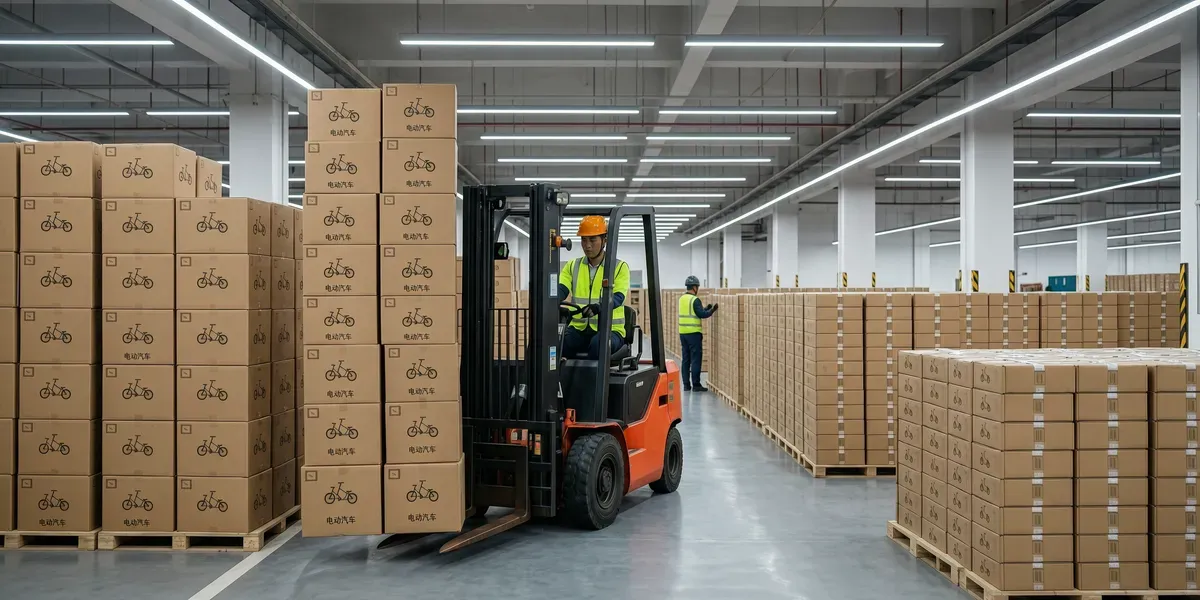
Actionable Tip #2: Ask your factory for the UN38.3 report and MSDS with the quotation, not with the shipping instructions. Factories without current documents are telling you something important about their export track record.
What U.S. Certifications Do E-Bike Importers Need?
You need a General Certificate of Conformity (GCC) backed by testing to 16 CFR Part 1512 (the federal bicycle safety standard) before the product is sold in the U.S. — and, in practice, you also need UL 2849 certification for the electrical system. UL 2849 is technically a voluntary consensus standard, but the CPSC formally urged compliance in December 2022, a proposed mandatory micromobility rule built on UL 2849/UL 2271 is moving through rulemaking, New York City already requires UL 2849 for e-bike sales, and most U.S. retailers, insurers, and marketplaces will not touch an uncertified bike. Treat it as mandatory.
| Requirement | Standard / Rule | Who Enforces | Status for Imports |
|---|---|---|---|
| Bicycle safety | 16 CFR Part 1512 + GCC | CPSC | Mandatory to sell; GCC issued by importer |
| Electrical system | UL 2849 (bike) / UL 2271 (battery) | CPSC urged; NYC law; retailers | De facto mandatory for retail & insurance |
| Proposed battery rule | CPSC Part 1265 (micromobility) | CPSC | In rulemaking — track it |
| Radio displays | FCC Part 15 | FCC | Mandatory if Bluetooth/display electronics |
| Motor limits | ≤ 750 W, ≤ 20/28 mph, pedals | CPSC definition | Defines bicycle vs. motor vehicle |
One more layer that bites experienced importers: FCC Part 15 applies to the display, controller, and any Bluetooth connectivity. It is cheap to certify at the factory and expensive to discover missing at the port.
Actionable Tip #3: Verify the UL 2849 certificate against the certifier’s online directory (UL, TÜV, or Intertek all publish them). A photo of a certificate is not evidence — certificate numbers that fail a directory lookup fail retailer onboarding too.
What Does It Cost to Import E-Bikes from China in 2026?
Plan on a 37.5% duty stack on the customs value of Chinese e-bikes as of November 2026 — and build your margin math on the full landed cost, not the FOB price. The stack breaks down like this: the base MFN duty on HTS 8711.60 is 0%, but e-bikes carry 25% under Section 301 (2018 action) plus the new 12.5% Section 301 forced-labor duty that took effect July 24, 2026. The 2025 IEEPA layers are gone after the Supreme Court’s February 2026 ruling, and the U.S.–China truce now runs to January 10, 2027 — but USTR has signaled a possible further overcapacity layer, so date-stamp every quote.
On top of duties, expect the Merchandise Processing Fee (0.3464%, capped) and, for ocean freight, the Harbor Maintenance Fee (0.125%) — plus a DG handling surcharge of roughly $250–$500 per container for the battery paperwork and segregation.

Here is the worked example behind the chart — 150 units in a 40HQ to Los Angeles, FOB $380 per bike, declared value $57,000:
| Cost Component | Calculation | Amount |
|---|---|---|
| Product (FOB) | 150 × $380 | $57,000 |
| Section 301 duty (25%) | $57,000 × 25% | $14,250 |
| Forced-labor duty (12.5%) | $57,000 × 12.5% | $7,125 |
| Ocean freight + DG surcharge | 40HQ, Yantian–LA | ≈ $5,500 |
| Origin, ISF, broker, MPF/HMF, insurance & drayage | — | ≈ $2,240 |
| Total landed cost | — | ≈ $86,115 |
That works out to ≈ $574 per bike — about 51% above FOB. The duty alone adds $142.50 per unit; freight and fees add only about $52. On this cargo, the tariff stack, not the freight rate, is your margin.
Price Volatility Notice: Ocean rates move weekly with capacity and season (August–October peak surcharges are real), and tariff lines can change with a single Federal Register notice. These figures reflect market conditions as of Q4 2026 — always request a current, itemized quote before booking.
Sea, Air, or Express: Which Mode Moves E-Bikes?
Sea freight is the only sensible mode for inventory; air and express exist for samples and emergencies. An e-bike is 25–30 kg of product in 0.38 CBM — volumetric weight punishes it in the air (a carton can “weigh” 60+ chargeable kg), and the Class 9 documentation limits routings either way.
| Mode | Transit (door-to-door) | Planning Range (Q4 2026) | Best For |
|---|---|---|---|
| Sea FCL 40HQ | 25 – 32 days to West Coast | $3,500 – $7,000 ocean leg + DG surcharge | 100+ units, program orders |
| Sea LCL | 30 – 45 days | $120 – $220 per CBM + DG handling | 10 – 60 units, market tests |
| Air DDP | 6 – 10 working days | $7.50 – $9.00 per kg all-in | Launch samples, urgent restocks |
| Express courier | 3 – 6 days | highest per-kg, strict Wh limits | 1 – 2 sample units |
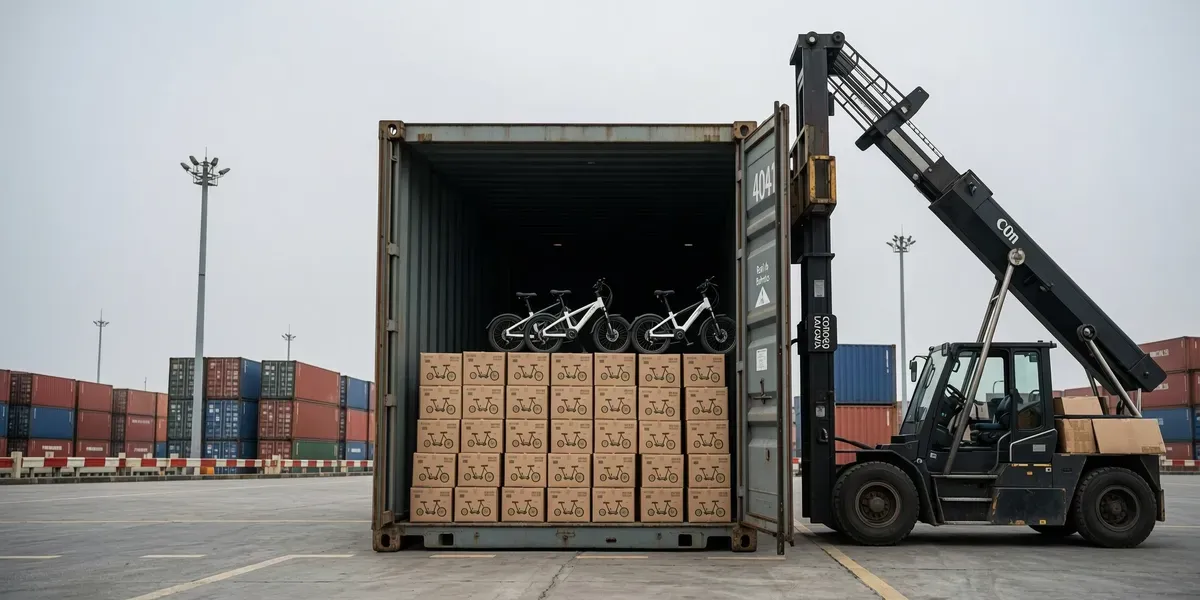
For the ocean leg itself, West Coast gateways (Los Angeles/Long Beach, 14–18 days sailing from Yantian) are cheapest; all-water to New York runs 27–32 days. Our guide to DDP shipping from China to the USA covers the full door-to-door cost structure — on a high-duty cargo like e-bikes, honest DDP quotes separate the logistics charge from duties at actuals.
Actionable Tip #4: Book a DG-accepting sailing, not just a cheap one. Some carriers restrict Class 9 vehicles on certain strings; a forwarder who knows which lines accept UN3481/UN3556 cargo saves you rolled-booking delays every single time.
How to Import E-Bikes from China to the USA: Step by Step
The whole process compresses into seven steps, and steps 1–3 decide 90% of the outcome:
- Qualify the product — confirm 750 W / 20–28 mph / pedals spec, UL 2849 certificate verification, UN38.3 and current MSDS in hand.
- Fix the commercial terms — FOB vs CIF vs DDP decides who owns the U.S. entry; most SME importers are best served by DDP or by FOB plus their own DG-capable forwarder.
- Classify and price the duty — HTS 8711.60 review, the 37.5% stack modeled into your landed-cost sheet, MPF/HMF included.
- Book the booking — DG declaration filed, ISF submitted 24+ hours before vessel loading (late ISF exposure runs to $5,000 per violation).
- Sail and pre-clear — entry pre-filed while the vessel crosses the Pacific; continuous bond in place.
- Clear and inspect — 1–3 days standard; CPSC-flagged or exam-selected cargo takes longer, which is why the certificate file travels with the goods.
- Deliver — drayage to your warehouse, 3PL, or FBA center, with liftgate pre-booked for any residential or dock-less delivery.
Two things belong on every e-bike importer’s risk list. First, insurance: carrier liability is trivially small, so add cargo insurance for China exports — roughly 0.3% of cargo value for all-risk cover, and declare the DG nature honestly or the policy will not respond to a battery event. Second, origin honesty: the EU’s 17.2% countervailing duty and CBP’s origin rules both make “transshipment through a third country” a seizure scenario, not a savings strategy.
Why Efanda Logistics for Your E-Bike Shipments?
Battery cargo punishes improvisation, and this is exactly where an experienced freight forwarder from China to USA earns the fee. At Efanda Logistics, we have managed China–USA e-bike and battery shipments since 2018 from our Shenzhen headquarters — from factory pickup and consolidation through DG declaration, ocean and air capacity on DG-accepting sailings, U.S. entry as IOR, and final delivery to your warehouse or fulfillment center.
Our quotes itemize freight, the full duty stack, MPF/HMF, clearance, and delivery — no hidden DG fees, no surprise liftgate charges. We are honest about rate volatility on this lane, we verify UL and UN38.3 documents before the cargo leaves the factory, and every client gets a dedicated logistics advisor with real-time tracking from pickup to the final delivery scan. For a tailored, all-inclusive quote on your e-bike program, contact our team at +86 18929345880.
FAQs
What is the total tariff on e-bikes from China to the USA in 2026?
As of November 2026: 0% base duty + 25% Section 301 + 12.5% forced-labor Section 301 = 37.5% of the customs value. The IEEPA tariffs from 2025 were struck down by the Supreme Court in February 2026, but USTR has proposed an additional overcapacity layer — verify the current status before signing long-term contracts.
Do e-bikes need UL 2849 certification to enter the U.S.?
Federal law requires a GCC based on 16 CFR Part 1512 testing. UL 2849 is officially “voluntary,” but CPSC has urged compliance, a mandatory rule is in progress, New York City requires it, and most retailers and insurers demand it — so for any commercial import, yes, budget for it.
Can I ship e-bikes by air from China?
Yes, but with conditions: batteries must be at ≤ 30% state of charge, routing is limited to carriers accepting large-format lithium devices, and volumetric weight makes it cost roughly $7.50–$9.00 per kg all-in. Air is for samples and genuine emergencies — inventory belongs on the water.
How many e-bikes fit in a 40HQ container?
Roughly 140–160 semi-assembled units (about 0.38 CBM per carton). Fully assembled bikes reduce the count by a third or more, which is why semi-assembled export packing is the industry standard.
What documents should my Chinese supplier provide?
UN38.3 test summary, an MSDS referencing IMDG Amendment 42-24, dangerous goods declaration, vanning certificate for ocean freight, plus your product certificates: UL 2849, the GCC/16 CFR Part 1512 test file, and FCC Part 15 for any radio electronics.
Is DDP shipping available for e-bikes to the USA?
Yes — but only from DG-capable forwarders, and honest quotes calculate duties at actuals on your declared value. A flat per-kg “DDP” rate that ignores the 37.5% stack is a quote built on undervaluation, and the Importer of Record carries the penalty risk.
Conclusion
E-bike importing in 2026 comes down to three numbers: 37.5% — the duty stack to model into every quote; 140–160 — the semi-assembled units that fit in a 40HQ; and ≈ $574 — the realistic all-in landed cost of a $380 FOB bike at a West Coast door. Get the classification, certifications, and battery paperwork right before the cargo moves, choose a DG-experienced forwarder, and the lane is as reliable as any consumer product on the Pacific.
Ready to price your e-bike program with an itemized, no-surprises quote? Contact Efanda Logistics today at +86 18929345880 — or start with our shipping from China to the USA lane page for the full service picture.

Written by the EFANDA Logistics team — a Shenzhen-based freight forwarder established in 2018, moving cargo from China to ports worldwide with end-to-end pickup, consolidation, customs and door delivery.About us