How many days should you budget between a Chinese factory gate and a delivery in Tehran — and why do forwarders give you answers that differ by a month? How long shipping from China to Iran takes depends first on the mode: plan on 3–7 days by air, 12–20 days by rail station to station, 18–30 days by TIR truck from the border crossing, and 30–50+ days by sea under current conditions. But the honest answer for an importer is the door-to-door figure, and in 2026 that gap between line-haul and door-to-door matters more on this lane than almost anywhere else.
This guide breaks the timeline down the way we plan it for our own clients: a quick-answer table, what changed on the lane in 2026, mode-by-mode transit bands with the stages that add days around the line-haul, the delay drivers specific to Iran, and the booking habits that reliably shave days off. All figures are operating bands as of November 2026 — useful for planning, never a guarantee — and rates and schedules on this corridor move faster than most, so confirm the current picture before you book.
Quick Answer: China to Iran Transit Times at a Glance
The shortest honest answer: air freight delivers in about a week, rail and truck in about three to five weeks door to door, and sea freight currently needs six to nine weeks end to end. The table below separates the line-haul leg — the number carriers advertise — from the door-to-door band you should actually plan around.
| Mode | Line-haul transit | Door-to-door planning band | Best for |
|---|---|---|---|
| Express courier | 2–4 days | 3–6 days | Samples, documents, parcels under 30 kg |
| Air freight | 3–7 days airport-to-airport | 5–10 days | Urgent, high-value, production-line cargo |
| Rail freight | 12–20 days station-to-station | 18–26 days | Full containers to inland Iran on a schedule |
| TIR trucking | 18–30 days from the border crossing | 28–35 days | Palletized freight, flexible pickup anywhere in China |
| Sea freight | 30–50+ days port-to-port (current) | 40–60 days | Non-urgent full-container volume that can absorb risk |

Two things jump out of that table. First, the ranking most importers remember — sea slowest but reliable, air fast but expensive — no longer describes this lane: sea is now both the slowest and the least predictable option. Second, door-to-door adds one to two weeks on top of every line-haul figure, and on the Iran lane that buffer is where schedules are actually won or lost.
Why Did Every China–Iran Timeline Change in 2026?
Every transit figure on this lane moved in 2026 because the sea leg that anchor it was disrupted at its narrowest point. Since late February 2026 the Strait of Hormuz has been effectively closed to container shipping, and a US naval blockade of Iranian ports followed. A peace framework was reached in mid-June 2026, but recovery is deliberately slow: minesweeping was expected to run four to six months, and war-risk premiums need months of proven stability before they normalize. Direct services from Chinese ports to Bandar Abbas still run, but at 30–50+ days with routing risk no importer can plan around — before the crisis, the same port pairs ran 18–32 days.
Two further shocks landed on top. In August 2026 the UAE — historically the largest transshipment and re-export source for Iranian imports — suspended trade and banking channels with Iran, cutting the classic sea-plus-Jebel-Ali relay that many forwarders had used to bypass direct-service congestion. And in October 2026, fresh US sanctions on Iran’s railway companies, alongside reports that Turkmenistan is tightening rail transit, put question marks around the rail corridor’s reliability.
The practical result: sealed TIR trucks through Central Asia have quietly become the backbone of the lane, because road freight is the only corridor that bypasses both the Strait of Hormuz and the Gulf transshipment hubs while still delivering in about three weeks. We covered the corridor’s routes, rates, and border mechanics in our China to Iran trucking guide — this article stays focused on the clock.
How Long Does Sea Freight from China to Iran Take?
Sea freight from China to Iran currently takes 30–50+ days port to port on the remaining direct services to Bandar Abbas, and you should plan on 40–60 days door to door. In normal conditions the same lanes run 18–32 days port to port and 35–40 days door to door — our FCL shipping from China to Iran guide quotes those pre-crisis bands, and the gap between the two articles is exactly what the 2026 disruption looks like in days.
Port-to-port transit by origin port
Under normal scheduling, the main Chinese origin ports reach Bandar Abbas on these bands — treat them as the baseline the current 30–50+ day reality sits on top of:
| Origin port | Normal transit to Bandar Abbas | Notes |
|---|---|---|
| Shenzhen / Guangzhou | 18–24 days | Shortest South China routing via the Strait of Malacca |
| Shanghai | 20–25 days | Densest direct-service coverage |
| Ningbo | 21–26 days | Similar profile to Shanghai |
| Qingdao | 18–24 days | Northerly position shortens the ocean leg |
| Tianjin | 24–30 days | Longest haul among the major origins |
Cargo that transships through Singapore or Port Klang historically added 5–10 days; with the Jebel Ali relay suspended since August 2026, Gulf transshipment is effectively off the table for now. Bandar Abbas itself can add 3–7 days of unloading backlog during peak import seasons before your container is even available for clearance.
The door-to-door sea timeline
| Stage | Duration | What drives it |
|---|---|---|
| Factory pickup → export port | 1–2 days | Supplier distance from the loading port |
| Export customs and port handling | 1–3 days | VGM, declaration accuracy, cut-off timing |
| Ocean transit | 30–50+ days (current) | Routing, congestion, Hormuz risk posture |
| Iran import customs clearance | 3–7 working days | Extends to 14+ days on document errors |
| Inland delivery (e.g. Bandar Abbas → Tehran) | 1–3 days | Rail-linked port shortens this leg |
| Total door-to-door | 40–60 days | Plan here, not on the ocean leg alone |
Sea freight still makes sense for heavy, non-urgent volume where the per-container cost matters more than the calendar — basic ocean freight for a 20ft container starts around $2,200. If your cargo is smaller than a full container, our LCL shipping from China to Iran guide covers the consolidation math, and the shipping from China to Iran route page maps all four modes side by side.
How Long Does Air Freight from China to Iran Take?
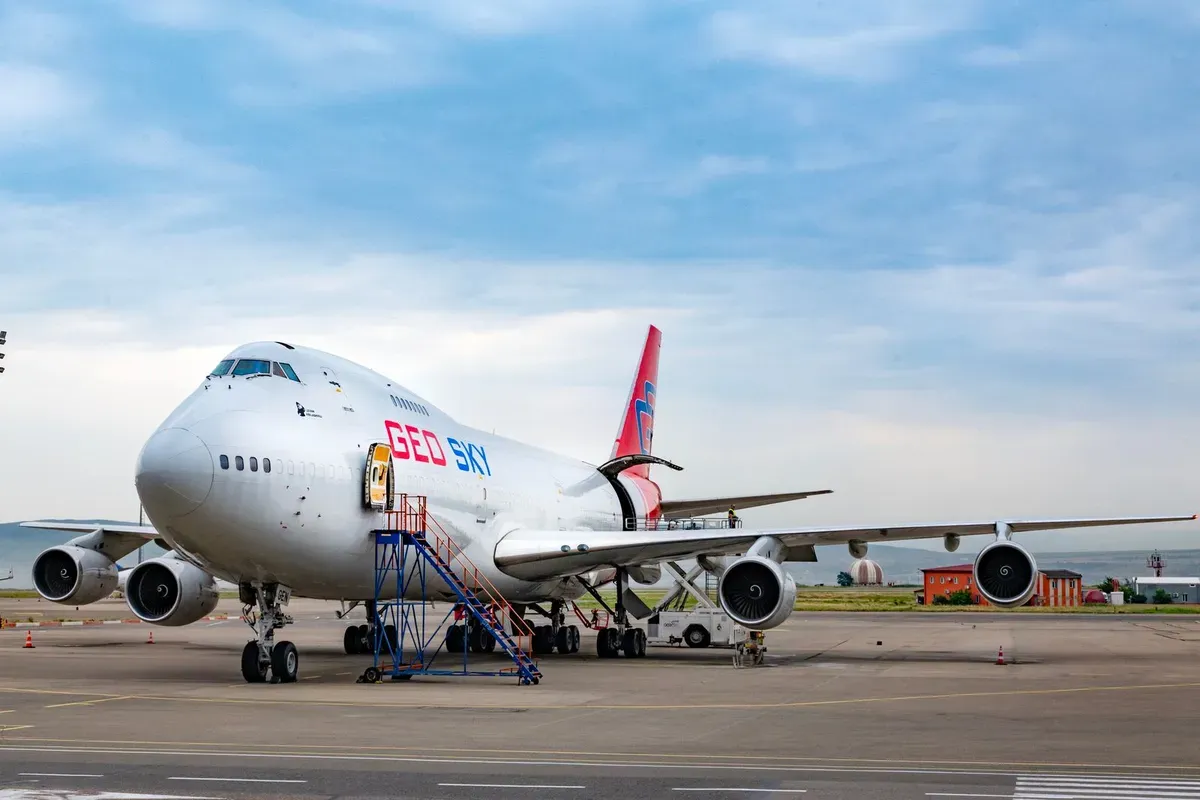
Air freight from China to Iran takes 3–7 days airport to airport into Tehran’s Imam Khomeini International Airport (IKA), and 5–10 days door to door once pickup, export clearance, and destination handling are included. A direct freighter covers the distance in roughly nine hours of flying — the remaining days are booking lead time, export formalities, and destination processing, which is why “air freight” on a quote never means next-day delivery.
Three factors stretch air timelines on this lane specifically. Offloading — when airlines prioritize passenger luggage over cargo on combined services — can hold a shipment at the origin airport for several days. Pre-holiday congestion around Chinese New Year and the year-end peak tightens cargo space and pushes both rates and transit times up. And destination clearance at IKA varies widely: a clean document set clears in days, while a shipment that arrives before its paperwork can sit in the airport warehouse for over a week accumulating storage charges.
For small, urgent consignments under about 30 kg — samples, documents, exhibition material — international express couriers deliver door to door in 2–4 days and handle clearance as part of the product. Standard air freight at $4.00–$8.50 per kg (as of late 2026, varying with capacity) becomes the better answer above roughly 100 kg. Our air freight from China to Iran guide covers chargeable-weight math and the DDP option that pre-clears documents before the flight departs — the single most effective way to keep the door-to-door figure near the 5-day end of the band.
How Long Does Rail Freight from China to Iran Take?
Rail freight from China to Iran takes 12–20 days station to station on the standard route — Chinese hubs such as Xi’an or Yiwu through Kazakhstan and Turkmenistan to the Sarakhs crossing and on to Tehran — with premium block trains reaching about 14 days terminal to terminal. Add the feeder leg from a coastal supplier to the rail hub (typically 3–5 days by truck) and destination handling, and the door-to-door planning band lands at 18–26 days.
That makes rail the fastest full-container option on paper: it undercuts sea by weeks and costs a fraction of air. The caveats are capacity and politics. Block-train slots are finite and book out in peak weeks; the gauge changes at the China–Kazakhstan and Turkmenistan–Iran borders add handling time and $500–$800 in transfer cost per container; and the October 2026 sanctions on Iranian railway companies, plus reports of tighter Turkmen transit formalities, mean schedules need confirming week by week rather than assumed from a timetable printed last quarter. LCL rail adds 2–4 days for consolidation and deconsolidation at each end.
For rate cards, departure hubs, and the gauge-change mechanics, see our China to Iran rail freight guide.
How Long Does Trucking from China to Iran Take?
A direct TIR truck runs 21–23 days from the Wuqia crossing to Tehran’s West Customs bonded warehouse and 18–21 days to Mashhad Customs; a transshipment truck — cheaper, with cargo reloaded at Osh and Bukhara — runs 24–28 days to Mashhad and 26–30 days to Tehran. Counted from your Chinese supplier’s gate rather than the border, plan on 28–35 days pickup to delivery, because the domestic leg from any Chinese hub to the exit gateway takes up to about 7 days on its own.
A few scheduling realities shape that band. The clock starts at the border, not at your factory, so an advertised “10–15 day” operator figure usually counts from the exit gateway and excludes both the domestic leg and the queue to cross. Consolidated cargo departs on fixed weekly schedules, which means waiting for the next truck is part of lead-time math for smaller loads. And winter — December through February — adds 3–7 days on the mountain approaches to the Kyrgyz and Kazakh crossings, so a December booking and a May booking on the same service can land a week apart.
What road freight buys for those three to five weeks is predictability: a sealed trailer, one TIR carnet, and delivery to an inland customs yard in Tehran or Mashhad rather than a congested seaport. Rates as of late 2026 run $3,000–$5,000 per full trailer, or $2.50–$3.50 per chargeable kilogram for LTL cargo from as little as 100 kg. The choice between the two exit gateways — Wuqia via Kyrgyzstan versus Khorgos via Kazakhstan — trades a shorter path against a 0.4% Kyrgyz transit tax; our Wuqia vs Khorgos comparison and the door-to-door trucking guide cover that decision and the DDP variant in detail.
What Adds Days on the China–Iran Lane?
The line-haul leg is only half the timeline; the Iran lane has a specific set of delay drivers, and most of them sit at the borders and the customs desk rather than on the road or the water.
- Iranian customs clearance. Standard clearance with complete, accurate documentation runs 3–7 working days; a wrong HS code, a missing certificate, or a consignee mismatch pushes it past 14. Clearance time is the single most controllable variable in the whole timeline.
- Compliance screening. Iran’s sanctions environment means banks, insurers, and carriers each run their own checks. Cargo that touches a flagged entity or an unclear product description can stall for days while paperwork is reconciled — one reason our prohibited items list is worth reading before you book, not after a hold.
- Border queues. Exit-gateway congestion at Wuqia or Khorgos and transit formalities in Turkmenistan move with season and politics; the same route can cross in hours one week and queue for three days the next.
- Winter weather. December through February adds 3–7 days on the mountain approaches to the Central Asian crossings.
- Peak calendars. The weeks before Chinese New Year (January–February), before Nowruz (March), and the Q4 global shipping peak push transit 5–10 days above normal across every mode.
- Port and yard congestion. Bandar Abbas unloading backlogs add 3–7 days in peak import seasons; at destination, standard free time is 7–10 days, after which demurrage and detention charges start accumulating.
Notice how many of these are documentation problems wearing a logistics costume. A forwarder that pre-clears your document stack before the cargo moves removes the most common multi-day delay on the lane before it happens.
How Can You Shorten Your China–Iran Shipping Time?
You cannot negotiate with geography, but you can control almost everything else on this lane. These are the levers that measurably move the door-to-door figure.
- Match the mode to the real deadline, not the hoped-for one. If the cargo must land inside 10 days, air is the only honest answer; if you have three to five weeks, a direct truck or a block train gets it done at a fraction of the air rate; if the shipment is heavy, non-urgent volume, sea is back in play despite the current transit penalty. Booking sea freight against a 30-day deadline is the most expensive mistake on this lane.
- Take the direct truck when days matter. Direct versus transshipment trucking differs by 3–7 days for a modest rate premium — cheap insurance against a missed sales window.
- Book ahead of the peak calendars. Space tightens and transit stretches before Chinese New Year, Nowruz, and the Q4 peak. We give clients a rolling four-week forecast so bookings lock in before the surcharge-and-delay window opens.
- Pre-clear the documents. A DDP service that files the Iranian import declaration before the cargo arrives routinely converts a 10-day customs hold into a 2-day release. The document stack — commercial invoice, packing list, certificate of origin, and any product-specific permits — should be complete before the truck loads, not while it queues.
- Extend free time upfront. Negotiating 14–21 days of free time at destination costs little at booking and protects you from demurrage if clearance runs long — far cheaper than paying per-day penalties after the fact.
- Fix the payment channel early. With UAE banking channels suspended since August 2026, settlement now largely runs in yuan through Chinese channels; sorting this out at the quoting stage avoids a shipment that is physically ready but commercially stuck.
FAQ
Q: What is the fastest way to ship from China to Iran? A: International express courier, at 2–4 days door to door for parcels under about 30 kg. For commercial cargo above 100 kg, standard air freight into Tehran IKA at 3–7 days airport to airport (5–10 days door to door) is the fastest practical option.
Q: How long does sea freight from China to Iran take right now? A: As of November 2026, direct services from Chinese ports to Bandar Abbas run 30–50+ days port to port, and you should plan 40–60 days door to door. Pre-crisis bands of 18–32 days port to port will likely return only after Hormuz transits and war-risk premiums normalize.
Q: How long does Iranian customs clearance take? A: For standard commercial goods with complete, accurate documentation, 3–7 working days. Document errors, wrong HS codes, or missing certificates routinely push clearance past 14 days, so the document stack deserves as much attention as the booking itself.
Q: Is rail or truck faster from China to Iran? A: On paper, rail: 12–20 days station to station versus 18–30 days border to customs yard by truck. In practice the gap narrows once you add rail’s feeder legs, gauge-change handling, and capacity limits — and trucking picks up anywhere in China without a railhead. For inland destinations like Tehran and Mashhad, both land in the same three-to-five-week door-to-door window.
Q: How long does DDP door-to-door shipping from China to Iran take? A: Air DDP runs about 6–10 days door to door, truck DDP about 28–35 days, and sea DDP roughly 45–60 days under current conditions. DDP’s advantage is not raw line-haul speed but pre-clearance: duties and documents are settled before arrival, which removes the most common multi-day hold at destination.
Q: Do transit times to Iran change in winter? A: Yes. December through February adds 3–7 days on the mountain approaches to the Central Asian border crossings used by truck and rail services, and Chinese New Year factory closures in January–February compress capacity either side of the holiday. Sea schedules are less seasonal but carry their own congestion cycles.
Conclusion
So, how long does shipping from China to Iran take? As of November 2026 the honest planning numbers are 5–10 days door to door by air, 18–26 days by rail, 28–35 days by truck, and 40–60 days by sea — with the sea figure inflated by a Hormuz disruption that has no confirmed end date, and the overland corridors carrying the reliability the lane used to get from the water. Build your plan on the door-to-door band, not the advertised line-haul leg, and spend your effort where the days actually hide: documents, border timing, and the peak calendar.
Efanda Logistics has run China–Middle East lanes from our Shenzhen headquarters since 2018, with transparent per-charge quoting, realistic transit commitments, and a dedicated logistics specialist tracking your shipment from factory pickup to Iranian customs release. Contact us at +86 18929345880 for a current transit-time assessment and itemized quote for your China–Iran shipment.

Written by the EFANDA Logistics team — a Shenzhen-based freight forwarder established in 2018, moving cargo from China to ports worldwide with end-to-end pickup, consolidation, customs and door delivery.About us